A paralyzed woman speaks again in the voice from her wedding video
The system learned her voice and emotive patterns, then kept learning from each conversation.
 Andrew Huberman · Using AI to Increase Your Intelligence & Enrich Humanity | Dr. Fei-Fei Li
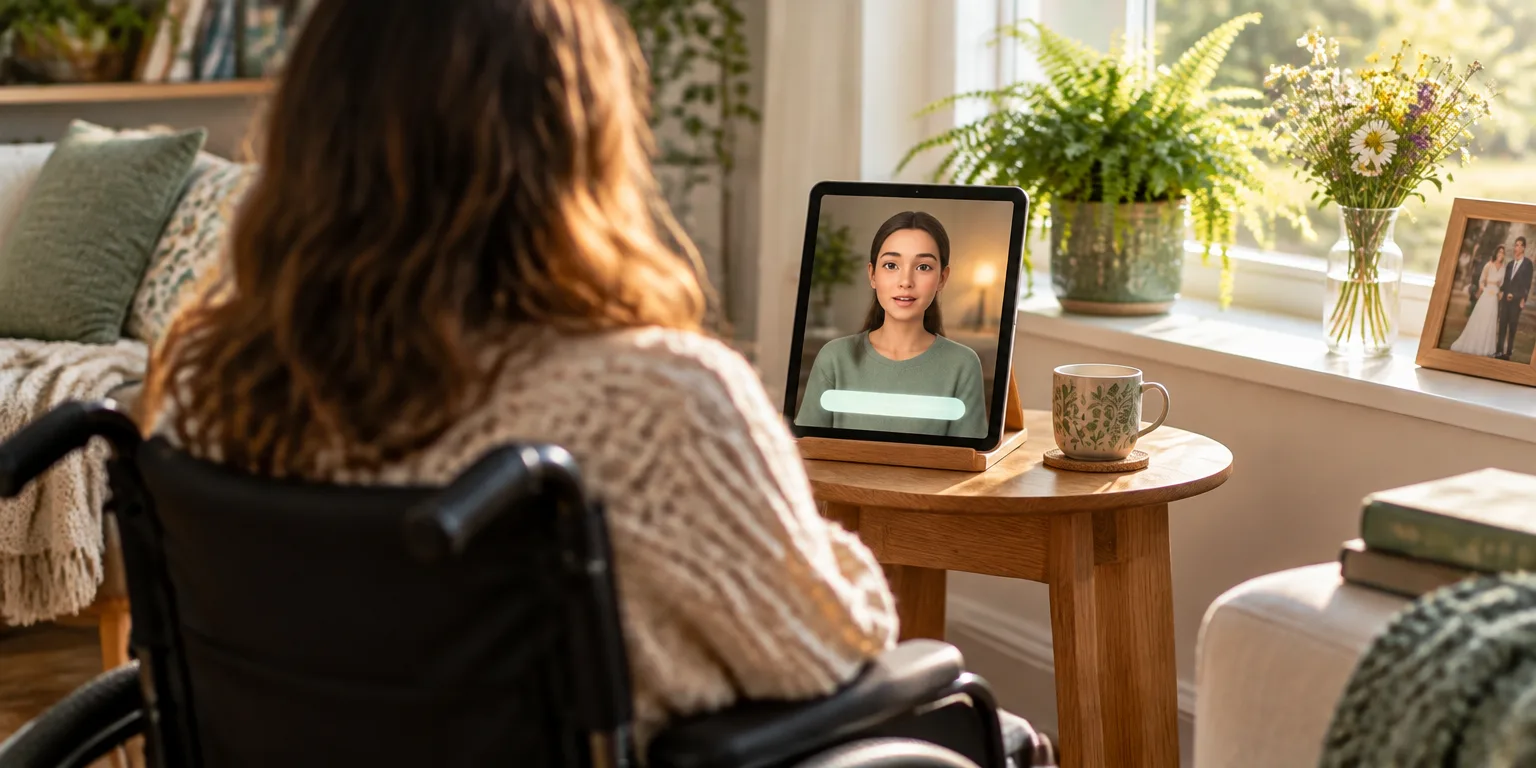
The woman in the wheelchair cannot move her face. Beside her, propped where visitors can see it, an iPad speaks for her, in her own voice.
The researchers had a head start. They had video from her wedding day, showing how she sounded, how her voice rose and fell with feeling, and even a little about how she moved.
The work comes from Dr. Eddie Chang, a chair of neurosurgery and bioengineer who studies speech and language, and a childhood friend of Fei-Fei Li, the Stanford professor who leads Stanford's Human-Centered AI institute. Chang studies how patterns of activity in the brain become commands to the voice box and throat, and he has used that link to bring people essentially out of locked-in syndrome, a condition in which a person is conscious but cannot move or speak.
For this patient, who is paralyzed, that science meant she could speak through a computer. Li described how the team paired that decoded speech with an iPad placed next to her still face, and taught it with the wedding video so it carries her voice and her emotive patterns.
Li said the face on the screen matters more than the voice alone.
The result can hold a conversation, not just say words. The system is constantly updated through machine learning, a method in which software improves by finding patterns in new examples, and it pays attention to whom she is talking to and how they respond.
That responsiveness is the difference Li points to. A voice alone only says what she wants to say. A face on a screen that answers, adjusts, and interacts lets the world interact with her at a different level of depth.
Li called this embodiment. She acknowledged that it is still on a flat, two-dimensional screen, but she called it an exponential leap over accurate sound alone.
She remains in the wheelchair while the conversation happens on the screen beside her.
Questions people ask
How does brain activity become speech?
Surgeons place sensors over brain areas that normally drive the lips, tongue, larynx, and throat during speech. Software learns the pattern that goes with each intended sound, then sends those predictions to a speech synthesizer. With training, imagined or attempted speech can produce audible words within seconds.
Why use a wedding video?
A brain decoder can recover the words, but not what the person used to sound like. Old recordings supply samples of pitch, accent, and pace, which a voice model can copy. They also show emotional expression, helping the new voice sound familiar rather than flat and robotic.
Is this the same as Stephen Hawking's system?
No. Hawking selected letters and words with a cheek switch, and a synthesizer read them in a generic voice. Chang's approach decodes intended speech movements directly from neural signals, and adds a face and voice modeled on the patient. It is faster and more personal.