A Plastic Honeycomb Made Harbor Mud Into Ground Described as Able to Hold 100-Ton Machines
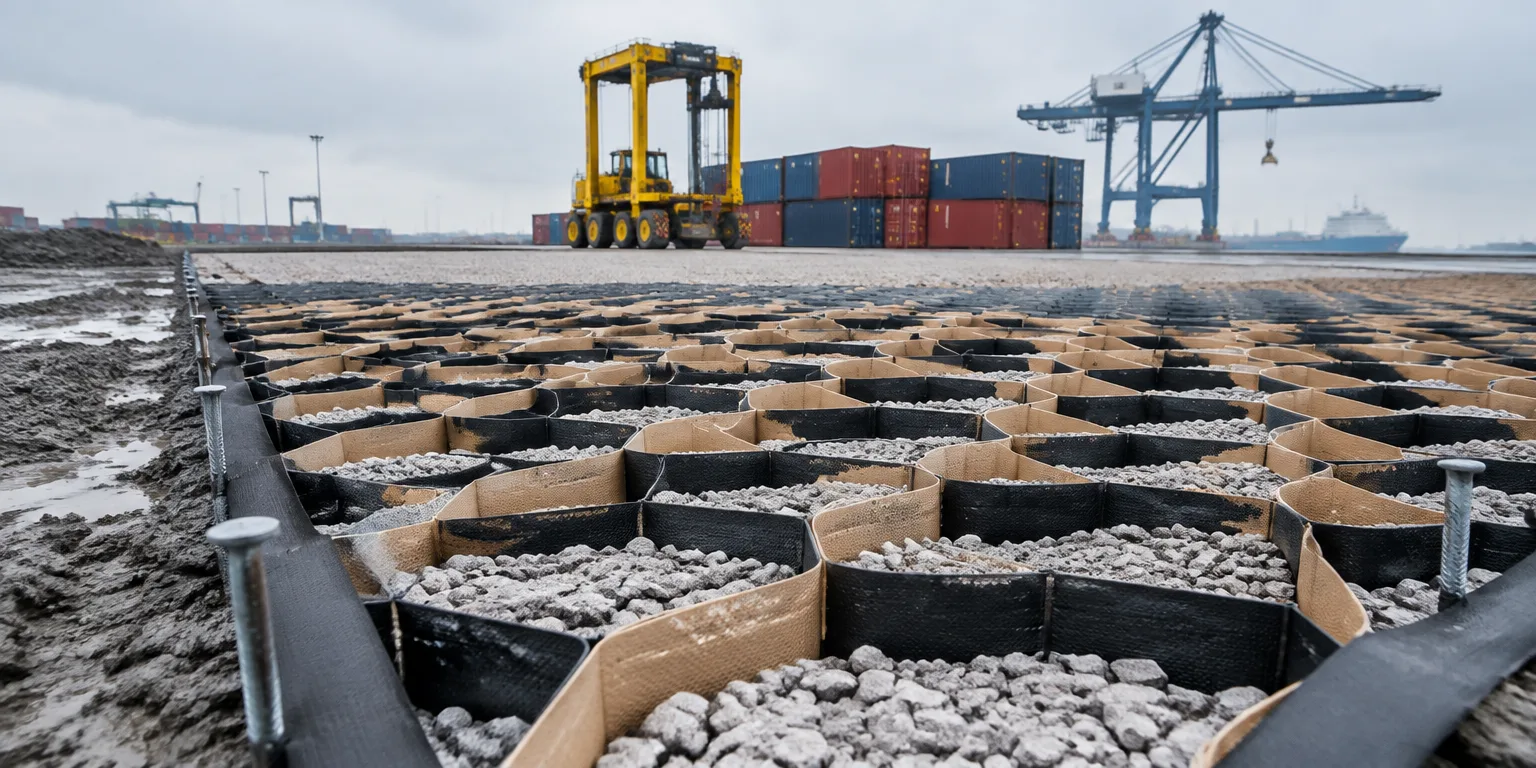
Engineers stretched the grid over soft ocean silt, filled it with that same weak soil, creating a platform described as able to hold up 100-ton machines.
 Practical Engineering · The Grid That Doubles the Strength of the Ground
In the early 2000s, engineers expanding the container yard at Pier T in Long Beach stood at the edge of an old, disused dry dock. It sat well below the surrounding yard, and to make it usable they would have to fill it to the same level.
That is routine work in a port that, with its neighbor in Los Angeles, moves roughly half a trillion dollars in trade a year and is almost constantly being expanded. But this hole was full of trouble. The local fill available was soft silt dredged from the seafloor, which "has the structural integrity of a cake in the rain," as Grady put it. On top of it would run some of the heaviest traffic on land: cranes, forklifts, yard trucks, and stacks of loaded containers.
The usual fix would have been brute force. Clear out the weak mud, then truck in huge volumes of costly, stronger rock. The conventional route would have cost millions of dollars and taken years. Instead, the engineers unrolled something that "looks more like a giant plastic accordion than a structural foundation."
That accordion was a geocell, a three dimensional grid of plastic strips welded into a honeycomb. Crews can stretch it open across weak ground, pin it down, and fill the pockets with even poor soil. Once filled, the pockets sit side by side like a slab of connected cups.
The trick is confinement. Loose soil does not simply vanish under weight. Soil fails when its grains shift and shear under a load, which is how the ground sinks or tips. Sand in an open pile sinks deeply under a weight, but the same sand trapped in a small container barely moves because there is nowhere for the grains to go.
Packed together, the filled cells act like a building footing, spreading a heavy downward push over a much wider area so the soft silt below feels less stress. At Long Beach, the grid "physically transformed those mushy dredged spoils into a high-capacity platform." It was described as able to hold up 100-ton machines and long lines of stacked containers without being dug out and replaced.
Instead, the yard was built up on the silt, with the grid carrying the loads.
Questions people ask
What exactly is a geocell?
A geocell is a collapsible grid of plastic strips, usually high density polyethylene, welded into a honeycomb. It ships flat, pulls open like an accordion on site, gets staked to the ground, and is then filled with soil, sand, gravel, or dredged material.
Why does trapping soil make it stronger?
Soil usually fails when grains slide past each other and squeeze outward from under a load, a process engineers call shear. The cell walls trap each pocket of soil so the grains cannot move sideways, and the connected pockets spread the weight wider, lowering the pressure on the soft ground below.
Does the plastic last underground?
Yes, when designed for the load and covered to block sunlight. The plastic is the same family used for buried pipe, and because it stays underground and under fill, it is protected from ultraviolet damage that breaks down most plastics.