A Process Could Turn Wood and Trash Into Jet Fuel
The process gasifies waste at more than 1,000 degrees Celsius, cleans the gas, then rebuilds it into kerosene with metal catalysts.
 doi.org · Technological Processes in the Production of Sustainable Aviation Fuels
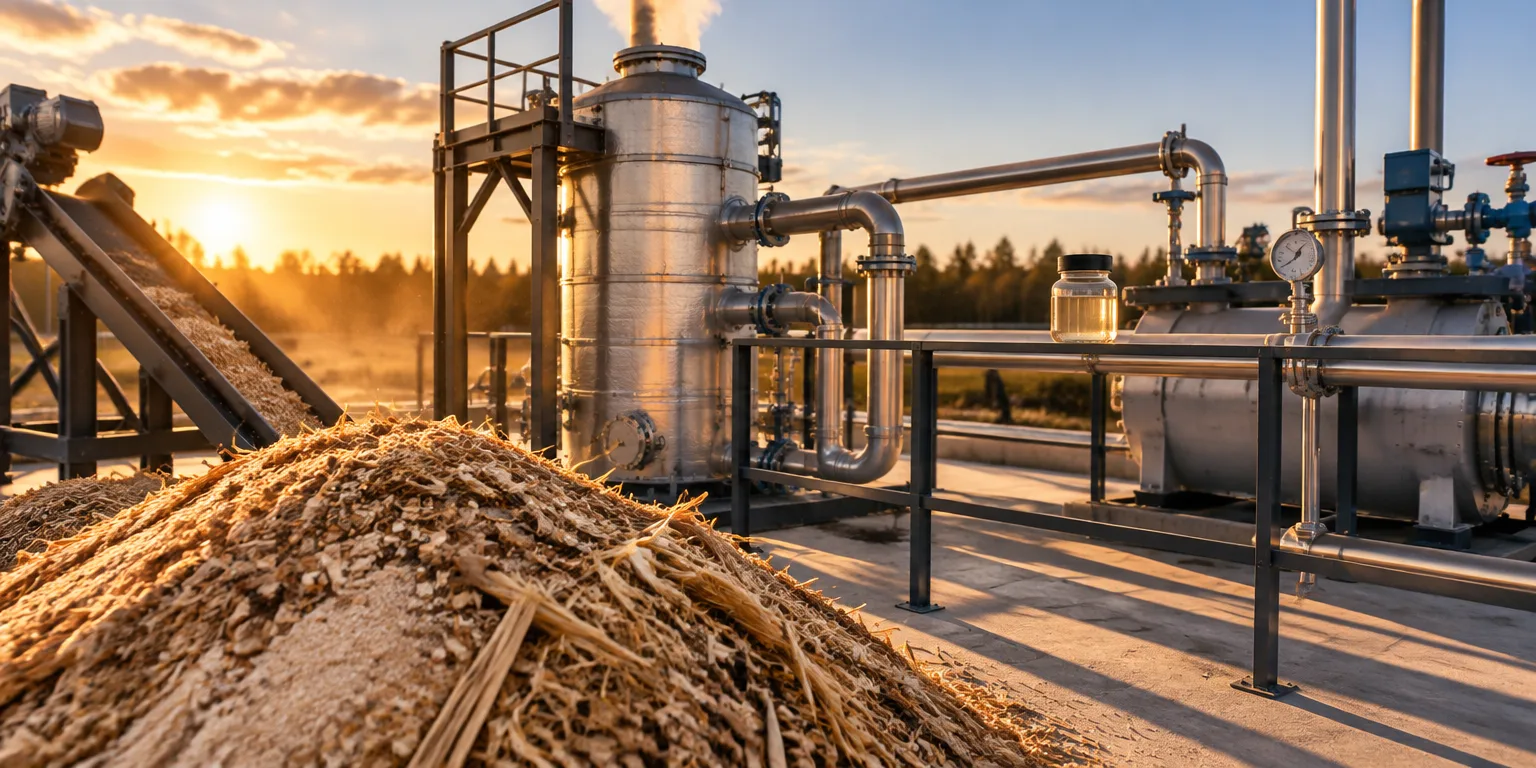
Wood, plant matter and solid organic household waste can be broken down into gas and then rebuilt into jet fuel. Ivan Benkov, author of a 2024 survey of sustainable aviation fuels, describes this Fischer-Tropsch biomass to liquid route.
First the material is prepared. The raw material is sieved, cut to certain sizes and dried before gasification.
The material is then heated in a gasifier at 20 to 70 times normal air pressure and above 1,000 degrees Celsius, where air or oxygen fluidizes the biomass until it breaks apart into solid, liquid and gaseous products. The largest shares are carbon monoxide at 21 to 22 percent and hydrogen at 16 to 21 percent, alongside carbon dioxide, methane and nitrogen.
That mixed gas is not yet useful. It goes through purification to make clean synthesis gas ready for the next step, the chemical rebuilding.
That rebuilding is called Fischer-Tropsch synthesis. In a catalytic reactor, catalysts containing cobalt, iron or ruthenium help link carbon and hydrogen back into longer hydrocarbon chains. Nickel instead steers the reaction toward methane.
Finally, those hydrocarbons are refined, and jet fuel fractions are separated out as synthetic kerosene. The wood's carbon and hydrogen are separated and rebuilt into fuel a jet engine can burn.
Questions people ask
What kind of waste does the source say can be used?
The source describes the feedstock only as solid organic waste plus sawdust, straw, and other plant matter, after sieving, cutting to size, and drying. It does not spell out detailed sorting rules.
Why bother sieving, cutting, and drying the material first?
The paper lists sieving, cutting to size and drying as preparation before gasification without explaining why. In general, dry and uniform pieces are easier to feed into high temperature equipment.
Can a plane fly on this fuel alone?
No. The May 2024 source describes biokerosene and synthetic kerosene as permitted in blends of up to 50 percent with conventional fuel. It also says that, for now, only HEFA fuels have been approved for blending, so this Fischer-Tropsch route was not approved as of 2024.