A pure math pattern matched the physics of atomic nuclei
A number theorist's formula looked familiar to a physicist, and a link between distant fields was born.
 Dwarkesh Podcast · Grant Sanderson (@3blue1brown) – AI disproved a famous math conjecture. Now what?
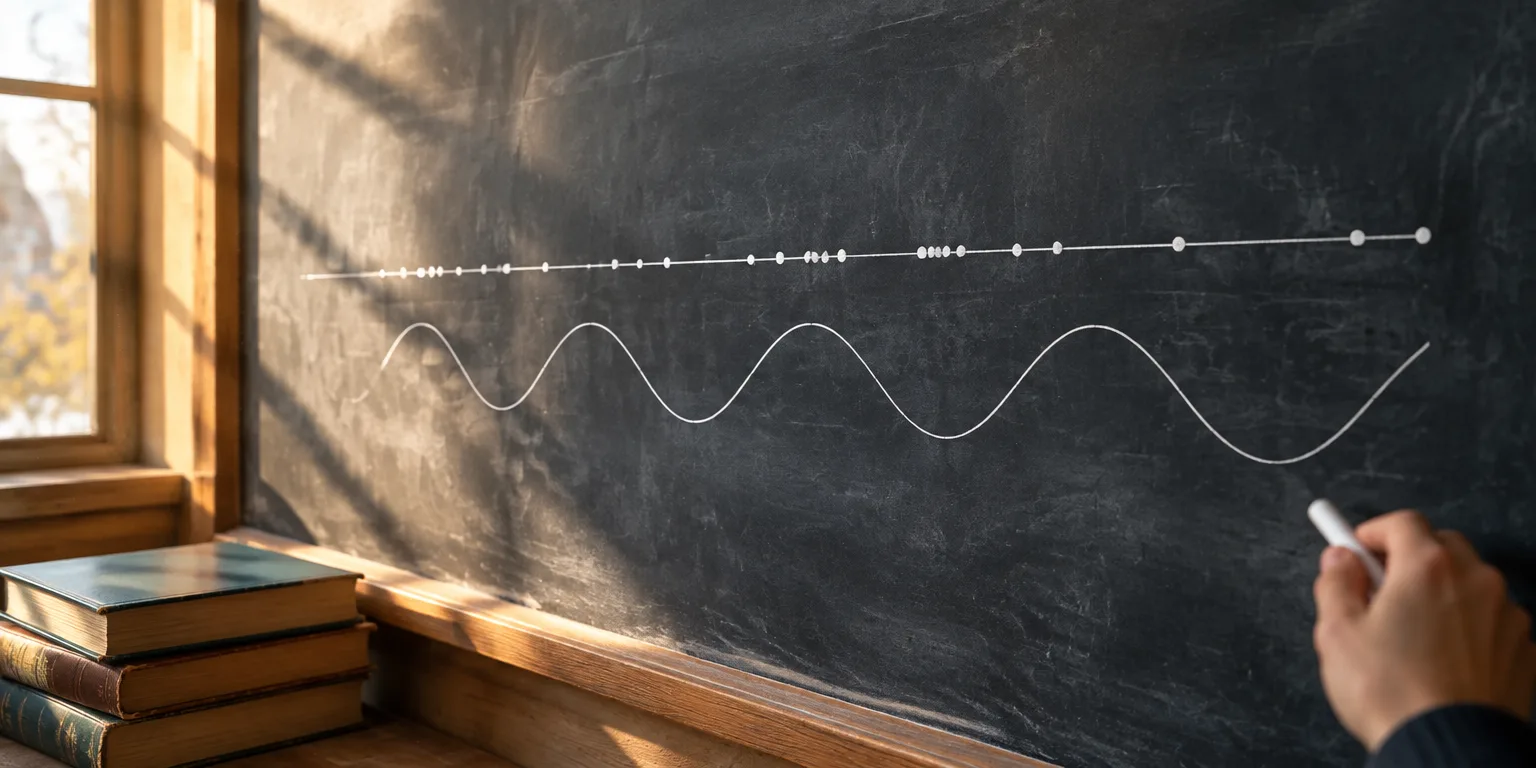
Hugh Montgomery, a number theorist, had been studying the Riemann zeta function, a mathematical function connected to prime numbers, the numbers divisible only by one and themselves, and asking how its zero points tend to be spaced relative to each other. He had narrowed a vast problem to a smaller calculation, and he had worked out a quantitative expression for that spacing, involving something like one divided by sine squared, a term from trigonometry that rises and falls in a repeating wave. In plain terms, he was asking how crowded or spread out those points tend to be.
The smaller question sat beside one of mathematics' most famous unsolved problems. The Riemann hypothesis is about whether all of those zeros lie on a single line in the complex plane, a two-dimensional grid of numbers that mathematicians use. Montgomery was asking what arrangement to expect among those points, without claiming to settle the larger claim.
The link appeared when Montgomery talked with Freeman Dyson, a physicist. Dyson said he knew that expression from elsewhere. It matched the patterns that show up in a large grid of random numbers, the kind of mathematics physicists had used to describe the energy levels inside an atomic nucleus, the dense center of an atom where most of its mass sits.
That match is what the story is about. The similarity raised an idea that random matrix theory, the mathematics used for those nuclear calculations, might also be relevant to the zeta function and its zeros. The point was not that numbers behave like atoms, but that the same statistics described both. It is an open question whether that idea will pay off.
Questions people ask
What is the Riemann hypothesis?
It is a conjecture from 1859 about the Riemann zeta function, a mathematical function closely tied to the distribution of prime numbers. It says that all of the function's nontrivial zeros lie on a single vertical line in the complex plane. It is one of the seven Millennium Prize Problems, with a $1 million reward for a proof.
What is random matrix theory?
It is the study of matrices whose entries are chosen randomly, and of the statistical patterns in their eigenvalues. Physicists in the 1950s began using it to model the complex energy levels of heavy atomic nuclei, where exact calculations were impossible. The same statistics have since turned up in many systems with many interacting parts.
Did the Montgomery-Dyson connection solve the Riemann hypothesis?
No. It suggested a possible new approach, by importing ideas from physics into number theory. Researchers have explored the link for decades, and the statistical match has held up in extensive computation. A proof of the hypothesis itself remains undiscovered.