A quantum computer gives you a likely answer from many runs
One run is not enough, so researchers repeat the measurement and settle for close enough.
 Computerphile · Quantum Machine Learning - Computerphile
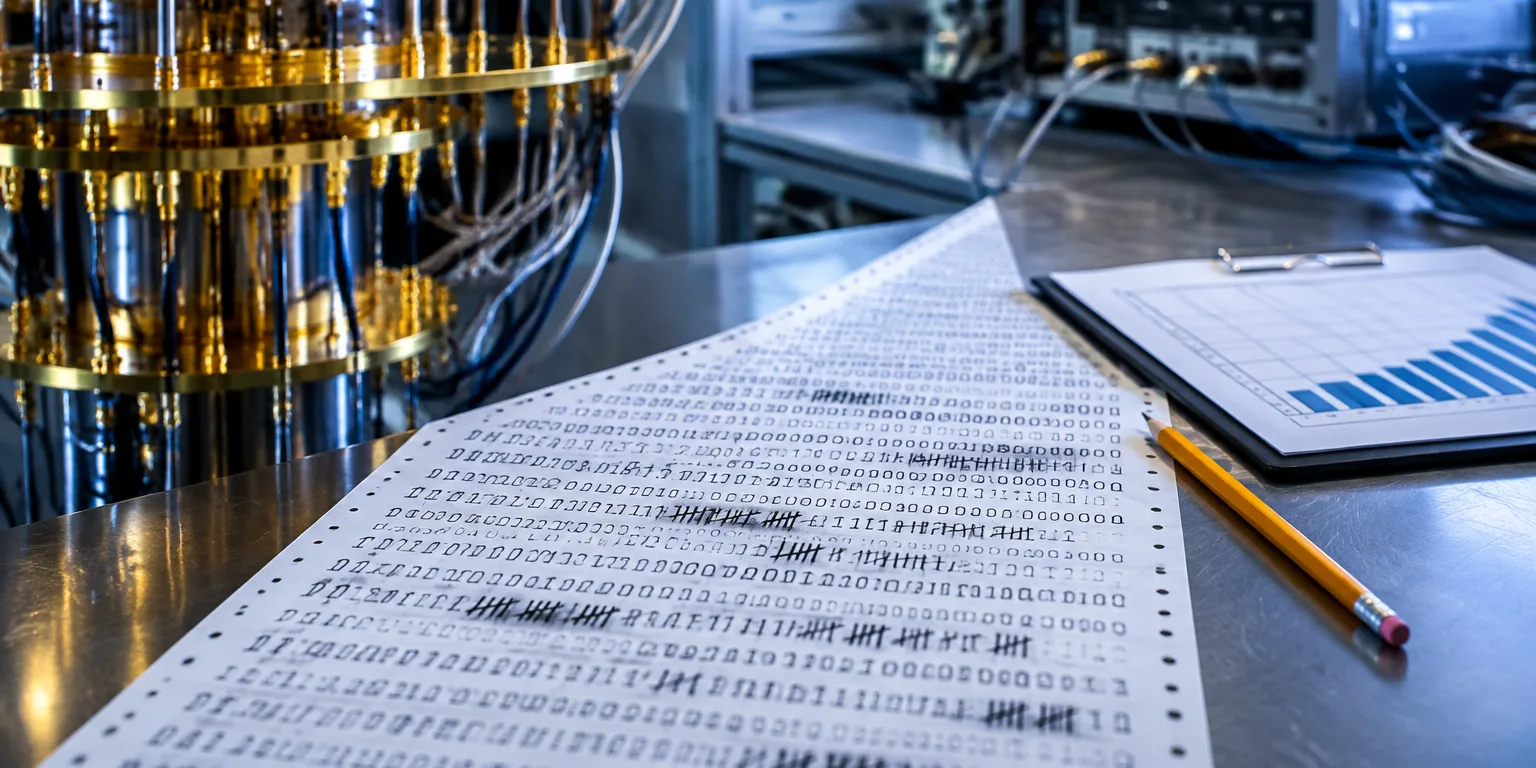
Each run of a quantum computer gives a probable result, not a certain one. Researchers run the same calculation many times to estimate the answer.
The machine stores data in qubits, the quantum version of bits. To read the result, it must measure that quantum data and turn it back into ordinary bits. That measurement is drawn as a little dial, and it returns 0 or 1 with odds that depend on the state of the quantum data.
Because quantum computation is inherently probabilistic, one run is not enough. Researchers repeat the process, with each full run of the circuit called a shot, to see where the answer tends to land.
Rebuilding a complete picture of the quantum data would take a huge number of shots. So in practice, researchers settle for an approximate property, a close sense of where the qubits were.
Questions people ask
Why does measuring make the result random?
A qubit can hold a blend of 0 and 1 before it is read, but the act of measuring forces it to become one definite bit. The outcome is random, with odds set by the prior blend. That is why each shot can give a different 0 or 1.
Does repeating the calculation erase the speed advantage?
It adds real overhead, and it is one reason practical speedups are hard to prove. The hope is that for certain problems, even with many repeated shots, the quantum approach still wins overall. For ordinary large calculations, conventional chips and graphics processors remain faster.
What kind of approximate answer is good enough?
Often they do not need the full quantum data, only a useful summary, such as which class a data point belongs to. Estimating that property takes far fewer shots than reconstructing everything. The approximation is then fed back into the ordinary part of the program.