A qubit is two spinning arrows that find patterns by falling out of step
Arrow length sets the odds of each outcome, and letting the arrows drift out of step lets a quantum computer pick out a hidden frequency.
 Computerphile · Shor's Algorithm for Quantum Computing - Computerphile
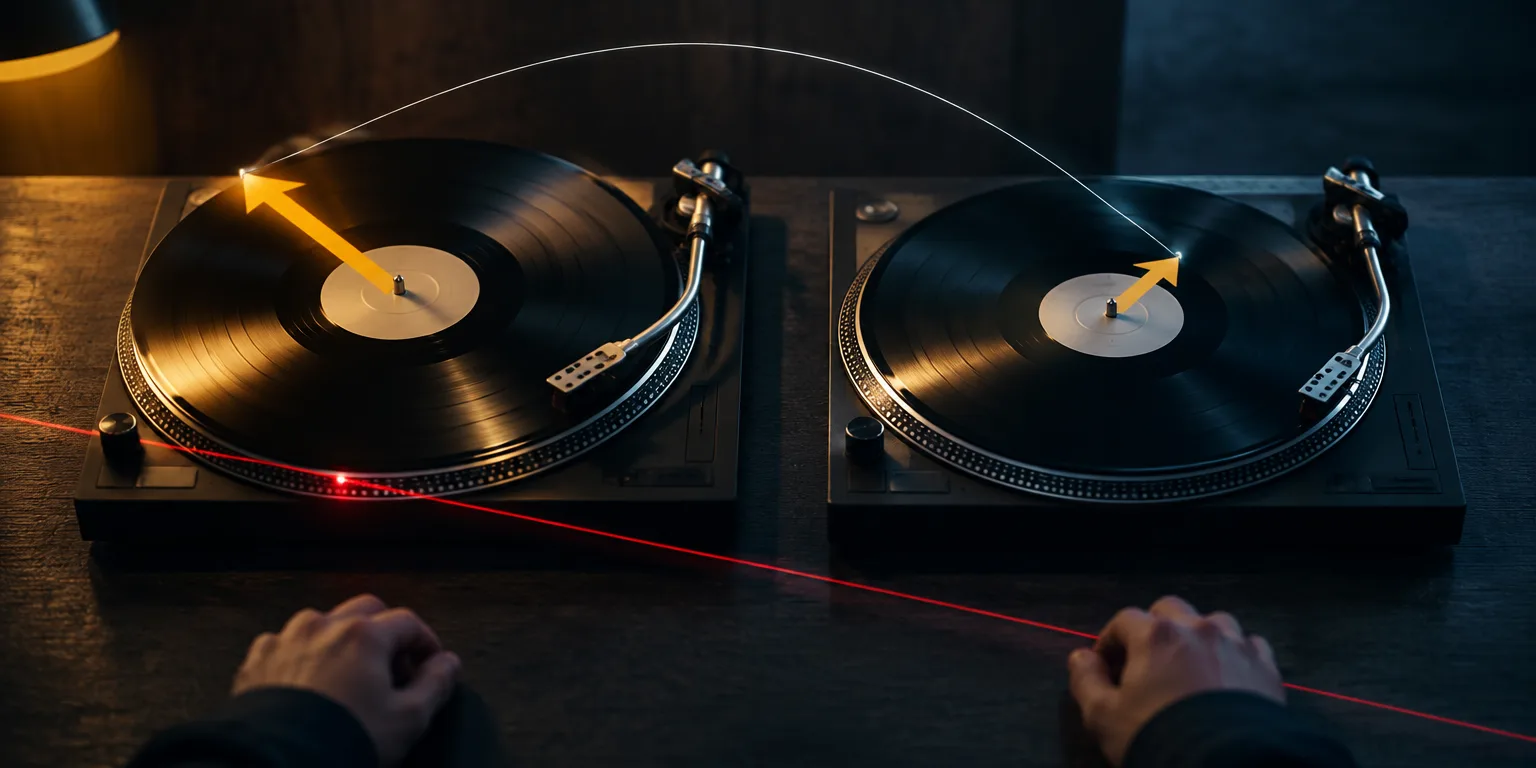
Forget the math for a minute and picture a qubit, the basic unit of a quantum computer, as two spinning records. The physicist explaining the idea draws an arrow on each vinyl disc, from the label to the edge, and sets them turning on two turntables. Each turning arrow, called a phasor, stands for one of the qubit's two possible states, 0 and 1, and traces out a wave as it goes around.
Spin speed stands for the energy level: the faster a record spins, the higher the energy of that state. That link comes from a basic rule of quantum physics, that energy equals frequency times a constant. Arrow length sets the chance of each result, so a longer arrow means a better chance of finding the qubit in that state when it is checked. If the two arrows match in length, the outcome is a coin toss, 0 half the time and 1 half the time, what physicists call superposition, meaning both states at once until measured.
Measurement changes the picture. In the usual way of keeping the books, both arrows exist until you look. When you measure, by flashing a laser and counting the light that comes back, the qubit snaps into one state or the other and the surviving arrow grows longer. To turn arrow length into odds, you square it. The physicist notes that no one fully knows why squaring is the rule, a puzzle known as the measurement problem.
Control comes from two simple moves. A precisely timed burst of microwaves, in the same range as a kitchen microwave, sets the lengths to almost any split, such as 10 percent versus 90 percent. Then you wait. Because the records turn at different speeds, the arrows drift out of step. When one points up while the other points down, the waves cancel each other out, what physicists call destructive interference. By arranging that cancellation across many qubits, the machine suppresses the wrong waves and leaves only the frequencies that build the pattern being studied. That sorting job belongs to the quantum Fourier transform, which breaks a repeating pattern into its frequencies the way a prism splits light.
Questions people ask
Do quantum computers really contain record players?
No, the records are only an analogy. Real machines in the demonstration use single charged atoms held in ultrahigh vacuum at low temperature, with two atomic energy levels serving as 0 and 1. Microwaves adjust the odds and lasers read the result.
Why must a quantum calculation be run over and over?
Measurement snaps the qubit into one outcome and wipes out the delicate odds that were stored. Researchers must rebuild the same starting arrangement, measure again, and average many runs to map the true probabilities. That rinse and repeat loop is part of every quantum calculation.
How does finding a frequency help factor a large number?
Breaking codes like RSA can be reframed as finding how often a particular mathematical function repeats. The repeat interval, called the period, reveals the hidden factors. A frequency analysis makes that repeat rate stand out without checking every possibility one by one.