A reactor that cannot run away stays just below the tipping point
Run the fuel at 0.97 instead of 1.0, supply the missing neutrons with a beam, and turning the beam off stops everything.
 20VC with Harry Stebbings · We Built Our Own Salesforce in Months. Here's Why We're Cancelling the $600K Contract | Curative CEO
Conventional nuclear reactors have to balance on a knife edge.
That is how Fred Turner, co-founder and chief executive of health insurer Curative, who co-founded the fission company Subcritical with his wife, explains it. Inside a reactor, each split atom releases neutrons that can split more atoms. Engineers call the balance criticality. To make steady power, each generation of splits must trigger exactly one more generation, a reproduction rate of 1.0.
Go above 1.0 and too many neutrons create a runaway reaction. Go below 1.0 and the reaction fizzles and produces no power. Turner says only one accident, Chernobyl, was ever that kind of runaway. But regulators, shaped by the anti-nuclear push of the 1980s, want proof that a plant cannot slip off that edge even in extremely rare events, and that guarantee is very hard to give for a traditional reactor.
The workaround he favors is called the energy amplifier, an idea from the late 1980s and early 1990s pushed by former CERN director and Nobel physics laureate Carlo Rubbia. The plant is designed to run at 0.97, meaning it never makes enough neutrons to sustain itself and would always fizzle out on its own.
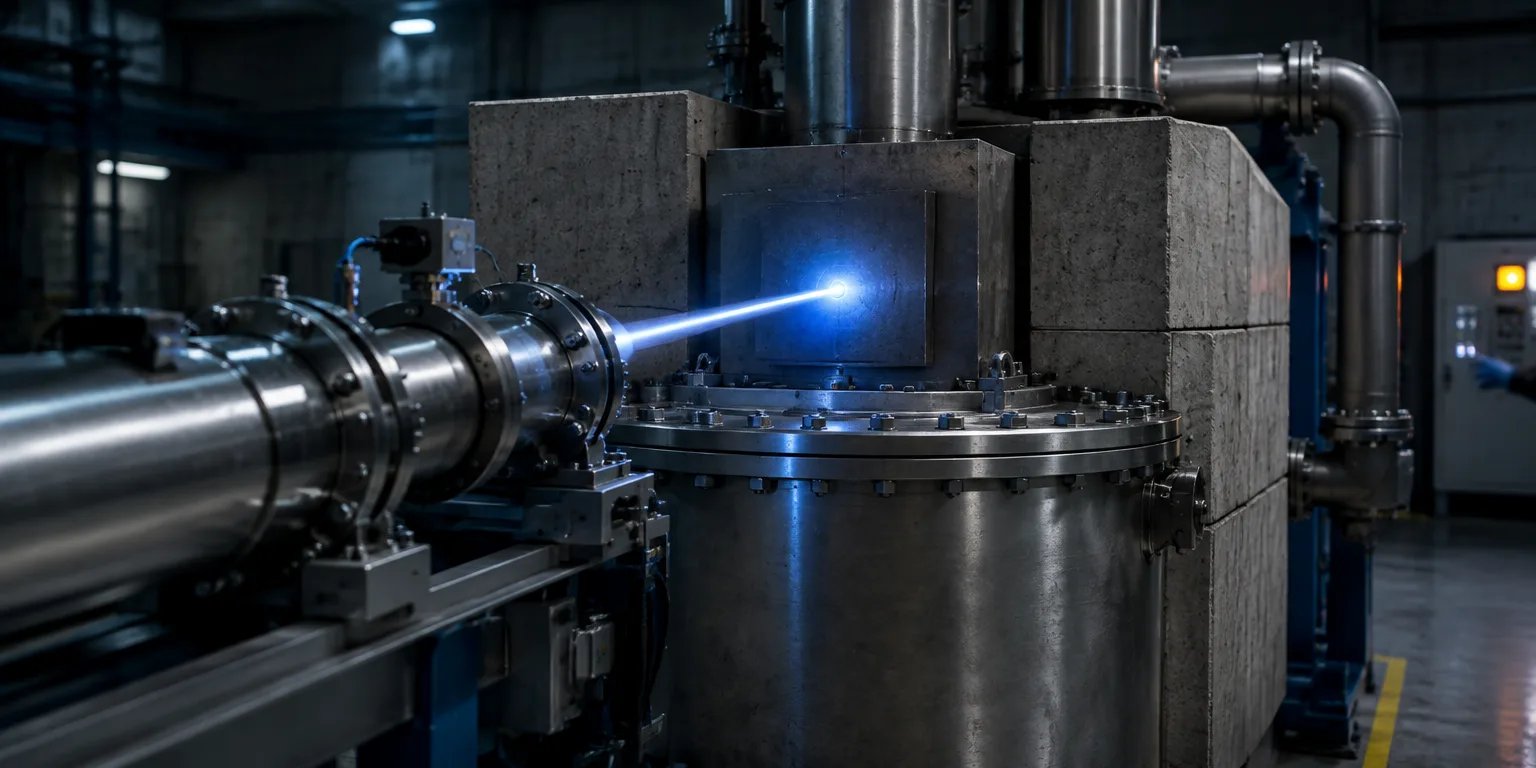
The missing neutrons come from a particle accelerator, a machine that fires fast particles into the fuel to knock extra neutrons loose and drive the reaction forward. Turn the accelerator off, and all the power stops. Turner says even feeding in 10 times as much accelerator power cannot make it run away. He says there is nothing operators can do to push that fuel over 1.0 and cause a criticality accident.
Turner says safe reactors have been built since the 1960s, and that the engineering is hard and complicated. The hard part now, in his account, is regulatory proof. Turner's answer is a design whose fuel cannot go critical without the accelerator, which can give regulators that proof.
Questions people ask
What does the particle accelerator actually do in this design?
It fires a beam of protons into a heavy metal target inside the reactor core. Each impact knocks loose many extra neutrons, a process called spallation, and those neutrons make up the 3% shortfall so the fuel can keep splitting and making heat.
How do ordinary reactors stay at exactly 1.0?
They use control rods that soak up neutrons, plus water or other coolant that slows neutrons down, and operators move the rods in and out to add or remove neutrons. The system works, but it requires active control to stay on the knife edge, which is why regulators demand proof it cannot drift high.
Does running at 0.97 mean the plant makes less power?
No. The 0.97 describes only what the fuel does by itself. The accelerator supplies the extra neutrons continuously during operation, so the combined system still runs at full power. When the beam stops, the combined system drops back to 0.97 and the chain reaction dies.