A rounded number turned a sunny forecast into a storm
A tiny rounding error compounded step by step, showing why even great intelligence cannot think its way past some kinds of uncertainty.
 Invest Like the Best with Patrick O'Shaughnessy · Cliff Sosin - Owning the Complements to Intelligence - [Invest Like the Best, EP.497]
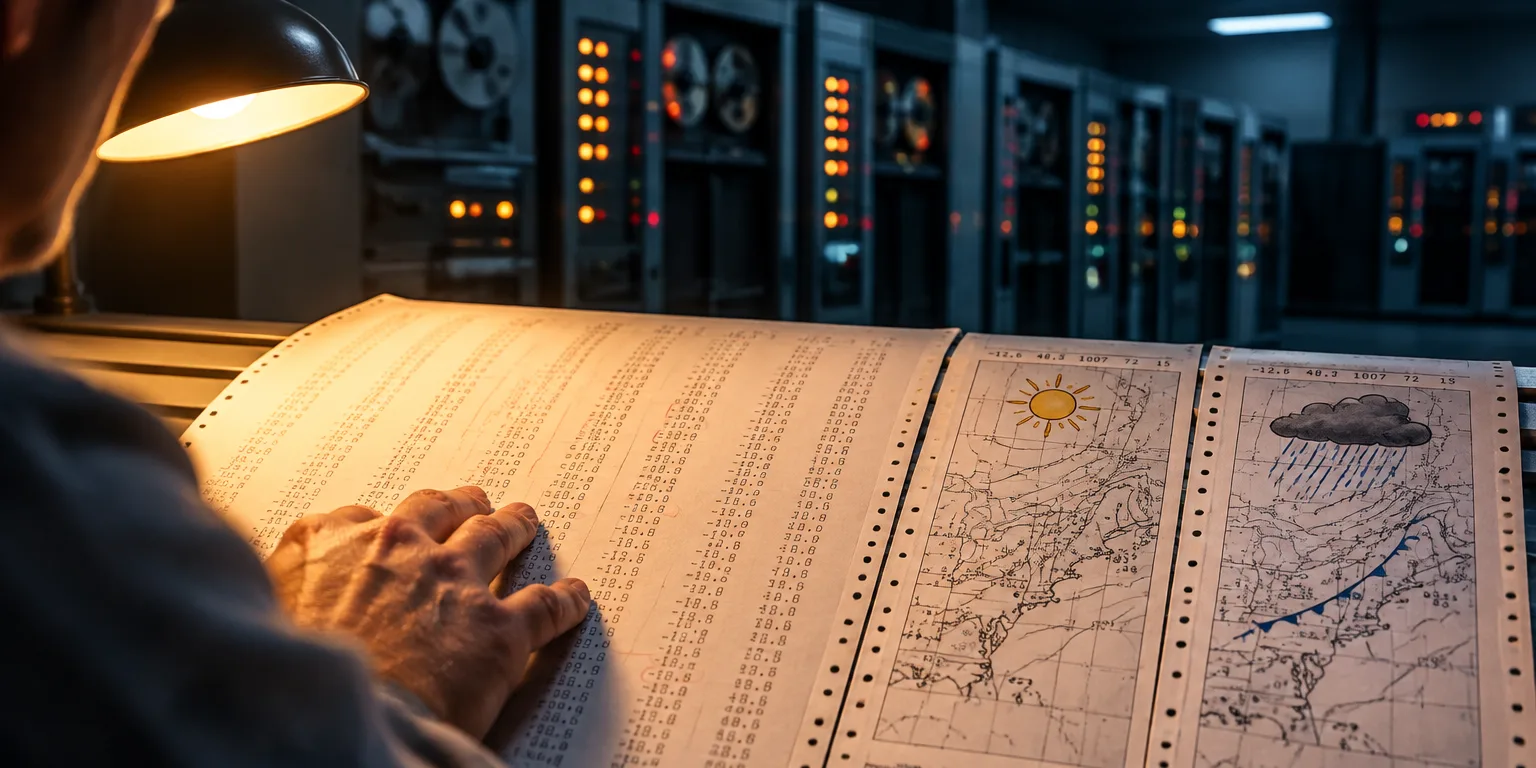
The computers filled whole rooms. A researcher building a weather forecasting model fed in his numbers for pressure and temperature, and the machine ground through them and produced a forecast for the days ahead.
Then he ran it again just to check that it was working. At first the second run looked the same. Then it began to drift. By the third, fourth, and fifth day, it was telling a completely different story.
He assumed he had a bug. As Cliff Sosin, who argues that intelligence has firm limits, retells the story, the researcher started hunting through the machine for the mistake that was keeping it from repeating itself.
The mistake was not in the machine. A technician loading the starting numbers for the second run had rounded them off, trimming about one decimal place from the initial readings for pressure, temperature, and the rest. It seemed like the kind of shortcut that should produce only a small and steady error.
Instead the tiny difference compounded. Weather forecasting works step by step, using current conditions to calculate the next conditions, and then using those to calculate the next. Each step carried the rounding error forward and enlarged it, until the two forecasts were unrecognizable to each other.
One version predicted 70 degrees and sunny. The other predicted 20 degrees and pouring. From that divergence came the name people still use, the butterfly effect, for the idea that in principle a butterfly flapping its wings in Africa could help set off a hurricane in North America.
The point, in Sosin's telling, is that many of the systems people most want to predict behave like weather. You can know a great deal about heat and air pressure, yet you cannot write down a simple equation that tells you whether a hurricane will form. You have to simulate it forward, and every simulation carries some error in its starting point or in its steps.
That is why more brainpower alone does not solve the problem. Even nearly perfect intelligence still has to guess the starting point imperfectly, and in a system like this, the imperfect guess eventually becomes a different future.
Questions people ask
What is chaos theory?
Chaos theory studies systems where tiny differences in starting conditions grow into huge differences later. It grew out of weather modeling in the 1960s, especially the work of mathematician and meteorologist Edward Lorenz, and now applies to many fields from ecology to economics.
Why would rounding one decimal change a whole forecast?
It means errors do not stay small. In a nonlinear system, each calculation feeds the next, so a difference of 0.01 today can become a difference of 10 next week. After enough steps, the two paths look unrelated.
Why can't supercomputers just measure more precisely and solve it?
More precise measurements help for a few days, but they never remove all error. Because the error still compounds with every simulated step, forecasts still break down after roughly 10 to 14 days, no matter how good the computers get.