A scholar ran into a burning palace to save the only surviving account of Majapahit, a Java kingdom
While soldiers carried off gold and silver, J.L.A. Brandes carried out books, including a court poem about King Hayam Wuruk.
 Fall of Civilizations · 21. Majapahit - Empire of the Islands
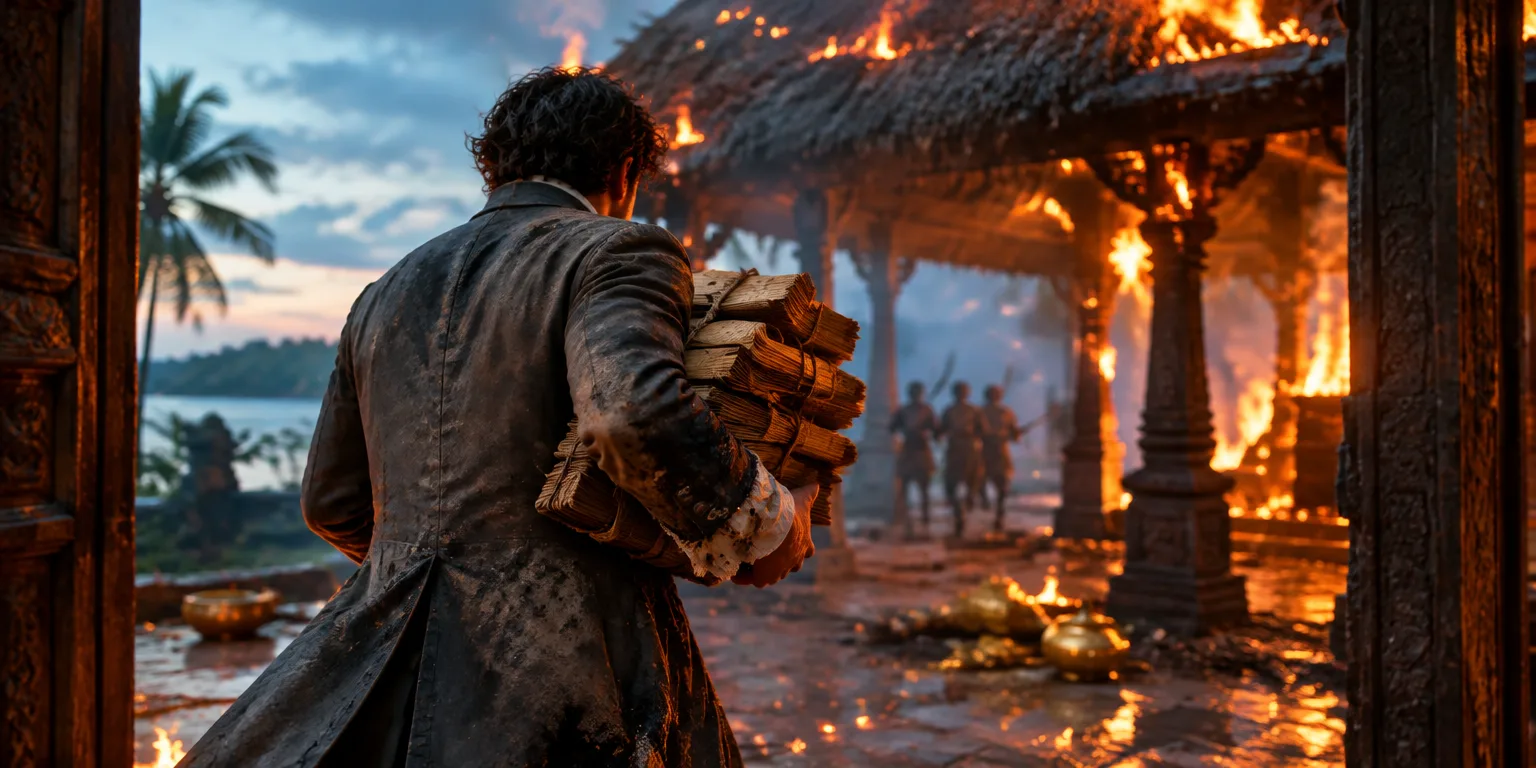
On the morning of November 19, 1894, Dutch marines forced their way into the royal palace on Lombok, a small island just east of Java. Shellfire had already set the compound ablaze. As flames moved through the wooden pavilions and thatch roofs began to give way, soldiers pushed inside and killed about 2,000 people.
Among the Dutchmen inside was J. L. A. Brandes, a scholar of Sanskrit and Old Javanese. He had heard that the king of Lombok collected rare old manuscripts, and while other men stripped the treasury, Brandes ran for the palace library. What he carried out would turn out to be the only surviving account of Majapahit, the kingdom based on Java that had once ruled much of the archipelago.
That account was the Desawarnana, a court poem about the Majapahit king and his realm. It had been written about 500 years earlier by a court writer named Prapanca, who traveled with the king and listed the places they passed. Through it, Prapanca preserved a detailed portrait of King Hayam Wuruk touring Java with his court, meeting villagers, visiting shrines, and reminding vassals who was in charge.
The rescue mattered because the colonial authorities had given the Javanese little reason to remember such a past. In the two centuries starting in 1602, Holland's East Indies trading firm shipped close to a million Europeans east in almost 5,000 vessels, and Java became a European colony. The Dutch had no desire to see colonized people rally around old kingdoms, and they mostly declined to investigate the brick ruins scattered around Java.
The neglect was so complete that, in an account of the islands published in 1820, British writer John Crawfurd dismissed talk of a great Javanese kingdom as empty pride without evidence. Yet some remembrance of Majapahit survived in songs, verse, shadow puppet dramas, and handwritten books kept in private collections such as the one on Lombok.
The king there, Aung Ketut Karangasam, was famed for gathering rare writings. After long and bitter local resistance, his palace was taken, he was seized, and he died months later in colonial custody. Brandes had heard of his love of manuscripts, and as other looters hurried out loaded with treasure, he grabbed as many fragile volumes as his arms could hold and rushed out ahead of the falling roof.
Gold, silver, and artwork taken that day, more than 130 kilos of gold and thousands of kilos of silver, were shipped away as spoils. A large share of the library burned, with contents that can never be recovered. What Brandes saved was boxed and sent to the colonial capital, where he later found the single court poem inside, the one text that lets the lost kingdom of Majapahit speak in its own words.
Questions people ask
What exactly is the Desawarnana?
It is a long court poem written in Old Javanese in 1365 by the court scribe Mpu Prapanca. It describes King Hayam Wuruk's realm, its capital, its rituals, and its dozens of tributary lands, and it is now usually called the Nagarakretagama.
Why were the Dutch attacking Lombok in the first place?
The Dutch intervened in a succession and tax dispute on Lombok and sent a large expeditionary force in 1894. After initial setbacks, they stormed the palaces at Cakranegara and Mataram in November, deposed the Balinese ruling house, and folded Lombok directly into the Dutch East Indies.
What happened to the Lombok treasure?
Most of it was shipped to the Netherlands as war booty. Large parts of the Lombok treasure, including gold, silver, jewels, and manuscripts, are now held in Dutch national collections, principally the Rijksmuseum and the Leiden museum collections, and Indonesia has long sought their return.