A Sheet of Paper Ran a Program on a Table in Brooklyn
The paper kept glowing after the keyboard was removed, and then a hand-drawn bunny came to life.
 motivenotes.ai · Against Usefulness
In June, a venture investor who backs startups through Motive Force and described the trip in an essay visited a warehouse space in Brooklyn where a researcher handed him a slip of paper that functioned as live software.
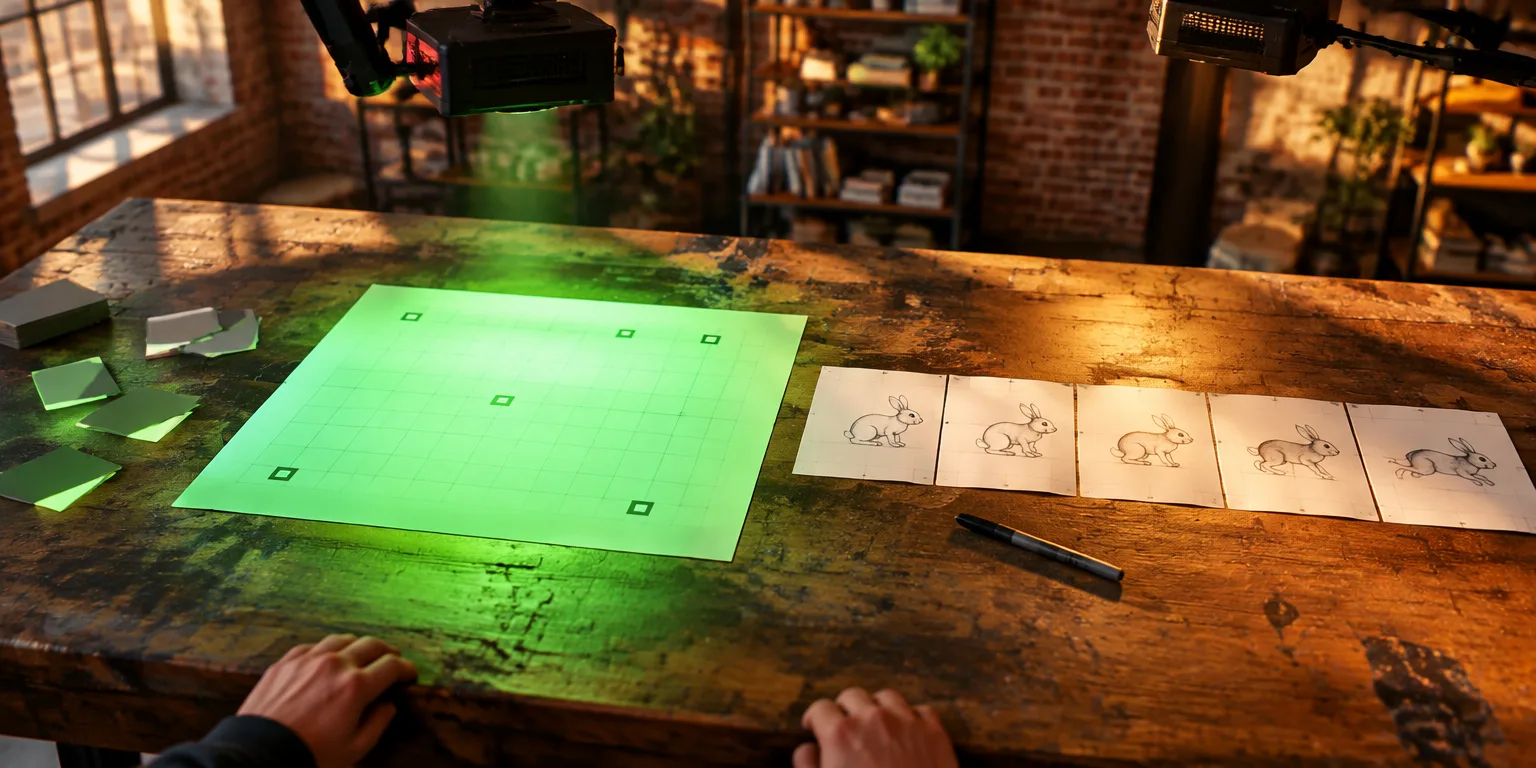
The researcher was Omar Rizwan, one of two builders of an open source system called Folk Computer. He laid the sheet on the tabletop for the room to run, then linked a keyboard to that page, entered a new command, saved it, and the paper turned green.
The investor wrote that "A printout would have been a picture of a program" and that "This was the program itself." Ceiling cameras track small tags on each sheet and projectors shine the running program back onto the table, so the computer is the room.
After Rizwan disconnected the keyboard, the sheet continued to operate, still lit on the tabletop. Nearby, a setup for animation was looping sketches drawn by hand. Rizwan handed the visitor a marker, and the visitor illustrated a bunny in sequential frames and observed the sketches animate instantly on the surface. Then the two men created tunes by placing cards between them, with each card acting as a track.
He surprised himself by saying aloud: “I don’t need the monitor anymore.” There was almost no gap between the idea and the working thing.
The investor wrote that “for the first time I was programming with my whole body, collaborating with another person in the same room.” It was, in his words, “the most human programming I have ever done.”
Questions people ask
Who built Folk Computer?
Omar Rizwan and Andrés Cuervo are researchers who previously worked at Dynamicland, a lab in Oakland that treated a whole building as a computer. They built Folk Computer as an open source version that other people can set up, copy, and change. Strangers have already added tools, including a music sequencer made from cards.
Can I try it myself?
Yes, because the designs and code are openly shared. The point of making it open source was to let people outside one building try the same kind of room-sized computing at home or in a classroom. The author invites readers to set it up, sponsor the work, or commission a demo.
Is paper meant to replace the laptop?
For typing and solo desk work, screens remain faster and more exact. The paper system is a research prototype for joint work, where people stand up, talk, draw, and move sheets around together. It explores what programming feels like when ideas do not have to pass through one rectangle.