A Starving King Sent His General to Buy Grain, and the General Kept It
With grain at 60 times its normal price, a simple errand became a betrayal, and invaders burned the capital.
 Fall of Civilizations · 8. The Sumerians - Fall of the First Cities
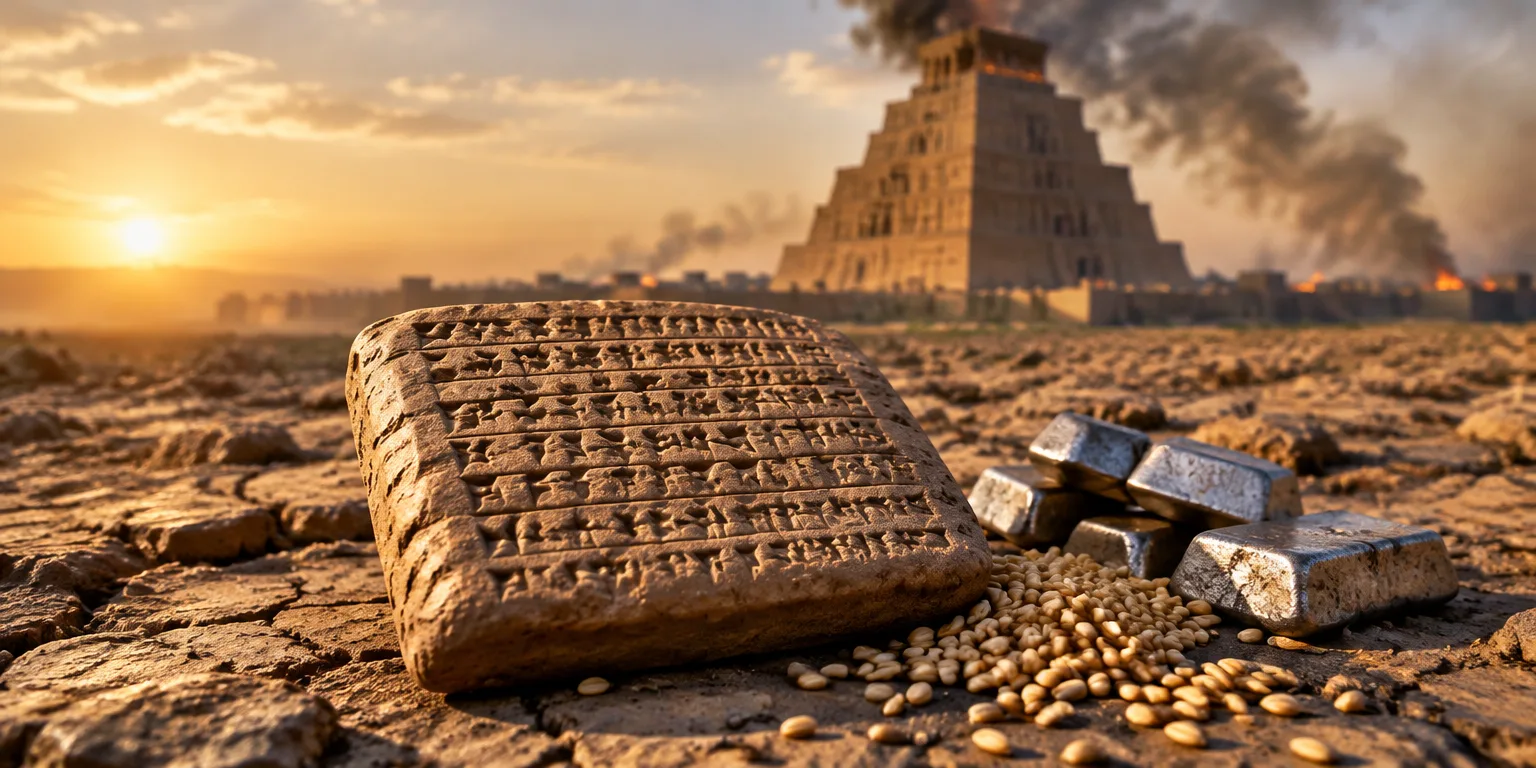
In his starving capital, Ibi-Sin, the last king of Sumer, summoned one of his generals and gave him silver to save the city. Go north to Isin, the king ordered, and buy grain at whatever it costs.
Ur was collapsing around him. Ibi-Sin had taken the throne in 2028 B.C., and in his first year the city of Ashuna al-Sharqiya broke away. In his third year, Susa, an Elamite center east of the plains, rebelled. In his fifth year, the invaders known as the Martu poured over the 300-kilometer wall his father had built and overran the rich farms behind it.
By his seventh year on the throne, grain in Ur cost 60 times its normal price, hungry residents crowded the streets, and the king began to lose his mind. The loss of the farms had cut off food, and famine struck the capital hardest.
The general, an Akkadian named Ishbi-Ira, was not a man the king fully trusted. In another letter, Ibi-Sin had questioned Ishbi-Ira's background and loyalty, doubting if the general was really Akkadian rather than Sumerian. But the king had few options, so he invested 20 weights of silver in the purchase.
From Isin, Ishbi-Ira wrote back with bad news. The Martu had entered the king's territory, he said, and were stronger than he was. He could not get through to deliver the grain. He asked the king to send 600 boats upriver to move it, and offered to stay and guard Isin and the city of Nibru. "Make it my responsibility, my king," he wrote.
He never came back. Ishbi-Ira remained in Isin, held onto the shipment, and declared himself king there.
Left with only his capital, Ibi-Sin ordered fortifications in Ur and Nibru, tried to hire the Martu as mercenaries, and even begged his runaway general for help. None of it worked. The Elamites, former subjects from the foothills of Iran, marched with an army of tribesmen, besieged Ur, breached its walls, and set the city on fire.
Historians imagine the Elamites rushing Ur's massive temple tower, slaying its clergy and stripping its riches, while the surrounding fields burned and the waterways were contaminated with disease.
They seized Ibi-Sin in the palace, put him in chains, hauled him to Elam as a prisoner, and imprisoned him there. The last king of a civilization that had endured for thousands of years died a prisoner in a foreign land, while survivors wrote, "The gods have abandoned us like migratory birds."
Questions people ask
What did Ishbi-Ira do after he declared himself king of Isin?
He founded a dynasty that ruled from Isin for more than 200 years. Isin became the main successor to Ur, and its kings presented themselves as the legitimate heirs of Sumer even as real power shifted to other cities like Larsa and Babylon.
Who were the Elamites who sacked Ur?
They were a powerful people from what is now southwestern Iran, with a capital at Susa. They had long traded and fought with Mesopotamian cities, and after Ur fell they remained a major rival to Babylon and Assyria for more than a thousand years.
What is the Lament for Ur quoted at the end?
It is a Sumerian poem written after the destruction, one of several laments for ruined cities. It describes gods abandoning the city, streets filled with corpses, and smoke hanging like a shroud, and it was likely performed in temples as mourning and ritual.