A Thick Liquid Snapped Like Glass Instead of Flowing
The fluid was a simple, nonelastic liquid that should only have stretched, and it snapped every time she tested it.
 Quanta Magazine · We Know Simple Fluids Can Flow. Turns Out, Some Can Fracture.
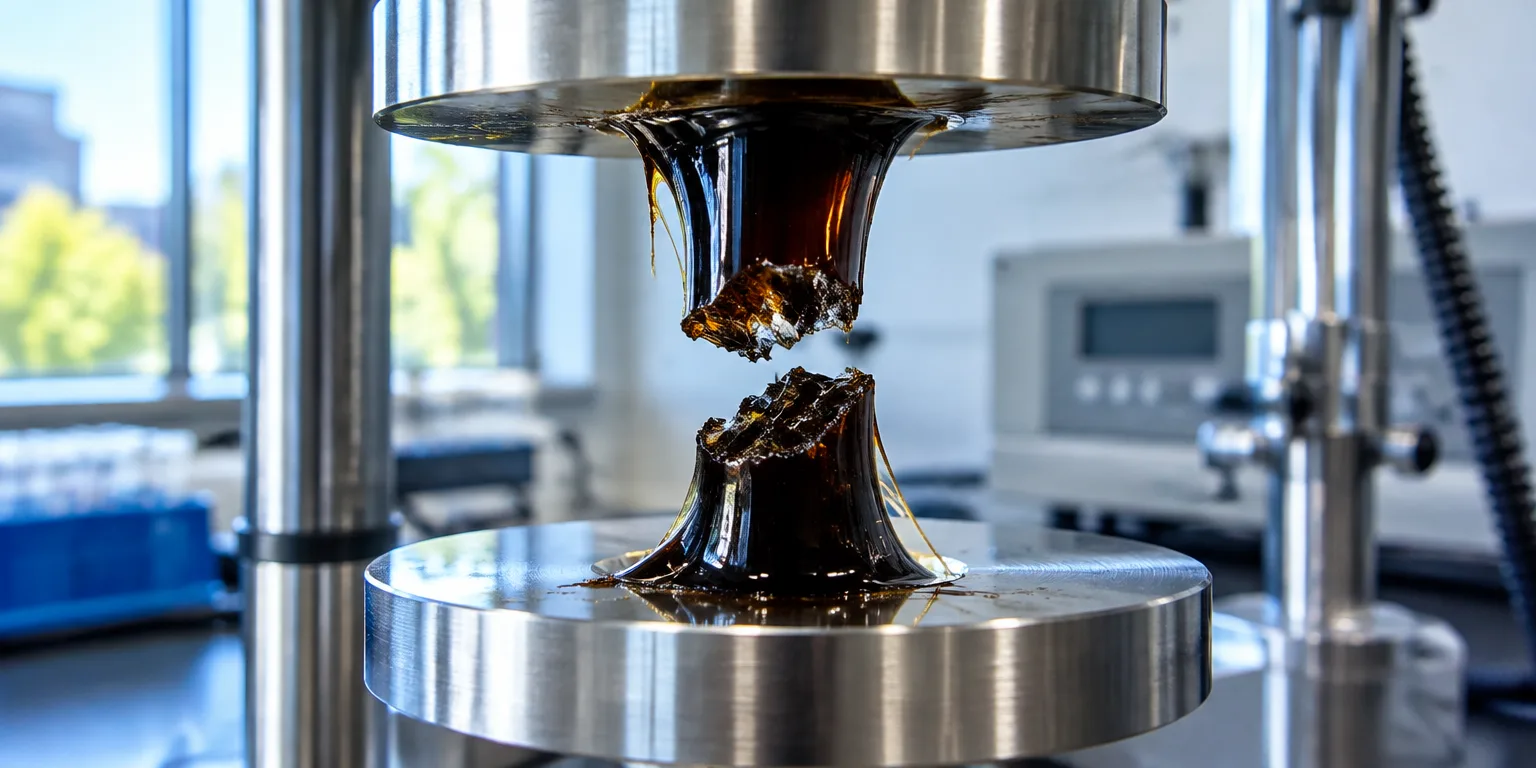
Thamires Lima was stretching a thick liquid when she heard it snap.
Lima, a Drexel chemical-engineering researcher who studies slow, syrupy liquids, was running an experiment for joint work with the oil company Exxon Mobil. She was using a technique known as extensional rheology, which tugs a sample between metal plates to measure the pull needed to make it flow. The sample was a sticky, dark mixture of hydrogen and carbon. As the plates pulled, a short, sharp crack rang out. “I thought it was the machine,” Lima said.
The sound had not come from the machine. It had come from the fluid.
That was startling because this kind of liquid was supposed to stretch and flow, not break. Cracks were familiar in a different group of liquids, those built from long, tangled chains that can stretch and spring back, that can turn solid-like in some cases and split. Hers was plainer stuff, made of small, unlinked molecules like oil or honey, with almost no ability to spring back.
Viscosity, the thickness of a liquid and its resistance to flow, normally lets such a plain liquid rearrange its molecules and keep flowing. “Nobody expected that this would be possible in this kind of simple fluid because viscosity usually just rearranges the molecules,” said Arnold Mathijssen, who studies fluids at the University of Pennsylvania. “You don’t expect it to crack. But it does, so I think that’s what’s really surprising.”
Lima pulled the blend again to check whether the crack was a one-off. Then she did it again, and again.
“Every time that she measured it, the material would break,” said Nicolas J. Alvarez, a Drexel chemical engineering professor whose lab led the research. “It makes a loud pop. I mean, like you just took a rubber band and pulled it and stretched it and it snapped.”
Convinced the snap was real, Lima and Alvarez filmed the event with fast cameras to examine it more closely. They realized the split was in essence a brittle break, the sort seen when a dropped glass dish shatters. In a brittle break, stress concentrates at a teeny flaw until growing the crack takes less energy than holding together, and then the crack races.
The puzzle now is why a plain liquid with almost no springiness can start such a crack at all. Alvarez wonders whether the answer lies less in stretchiness than in the cohesive energy that holds molecules together, and he says learning what the break means for the field is the most exciting part.
Questions people ask
How fast did the cracks in the simple liquid move?
They moved astonishingly fast, about 500 to 1,500 meters per second. For comparison, cracks in melted plastic creep along at about 0.07 meters per second because long chains absorb energy and slow them down.
Could thinner liquids like water break the same way?
Not with the current machine, which tops out at a pulling speed of 500 millimeters per second. Lima thinks a faster pull might crack thinner liquids like honey or even water, and she wants to try a clear liquid so she can film the crack forming.
Why did the finding bring back an old theory?
In the 1990s, engineer Daniel D. Joseph suggested any liquid could fracture under enough tearing stress, with tiny bubbles helping start the break. The Drexel team returned to his papers because the new result did not fit the idea that elasticity was required.