AI Is Best at Math and Code Because Those Answers Can Be Checked Automatically
Right-or-wrong answers give AI clear training signals, and helper programs check the work.
 Quanta Magazine · Is AI Reasoning Right for the Wrong Reasons?
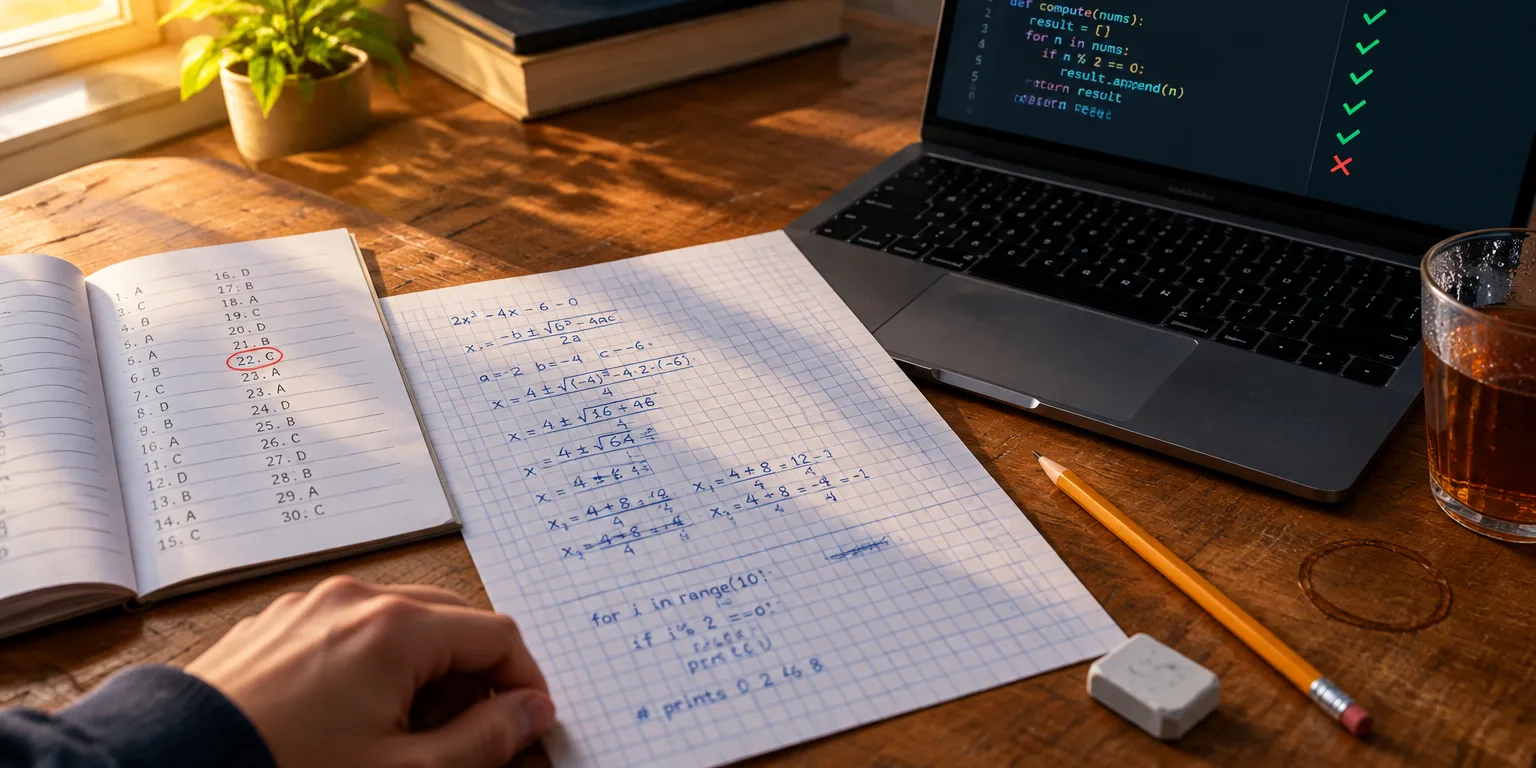
Math and computer code are the easiest school subjects for artificial intelligence, because they grade their own homework.
That is the straightforward explanation for why so-called large reasoning models, the AI systems trained to work through hard problems step by step, shine brightest in what researchers call verifiable domains. A program runs, or it does not. A proof is correct, or it is not. Those yes-or-no outcomes, along with the written work that leads up to them, give the model clear feedback for learning.
The process works like practice with an answer key in the back of the book. The model generates lots of attempts at reasoning-shaped text, its self-generated traces or think part. It does not have to learn a general rule for reasoning, or apply one reliably. It only needs to soak up plenty of illustrations of how such steps usually appear in order to copy that pattern while building what Arizona State University researcher Subbarao Kambhampati describes as "stitching together" a plausible-looking answer. Then the result can be checked, and the model gets a clear reward signal for being right.
The best current systems make that check literal, by surrounding the AI with ordinary software that guides and verifies its work. That point is echoed by Melanie Mitchell, an AI researcher at the Santa Fe Institute. Software-writing helpers that have reshaped programming work since late 2025 operate with that kind of outside checking. The same is true of AlphaProof Nexus from Google DeepMind, which uses Lean, proof-checking software for mathematical logic.
There is still a limit to how far training and step following can go, a boundary researchers call the inference horizon. Apple researchers exposed it in 2025 in a paper called "Illusion of Thinking." Newer models appear to have pushed that horizon further, though in an uneven way. Most of the time, Kambhampati says, they are probably not learning the underlying algorithm. They are leveraging a larger pile of examples, and clever rewards, to get the right answer in the places where right can be proven.
Questions people ask
Why don't essay subjects help AI learn the same way?
In math or coding there is usually a clear test for success, so the model gets a clean reward. In history or business writing, good answers are a matter of judgment, emphasis, and style, so there is no automatic grader. Without that binary signal, training is noisier and progress is slower.
What does checker software like Lean actually do?
Lean is an automated theorem prover, a program that checks whether each step in a mathematical proof follows the rules of logic. An AI can propose a proof, and Lean can confirm it or reject it without human help. Google DeepMind's AlphaProof Nexus relies on Lean to verify results.
What is the inference horizon?
It is the limit on how far a model's training and step-following capability can go before accuracy falls apart. Apple researchers exposed that limit in their 2025 Illusion of Thinking paper. Newer models appear to have pushed it further, though in an uneven way.