Alexander Hamilton Dueled on the Same Ground, With the Same Doctor and Pistols, That Killed His Son
Three years after advising his son to deliberately miss, Hamilton planned to do the same against Aaron Burr.
 The Rest Is History · Was Alexander Hamilton Murdered? | Founding Fathers EP 3
Just after 7 a.m. on July 11, 1804, Alexander Hamilton stepped onto a narrow ledge about 20 feet above the Hudson River in Weehawken, New Jersey. With him were his second, Judge Nathaniel Pendleton, and David Hosack, a New York doctor. Waiting on the cleared ground was Aaron Burr, the sitting vice president, ready for a duel to settle a matter of honor.
Less than three years earlier, Hamilton's 19-year-old son Philip had been killed in a duel only a few minutes walk away, on the same stretch of New Jersey shoreline.
In November 1801, Philip had quarreled with a man named George Eacker, who had publicly criticized his father. Philip challenged Eacker to a duel, and his father gave him advice. If Philip deliberately missed his first shot, Hamilton reasoned, Eacker would be satisfied, and the two men could settle the matter peacefully.
The plan failed horribly. The two young men stood facing each other for about a minute, neither firing. Then they leveled their pistols, Eacker shot, and Philip was mortally wounded. He died, leaving Hamilton and his wife Eliza grief-stricken.
Hamilton knew what that advice had cost, Philip's death, when he faced Burr, and he planned to do the same thing himself. In a statement written before the duel, Hamilton wrote he had "resolved to reserve and throw away my first fire and I have thoughts even of reserving my second fire and thus giving a double opportunity to Colonel Burr to pause and reflect."
The parallels piled up on the ledge. The dueling ground, roughly level with what is now West 42nd Street in Manhattan, was a popular spot for duelists. There was only one doctor present because Burr had said two were not needed, and that doctor was Hosack, the same man who had attended Philip.
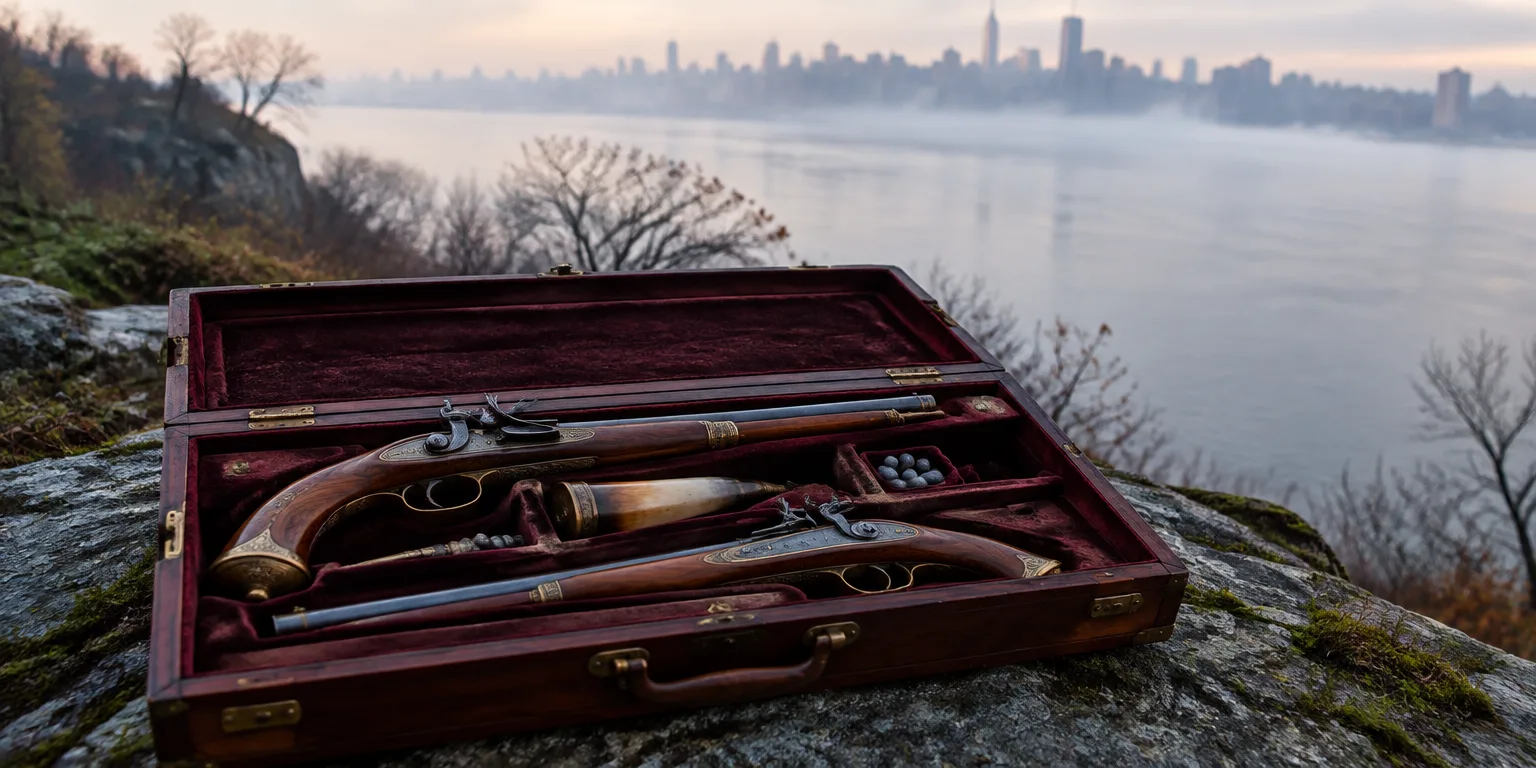
So were the weapons. The pistols, ornate London-made guns by Wogdon and Barton, belonged to Hamilton's British brother-in-law, John Barker Church, who had himself fought Burr in a bloodless duel in 1799. They may well have been the same pistols Philip had used.
Questions people ask
Why would deliberately missing help settle a duel?
Deliberately missing, or firing in the air or wide of an opponent, was an accepted signal in dueling culture. By wasting his shot, the shooter showed he did not want to kill but was still brave enough to stand and be shot at, which allowed the other man to preserve his honor by missing in return or calling the matter settled.
Why row across the river to New Jersey to duel?
Duels were illegal in New York, and participants could be prosecuted for murder if someone died. Weehawken, just across the Hudson in New Jersey, was known to prosecute dueling less aggressively, so New York gentlemen routinely rowed over there to fight.
What were dueling pistols like?
They were smoothbore, muzzle-loading flintlock pistols, often sold in pairs with powder, balls, and tools. They were deliberately short-barreled and inaccurate at more than a few paces, which made it easier for both men to miss and walk away with honor intact, though hair triggers could make them steadier and more lethal.