Amazon Barely Makes Money Selling Things. It Makes Money Selling Ads to Its Sellers.
A USB dongle that costs 80 cents explains why retail produces huge sales and tiny profits, while ads produce almost as much profit as Amazon's cloud business.
 Logically Answered · Amazon's $1 Trillion Empire...Now Just A Front For Temu | Logically Answered
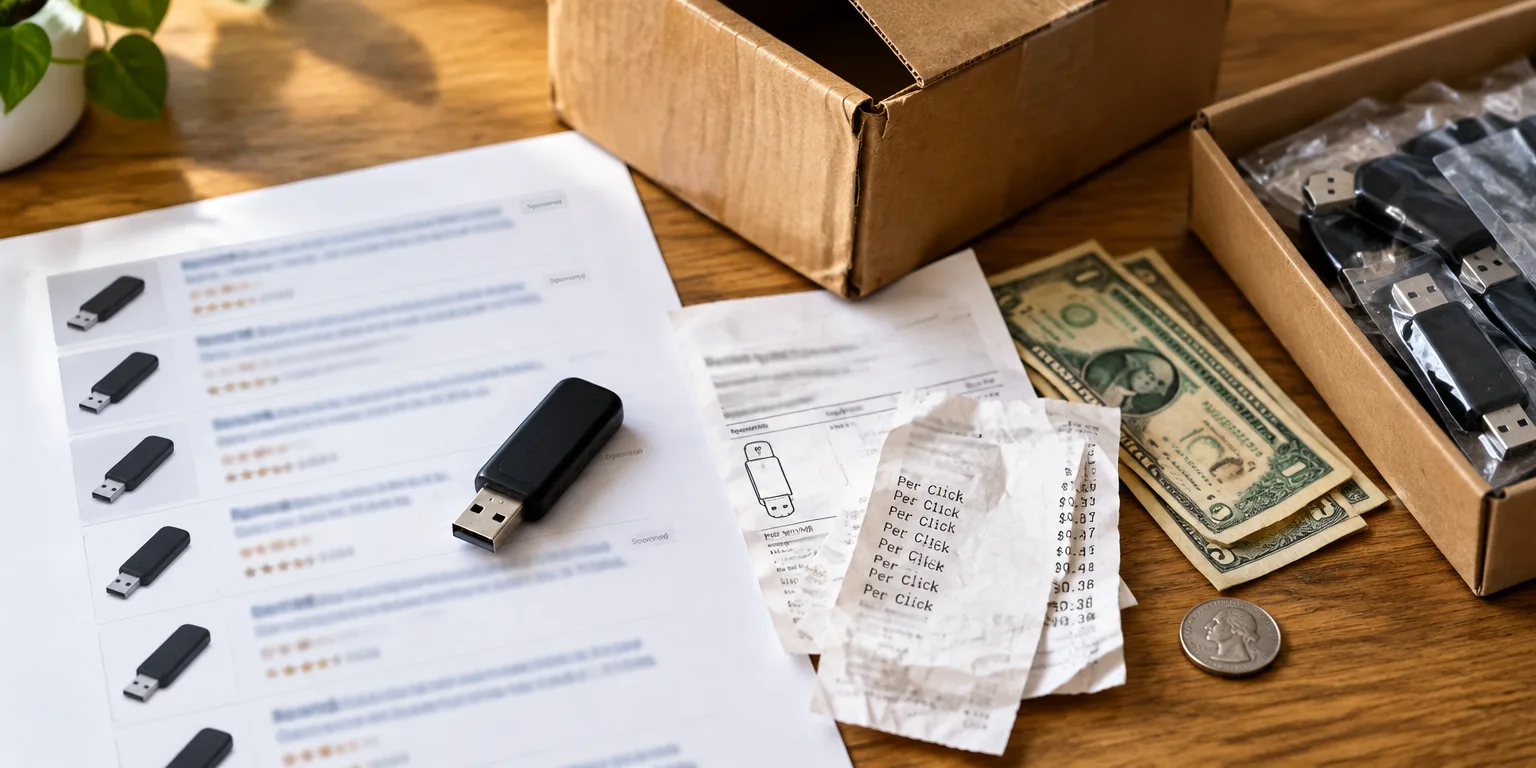
Search Amazon for a USB dongle and the top results say "sponsored." Those paid placements point to where Amazon earns much of its money.
Hari, the commentator who went through Amazon's numbers, starts with dropshipping. A seller spots a popular gadget, finds the same thing for about 80 cents on Alibaba or AliExpress, giant wholesale websites in China, and lists it on Amazon for 10 to 20 times that price. When you order, the seller never touches the box. The supplier or Amazon ships it.
The markup looks like free money until the costs pile up. The shipping cost, which is folded into the price shoppers see, plus Amazon's referral fee for hosting the sale and its individual seller fee, can eat about half the selling price, Hari says.
Then comes the part shoppers never see. To get found, the seller must buy ads on Amazon itself. Sellers pay for every click on their listing, whether or not the shopper buys. Clicks run from 50 cents to two dollars, and five or even 10 dollars for high value items.
More sellers bidding on the same USB dongle push the click price higher, and the retail price has to rise to cover it, even though the dongle is still worth 80 cents.
That is why Amazon can make almost nothing moving boxes and still make its biggest profits elsewhere. In the first quarter of 2025, retail brought in $126.4 billion in sales but less than $7 billion in profit. Advertising brought in only $13.9 billion in sales, but with profit margins of 75 to 80 percent, or roughly $11 billion, it produced almost as much profit as Amazon Web Services, the cloud computing division that earns the company the most.
Questions people ask
What exactly is an Amazon referral fee?
A referral fee is Amazon's cut of each sale for letting a third party seller use its store, payment system, and customer traffic. It is usually a percentage of the price, around 8 to 15 percent depending on the category, plus a small flat fee for some sellers.
What is AWS and why is it so profitable?
AWS stands for Amazon Web Services, the division that rents computing power and data storage to companies, governments, and apps. It grew out of the technology Amazon built to run its own store, and because software has few shipping or warehouse costs, it earns far higher margins than retail.
Do sellers have to store and ship everything themselves?
Yes. Sellers can also pay to ship their inventory to Amazon warehouses in advance, and then Amazon handles packing, shipping, and returns. In dropshipping, the seller often skips that step and has the factory ship directly, but still pays Amazon fees and ad costs to appear in search.