America Has Plenty of Gas in the Ground but Not Enough Ways to Deliver It
Shale wells fade fast, and the cleaning plants and pipelines needed to replace them take years to build.
 Invest Like the Best with Patrick O'Shaughnessy · The 2028 Natural Gas Crisis No One Sees Coming
The United States is not running out of natural gas in the ground. It is running out of time to get the gas out, clean it, and move it to where it will be needed.
That is the conclusion of Matt, an energy analyst who spent 18 months modeling nearly every American gas well and the pipelines and plants around them.
His team mapped land controlled by gas companies across the major gas producing regions. Those include Appalachia, a gas region in the east that holds two large gas bearing rock layers called the Marcellus and the Utica, plus the Haynesville, another large gas field, and the Permian and Eagle Ford, areas drilled mainly for oil where gas comes out as a byproduct.
That work finds enough acreage that companies already control, with wells that can still be drilled there, to support about 20 billion cubic feet per day of production growth.
The catch is that gas production is a flow, not a stockpile. A new shale well starts strong and then fades fast, and the combined portfolios of many companies are maturing. At current drilling plans, firms will work through most of their best remaining drilling spots over roughly the coming half decade. Even if every company drills its land well, the system tops out around 128 to 132 billion cubic feet per day, which means the country is depleting the known resource.
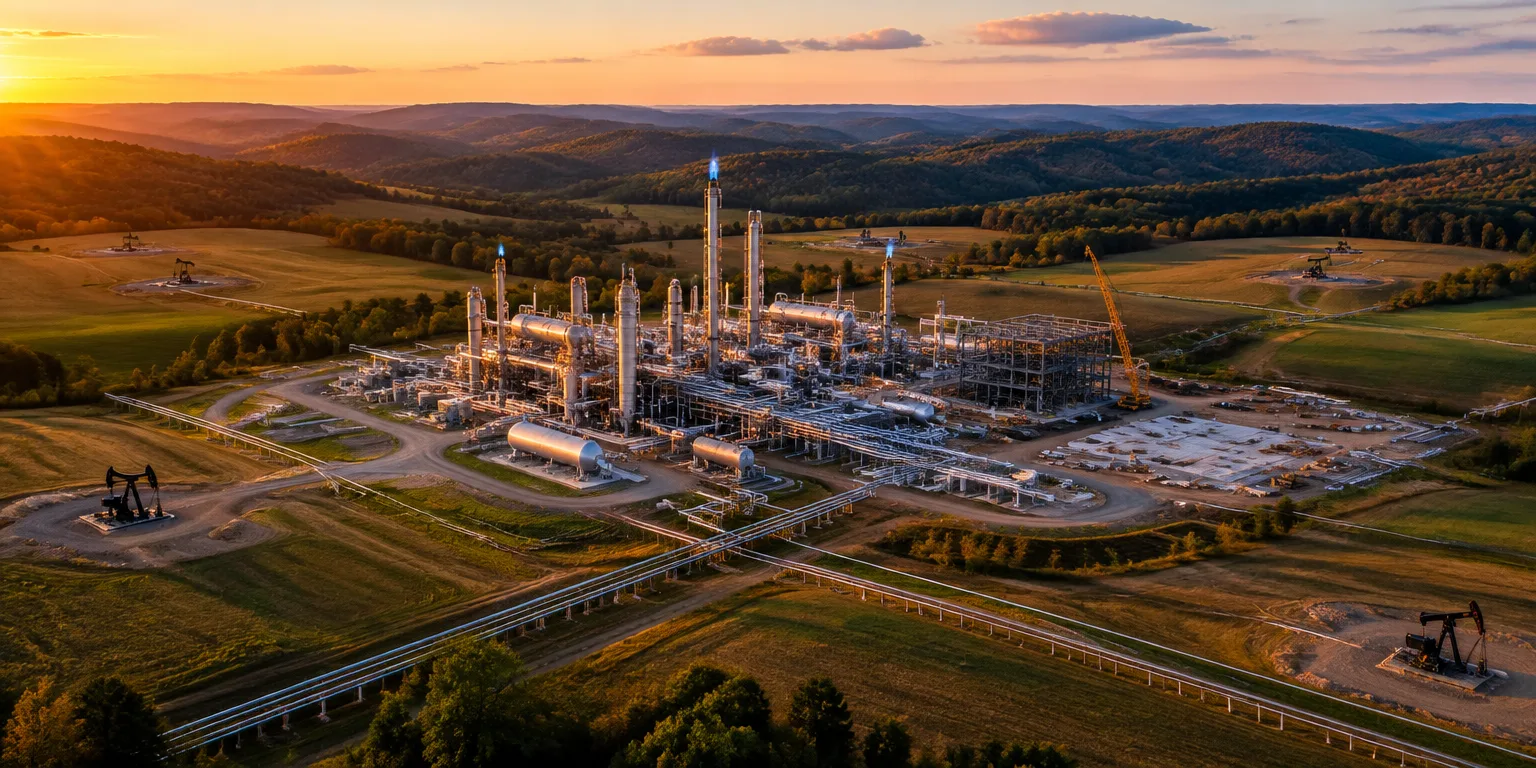
Then the gas must be cleaned. It comes up mixed with liquid hydrocarbons, sulfur, nitrogen, or oil, while regulated pipelines require uniform gas at about 1,030 British thermal units. Processing plants strip out the extras, and there is not yet enough processing capacity to reach the growth target. A new plant takes two to three years to build, so construction would have to start now.
Gathering lines, the small pipes that carry gas from each well to a plant or main line, must also be expanded materially and soon.
The hardest limit is long distance interstate pipelines, which are mostly monopolies and face heavy regulation. The local utilities that carry gas to home stoves are also monopolies or near monopolies. Only one big interstate line, the Mountain Valley line from Appalachia to the mid-Atlantic, has been built in the past 10 to 12 years, because environmental permitting has made new lines a nightmare to build. Without more cleaning and carrying capacity, more gas in the rock cannot become more gas for sale.
Questions people ask
What does billion cubic feet per day mean?
It is a rate of flow, like gallons per minute from a faucet. The United States now produces around 110 to 112 billion cubic feet of natural gas per day, so adding 20 billion per day would be roughly an 18% increase in daily output.
Why do shale wells decline so fast?
Shale rock is tight, so a fractured well releases a burst of oil and gas and then pressure drops quickly. Operators offset the drop by drilling new wells constantly, which is why steady output depends on a steady supply of good drilling locations and equipment.
Could higher prices simply unlock more gas?
Higher prices can make older or more remote rock worth drilling, but those areas often lack processing, gathering pipes, and interstate connections. Without that surface equipment, which takes years to permit and build, the extra rock cannot quickly become extra supply.