America's smallest bank runs on paper and a $5 bill
It has no computers, no ATMs, and no fees, and it shares a town of 1,828 people with two other banks.
 PolyMatter · How America’s 4,488 Banks Work
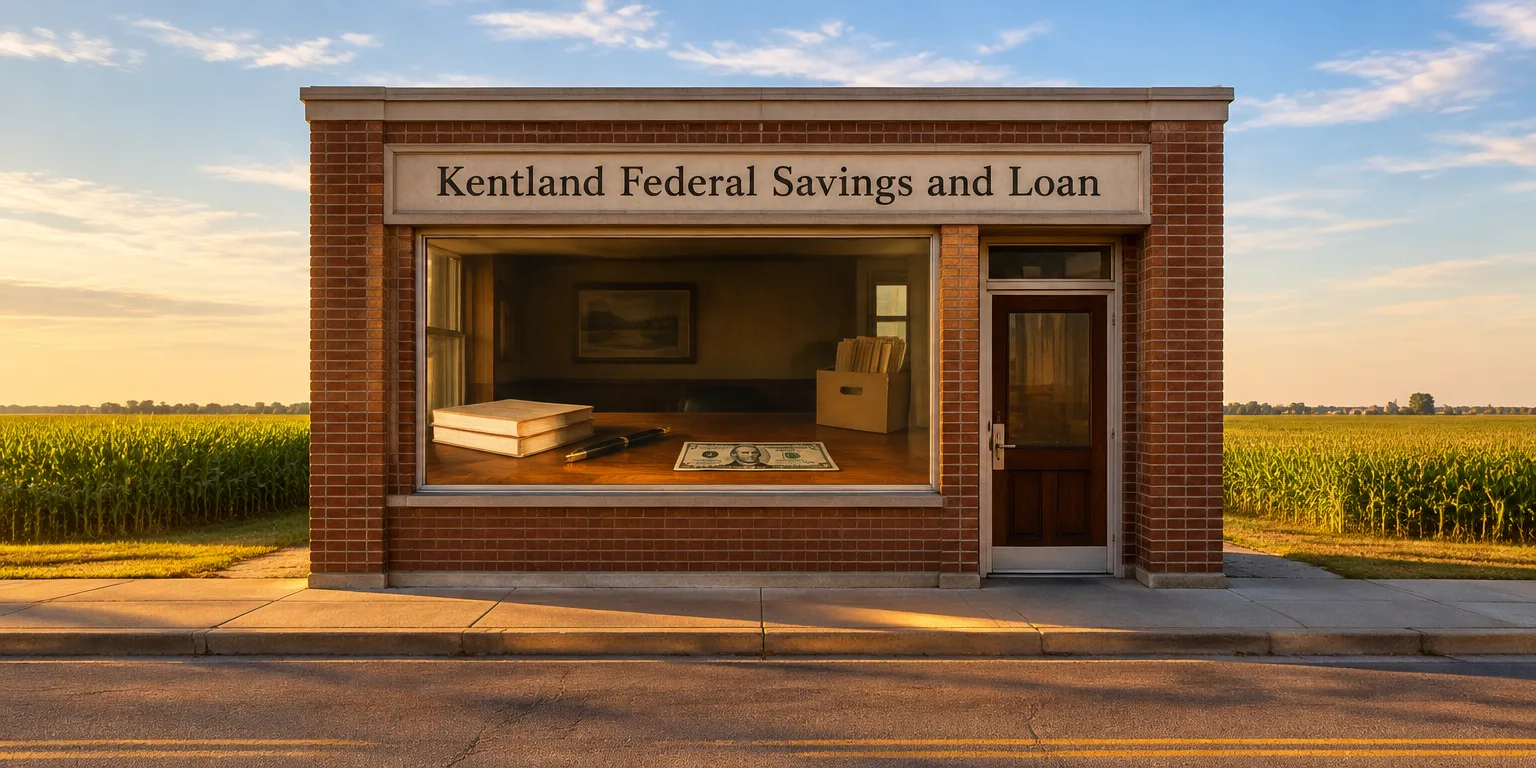
Kentland, Indiana, has 1,828 people, miles of cornfields in every direction, and America's smallest bank.
Kentland Federal Savings and Loan opened in 1920 and survived the Great Depression. More than 100 years later, it still does all its business in person and on paper, with no fees, no ATMs, and no computers. Property deeds sit in a cardboard box in the back room of its single office, and a single $5 bill is enough to open a savings account. The bank holds just $3 million in assets.
It is not even the only bank in town. Kentland has only one fast-food restaurant, one bar, and one gym, yet it supports three banks and a separate drive-up cash machine.
Questions people ask
How can a bank with only $3 million survive?
It works the same way big banks do. It takes in checking and savings deposits at very low interest, lends some of that money out at higher interest, and lives on the difference. With one branch, no computers, and almost no staff costs, it can survive on a tiny volume of loans.
Is money safe in such a tiny bank?
Yes, if it is federally insured, which almost all U.S. banks and savings associations are. That protection generally covers up to $250,000 per depositor, per bank, so ordinary checking and savings accounts are safe even if the bank fails.
Why does America have so many small-town banks?
History is a big reason. For most of American history, banks were generally limited to one location and one state, so thousands of local banks were created. Branching was not broadly allowed until the 1980s and 1990s, leaving only a few decades for mergers to reduce the number.