An Aging Engineer Who Feared He Would Miss a Signal Taught Japan to Point and Shout
What began as one engineer's workaround for bad eyesight was written into railway manuals in 1913.
 Curiosity Chronicle · A Japanese Ritual to Improve Your Habits
Yasuoichi Hori had to hang out the window to do his job. Hori was a steam train engineer in Japan in the early 1900s, driving a locomotive from a small cab tucked just behind the engine's big boiler. To spot the small signals along the track while moving fast, he frequently had to stick his head outside and squint into the distance.
His eyesight was getting worse, and he worried his vision was no longer reliable. That frightened him because his work depended on reading each signal quickly and correctly. In the cramped cab with him was only his fireman, who shoveled coal into the firebox and also kept watch for signs along the line. Hori dreaded overlooking or misreading one of those trackside signs, a mistake that could cause a terrible wreck.
So he started doing something odd. Whenever a signal came up alongside the track, he shouted its status out loud. At first the fireman did not know why Hori was yelling, but he answered back with his own confirmation of the signal, turning the outburst into a call and response.
What began as one worried older worker's workaround became one of Japan's most durable safety rituals, and the numbers help explain why. In a 1994 study by the Japan Railway Technical Research Institute, workers doing a simple task made 2.38 errors per 100 actions. When they both pointed at the task and called it out, errors fell to 0.38 per 100 actions, an 84 percent reduction.
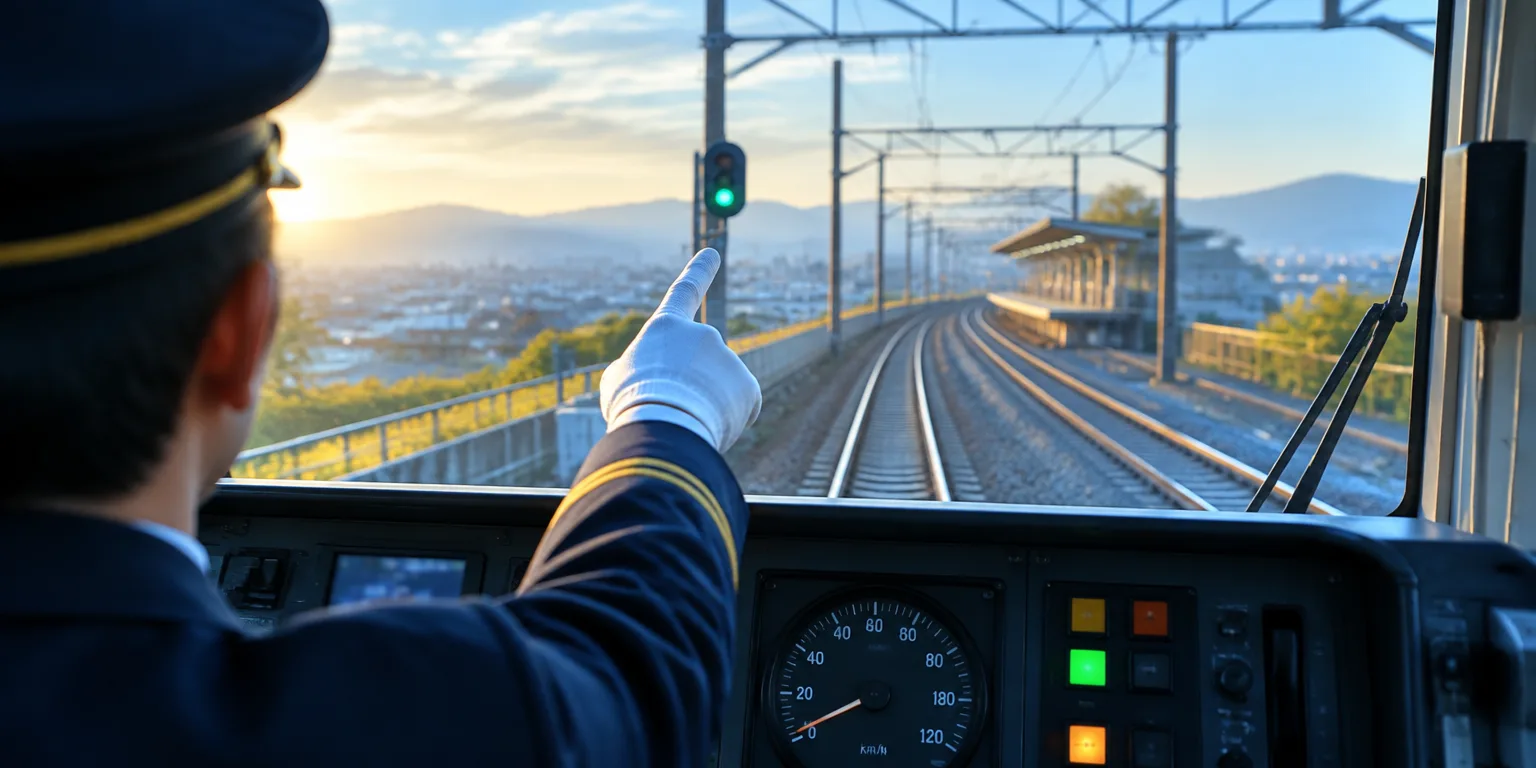
According to the account, the method entered the Japanese railway manuals in 1913, when call and response became official. In the late 1920s, pointing was added to the routine. From then on the driver was expected to gesture toward each signal while announcing what it showed, with his cabmate doing the same in return.
It came to be called shisa kanko, meaning pointing and calling. More than a century after Hori began shouting out signals from his cab, you can still see it in Japan, where conductors aim a finger at each signal while announcing what it shows.
Questions people ask
What does a fireman do on a steam train?
The fireman is the engineer's assistant in the locomotive cab. He shovels coal into the firebox to keep the boiler hot and the steam pressure up, and he also helps watch trackside signals and monitor the engine. On Hori's train, there were only those two men in the cab.
Do Japanese train crews really still point and shout today?
Yes. Pointing and calling remains standard practice on Japanese railways, subways, and buses. Conductors and drivers point at signals, speed markers, and clocks while calling out their status, and station staff point down platforms before dispatching trains.
Has pointing and calling spread beyond Japan?
Yes, versions have been adopted in rail systems, factories, and aviation operations in other countries. Transit agencies in places including New York and London have tested or used pointing and calling procedures for conductors and track workers, because the physical and vocal check draws extra attention to routine tasks.