An Ancient King Could Read and Write, and He Carried His Stylus to a Lion Hunt
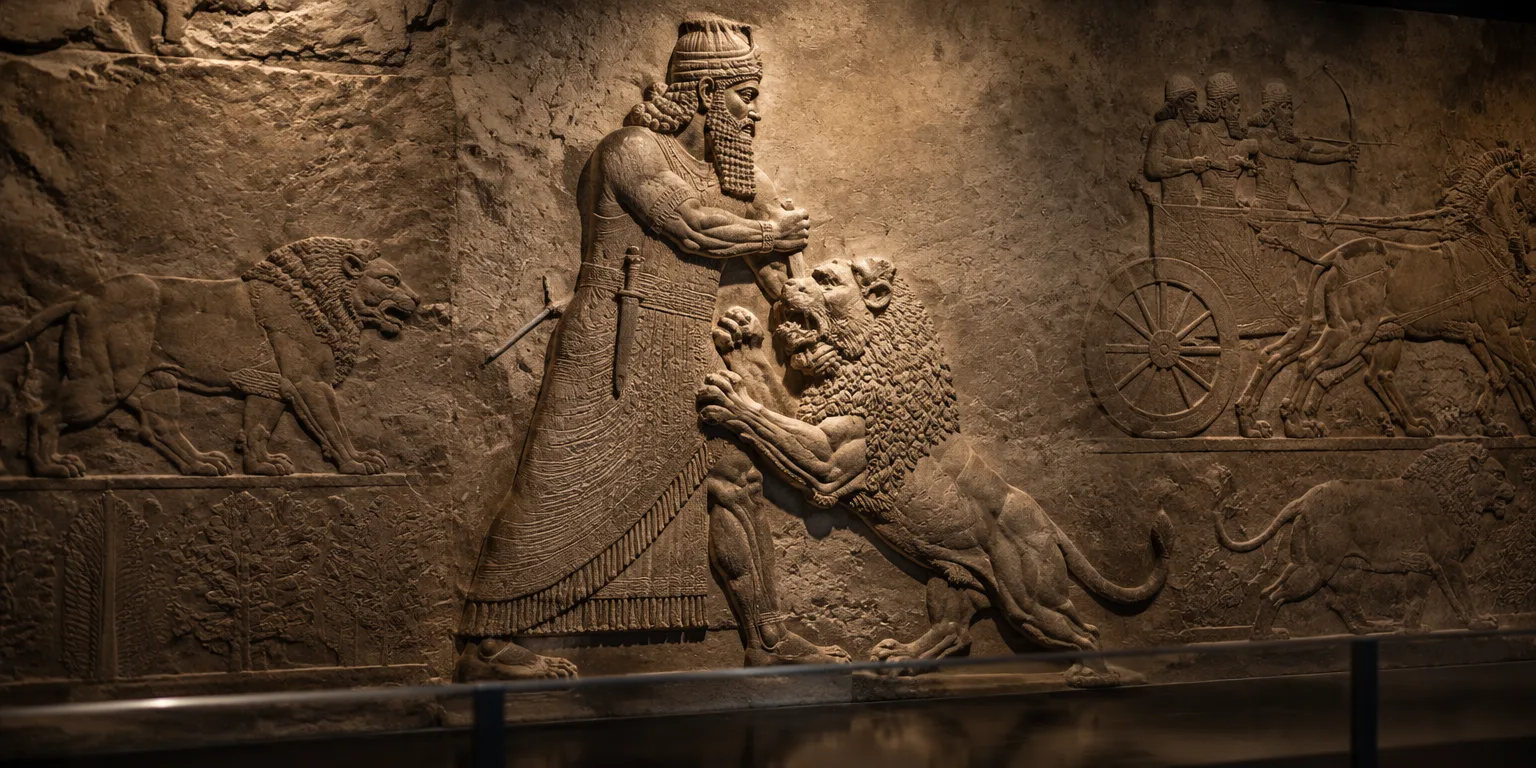
He had artists carve him with a writer's stylus in his belt, even as he stabbed a lion with a sword.
 Stuff You Missed in History Class · Ashurbanipal
Ashurbanipal, king of Assyria in the 600s B.C., could read and write. That alone set him apart, since kings of his era left reading and writing to scholars and scribes.
He had trained like a prince, in horsemanship, charioteering, archery, and military tactics, but also in literature and history. He learned to read and write several forms of Sumerian and Akkadian in cuneiform, the wedge-shaped script pressed into clay. He likely got that scholarly start only because, early in life, he was not expected to become king.
Once crowned, he made sure the skill was seen. Palace carvings show him fighting enemies, feasting, and stabbing a lion with a sword, with a writer's stylus tucked in his belt.
Questions people ask
What was Assyria, and when did Ashurbanipal live?
Assyria was a powerful kingdom in northern Mesopotamia, the land between the Tigris and Euphrates rivers in what is now Iraq. Ashurbanipal ruled the Neo-Assyrian Empire in the seventh century B.C., from about 669 to 627 B.C., when it was at its largest extent.
What exactly is cuneiform?
Cuneiform is one of the world's earliest writing systems, made by pressing a reed stylus into soft clay to leave wedge-shaped marks. It was used to write several different languages, including Sumerian and Akkadian, and dried or baked tablets could survive for thousands of years.
Where can you see those lion-hunt carvings today?
Many of the palace reliefs from Ashurbanipal's palace at Nineveh are in the British Museum in London. The lion-hunt scenes are especially famous for showing individual animals and people in motion, rather than repeating the same stiff figures.