An Octopus Does Not Steer Its Arms, It Lets Them Grab
Sixty percent of its nerve cells are in its limbs, so the brain orders a grab and the arm handles the bending.
 TED-Ed · Why the octopus brain is so extraordinary - Cláudio L. Guerra
Imagine your arm had a mind of its own. For an octopus, that is nearly true.
An octopus has about 500 million nerve cells. Only about 10 percent sit in the central brain. About 30 percent sit in two huge optic lobes, the parts that handle vision, and the other 60 percent are spread through its eight limbs, wired together in clusters of nerve cells called ganglia.
That layout matters because an octopus moves nothing like we do. We are vertebrates, animals with a rigid skeleton and joints that bend only certain ways. You cannot bend your knee backward, or fold your forearm halfway down.
An octopus has no bones at all, so it can flex an arm almost anywhere along its length and toward almost any side, creating a nearly limitless number of shapes.
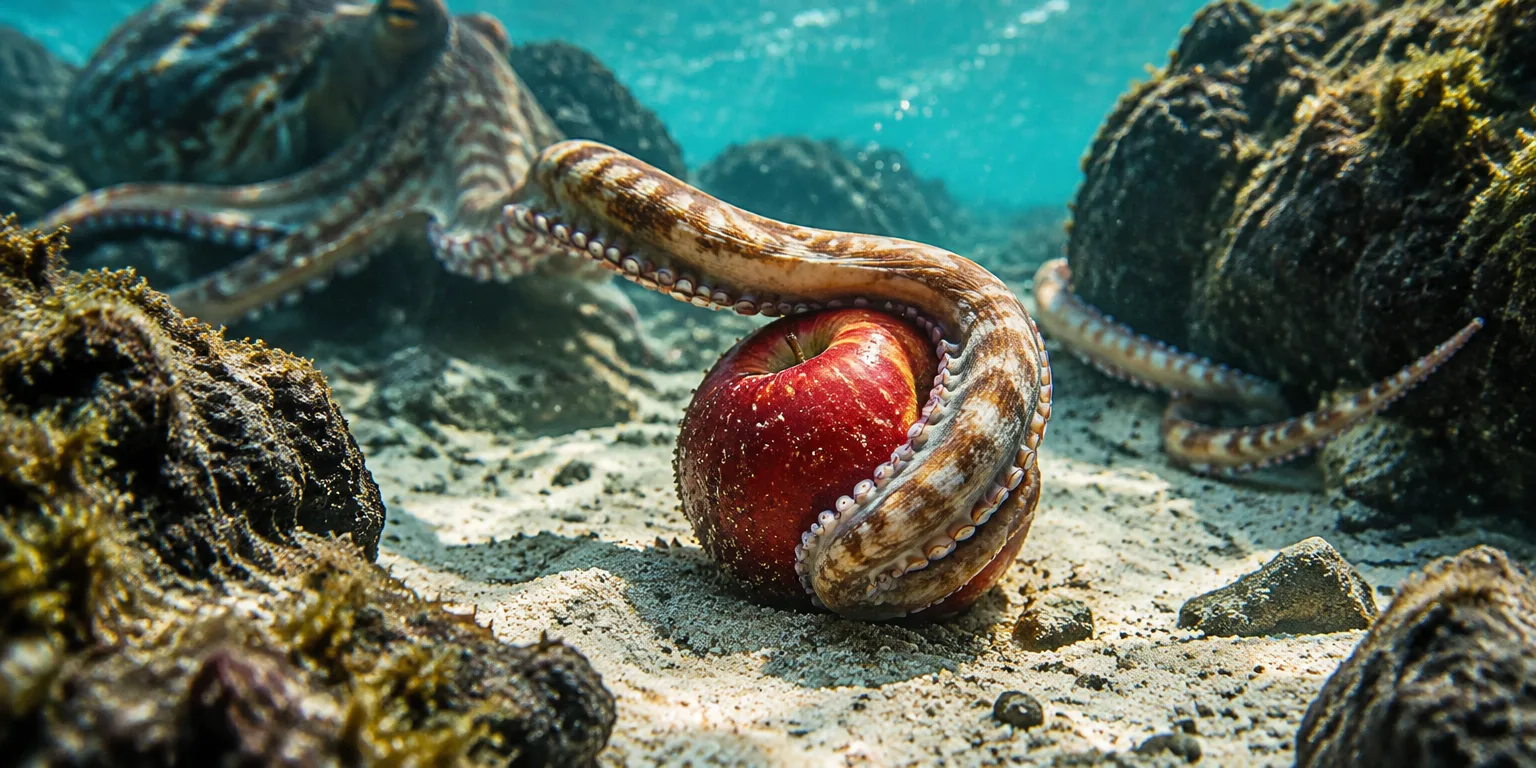
To pick up an apple, a person relies on what scientists call a body map. The human brain holds a working diagram of the body, and when the eyes see the apple, the brain’s movement center switches on the right muscles to reach out, grab, bend the elbow, and lift the fruit to the mouth.
An octopus skips the detailed directions. Instead of a body map, its brain keeps what scientists describe as a behavior library, a set of broad programs such as grab, crawl, or swim. When the octopus sees food, the brain calls up “grab,” and sends that instruction out through the network. The neurons in the arm pick up the message and handle the details of the movement themselves.
The trick works through traveling waves of muscle activity. Once the arm touches the food, one wave moves from that touch point toward the base of the arm, while another wave moves from the base toward the tip. Where the two waves meet, the arm bends. In that way, the arm finds the right bending point on its own, without the brain calculating every joint and muscle.
The result is that control is shared. The brain decides what to do, and each arm figures out how to do it.
Questions people ask
What is a behavior library?
Not a shelf of books, but a set of built-in movement programs. The brain stores general routines like reach, grab, or jet away, then activates one. The arms and body fill in the muscle-by-muscle details locally.
Can an octopus arm still move without the brain?
For a while, yes. Because the arm contains its own nerve circuits and muscles, a separated octopus arm can still flex, grip, and recoil from a poke for up to an hour. It cannot hunt or feed on its own, because the brain is no longer coordinating it.
Do squid and cuttlefish work the same way?
Other cephalopods, the group that includes squid and cuttlefish, also have large nervous systems spread beyond the brain and flexible, boneless limbs. Octopuses carry the design the farthest, with the largest share of nerve cells out in the arms.