Big Tech gives schools free tech to make students customers for life
Schools spend more than $30 billion annually for technology, but the bigger payoff is a child who stays with the same brand for life.
 Fresh Air · Back-to-school with Big Tech
The free email, free classroom software, and free chatbots in American classrooms are part of the same business strategy, one that is more than 40 years old.
It started with Apple. In the early 1980s, when Apple was still a small maker of desktop computers, Steve Jobs of Apple wanted to put its machines in every school in the country. Apple could not afford to give away that many computers, so Jobs went to Washington to press federal lawmakers for a tax break for companies that donated computers to schools, a campaign he called Kids Can't Wait. That account comes from Times reporter Natasha Singer, who has written a book about technology companies and public schools.
Congress did not pass the bill, but California passed its own tax break for computer donors. Then in 1982 Apple supplied thousands of schools across California, covering almost all of them, with an Apple IIe, its beige desktop machine. The giveaway popularized the term computer literacy.
There was a creative belief behind it, Singer says, and a business calculation. Her account frames it as a hope: a child who learned on an Apple at school could ask a parent to buy one at home, and could keep buying Apple for years.
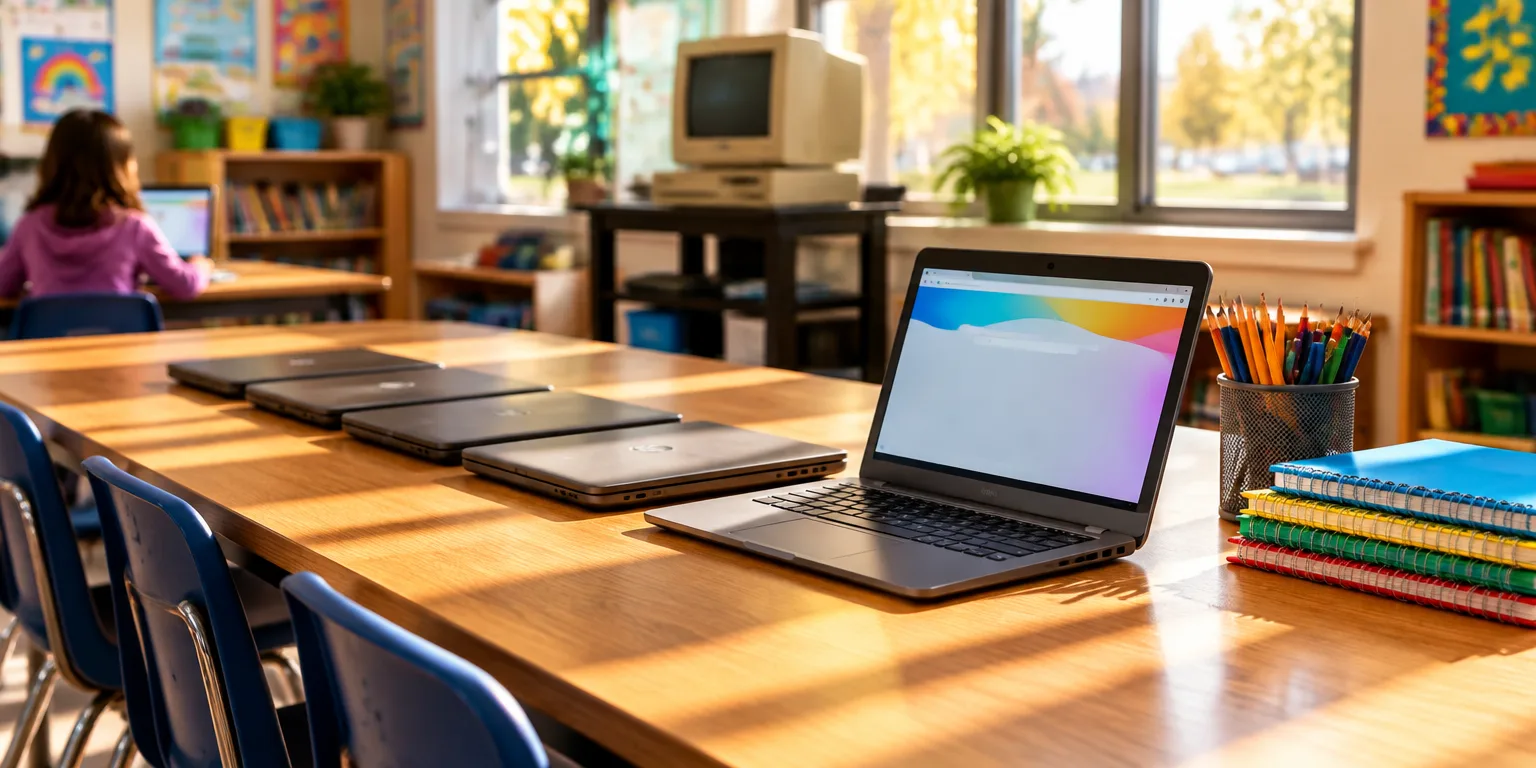
Google ran the same play two decades later. Around the start of the 2000s, colleges and districts paid a lot for older email and office software, and Google offered Gmail, Docs, and related programs free. Whole universities shifted their student bodies, numbering in the tens of thousands, onto Google's services almost overnight, followed by large districts such as Chicago Public Schools. Once schools depended on its software, Google introduced the Chromebook, a sturdy and inexpensive laptop that runs Google's operating system and stores student work online, which schools bought in bulk as a way to expand access.
The current version is artificial intelligence. A school that already uses Google programs can get Gemini, Google's chatbot, without an extra charge. Teacher training is often paid for or led by the technology companies themselves, as are digital lessons in spreadsheets, presentations, and coding.
Schools still spend heavily. American public districts lay out more than 30 billion dollars annually for devices and programs, Singer reports, including paid extras like the systems that track Chromebooks and lock them down during tests, which can cost about 12 dollars per student per year.
The larger prize is loyalty. A student raised on one company's operating system is likely to stay in that company's products. A MacBook student may ask for an iPhone, then buy music, television, and more computers from Apple. A Chromebook student may keep Gmail for life and later buy its cameras and home devices. She calls schools training wheels for brands.
That is why, she says, companies focus on young children, who may use an app for life, or on teachers, who will introduce it to children. OpenAI, a newer entrant to schools, offers a school version called ChatGPT Edu that, the company says, does not employ classroom information from teachers and pupils to improve its models and has added safeguards.
Questions people ask
What is an operating system and an ecosystem?
An operating system is the basic software that runs a phone or laptop, like Apple's iOS, Google's ChromeOS, or Microsoft Windows. An ecosystem is all the other products and services built to work easily with it, such as email, music, video, watches, cameras, and home devices, which makes it inconvenient to switch to a rival.
Do free school tools mean companies can use children's data for advertising?
Federal law limits that. Under the Children's Online Privacy Protection Act and the Family Educational Rights and Privacy Act, companies generally cannot use data collected from young students in school for targeted ads, and school contracts usually add further limits. Concerns remain about other uses, such as product improvement, which is why some districts require promises that student data will not train AI models.
How common are Chromebooks in schools now?
Very common. Market researchers have found that Chromebooks accounted for a majority of computers shipped to American primary and secondary schools for much of the past decade. Their low price, simple management, and connection to free Google programs made them especially popular in large public districts.