Black holes slowly leak away and then explode
They leak a faint glow that grows hotter as they shrink, but the biggest ones need far longer than the universe will remain livable.
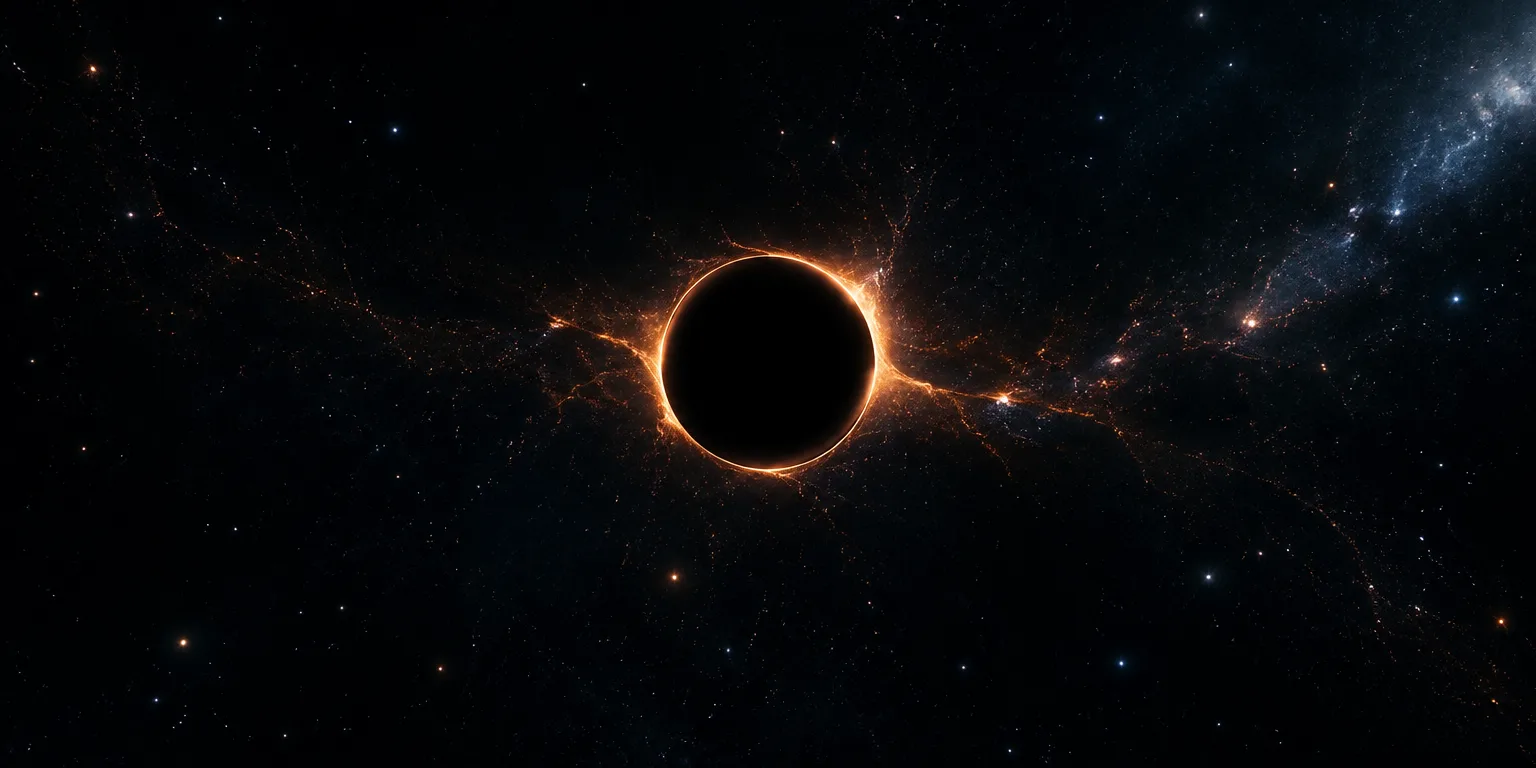
 Kurzgesagt – In a Nutshell · Black Holes Explained – From Birth to Death
Black holes, which swallow everything, slowly lose energy and die.
The leak, called Hawking radiation, starts with empty space, which is not really empty. It is constantly filled with pairs of so-called virtual particles that pop into existence and then wipe each other out.
When a pair appears right at the boundary around a black hole, one particle gets pulled inside while the other escapes and becomes real. Those escapees are the leak: each one carries away a tiny bit of energy, so the black hole loses a little mass. At first the drain is incredibly slow, then it speeds up as the black hole gets smaller.
Shrinking makes a black hole hotter, not colder, because a smaller black hole has less surface area to spread its radiation over, so it runs hotter. When it weighs about as much as a large asteroid, it glows at about room temperature. Once it is down to the weight of a mountain, it radiates about as much heat as the sun. In its final second, it lets out as much power as billions of atomic weapons going off at once.
For big black holes, that finale is almost unimaginably distant. The largest ones may need a googol years, or 1 followed by 100 zeros, to evaporate, so long that the cosmos will already be unable to support life well before then. When the last black hole flashes out, there will be no one left to see it.
Questions people ask
How long is a googol years?
A googol is 1 followed by 100 zeros, so a googol years is 10 to the 100th power years. The universe is now about 13.8 billion years old, or less than 10 to the 10th power years. The largest black holes would therefore last vastly, almost inconceivably longer than the universe has existed so far.
Who discovered Hawking radiation?
The British physicist Stephen Hawking proposed it in 1974. He combined quantum mechanics, which governs tiny particles, with general relativity, which governs gravity, and found that black holes should not be completely black. The glow is named Hawking radiation in his honor.
Why does a smaller black hole get hotter?
A black hole's temperature rises as its mass and surface area fall, so there is less room to spread the energy it radiates. A stellar mass black hole is colder than the faint afterglow of the Big Bang, so it still gains more energy than it loses today. Only after the universe cools further, and the black hole has shrunk a great deal, does the runaway heating take over.