Cargo planes stop in Anchorage to carry more packages, not more fuel
The city sits directly on the flight path between Memphis and Osaka, and the layover also gives FedEx and UPS a place to clear customs and sort packages.
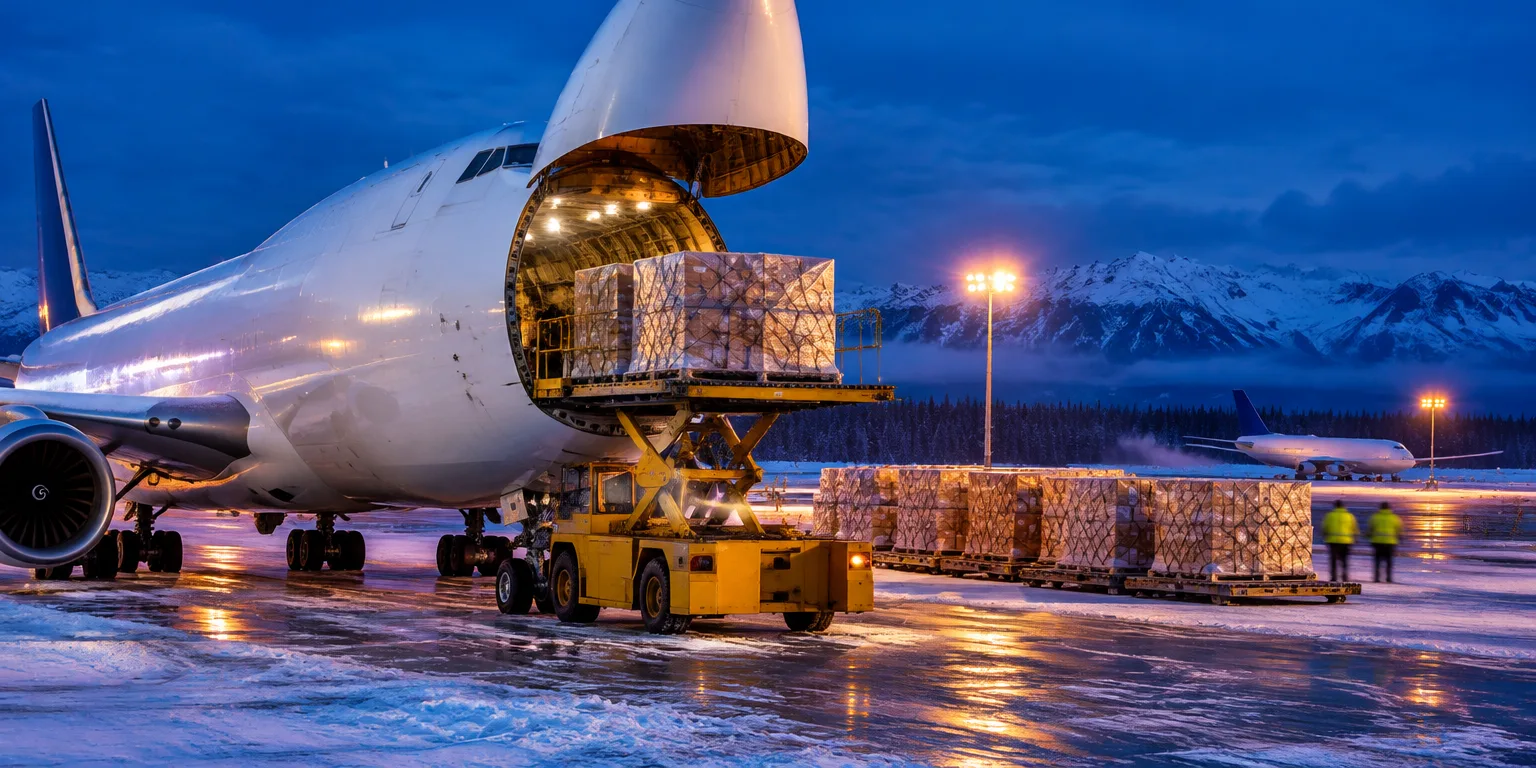
 Wendover Productions · How Overnight Shipping Works
Anchorage, Alaska, has fewer than 300,000 residents and one of the top freight airports globally by volume. The reason is location.
Because the planet is round, the shortest path between Memphis and Osaka, Japan, arcs far to the north and passes over Alaska. That puts Anchorage in a convenient spot for trips linking the United States and Asia. Many freight carriers land there briefly to take on fuel and hand the controls to a fresh crew.
Today's jets have the range to cross the Pacific without landing, but filling the tanks for that long jump leaves less lifting power for boxes. Weight is the limit, so fuel and parcels compete for the same capacity. Leaving some fuel behind and adding a stop lets a carrier replace heavy, unprofitable fuel with paying freight, which lowers the cost of the trip.
FedEx and UPS also use Anchorage to organize their loads. Keeping delivery times fast with only direct trips would require many separate links between sorting centers in Asia and sorting centers in America, with too few parcels to fill each flight. Instead, the companies combine loads into a smaller number of flights into Anchorage, then divide them again for onward trips to many cities across the United States.
While planes sit on the ground there, parcels coming in from across the Pacific go through United States border inspection and are reorganized onto the outbound jet flying nearest to where they need to go. That shortens both delivery times and expenses.
Moving boxes overnight is an intensely price sensitive business, built on huge contracts with retailers, some of which ship millions of packages per day. In that kind of business, stopping in Anchorage lowers the cost of moving each box.
Questions people ask
Why does the shortest route from Memphis to Japan go over Alaska?
A great-circle route is the shortest distance between two points on a sphere. On a flat map it looks curved, which is why a flight from Memphis to Osaka appears to go far north over Alaska rather than straight west across the Pacific.
Why do carriers not just fly directly from each Asian city to each American city?
They would need many more flights, and most would fly partly empty. By funneling parcels through Anchorage, carriers can combine loads from several Asian origins, fill each plane, and then split the loads again for different American destinations.