Cheap airplane seats sell out first, and that is why fares jump in steps
Even on an empty flight, a deadline can push you into a pricier bucket.
 Wendover Productions · How Airlines Price Flights
Airline prices do not creep up dollar by dollar. They jump, from $159 to $204 to $269, because the cheapest seats literally sell out first.
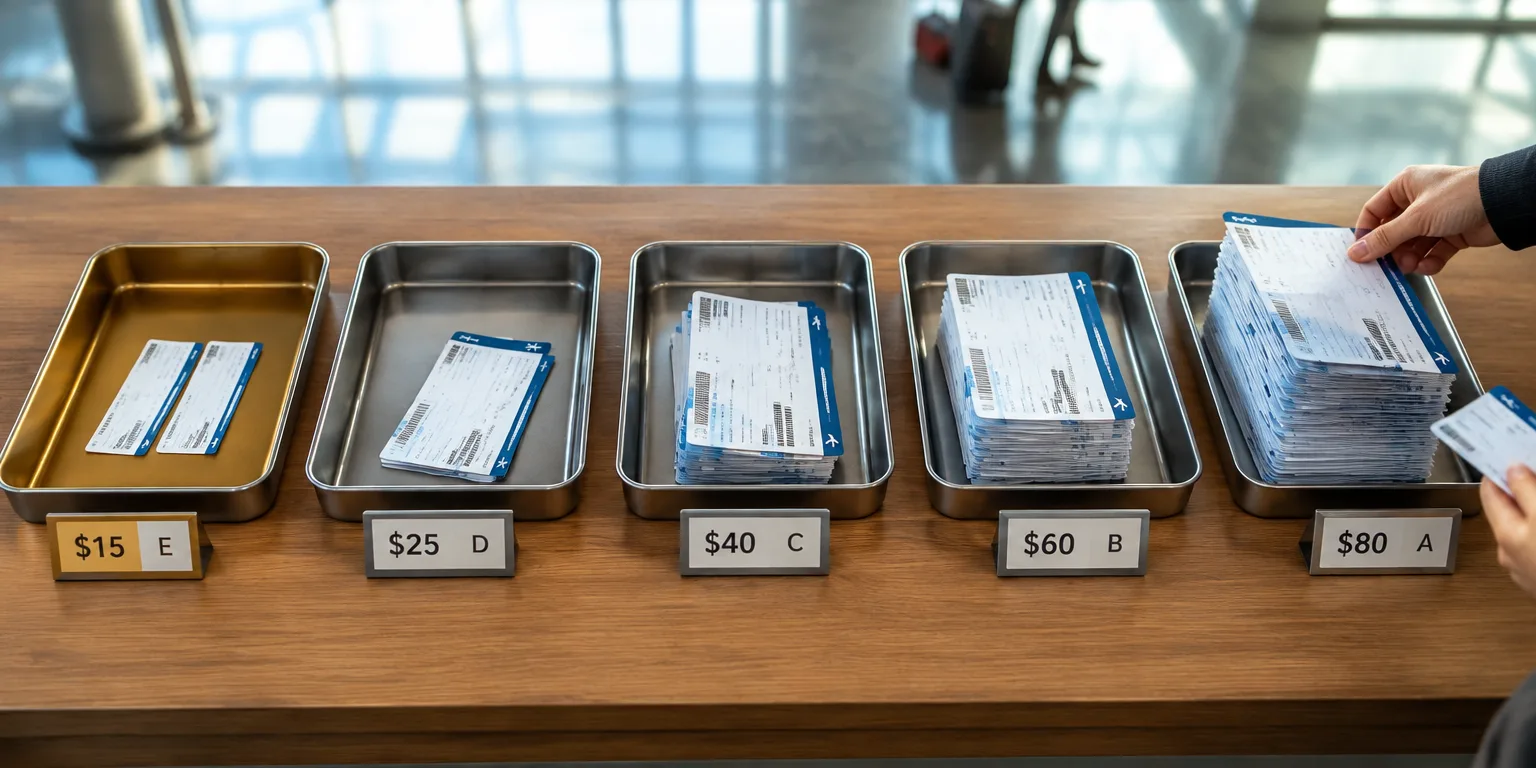
Think of the economy cabin as divided into buckets, not rows. Each bucket is a booking class with a one letter fare code, and it holds a set number of tickets at one fixed price. On one New York to Los Angeles flight, for example, the $129 and $144 tickets both book into code B, the $159 tickets book into code N, then $204 books into G, $269 into V, and $318 into L.
The airline might put 10 seats in the $159 bucket. When those 10 are gone, the next shopper is automatically offered the $204 bucket, then the $269 bucket, and so on. The seat is the same, the bucket is what changed.
Time can force the jump even if the plane is nearly empty. Many cheap buckets carry advance purchase rules, which are deadlines printed in the fine print of the fare. In this case, every fare below $204 stops being sold in the last two weeks, while the $269 fare stays on sale into the last week. Miss the deadline and you are locked out of the cheap buckets.
That is why last minute travel hurts. The cheapest fare with no advance purchase requirement at all is code K at $472, the most expensive economy ticket on the flight. Airlines can also nudge all the buckets at once, adding a fuel surcharge when oil prices rise, or raising the base price of every bucket for a busy season like summer.
The takeaway is simple: you are not just buying a seat, you are buying a place in line. Buy early and you get the cheap bucket. Buy late and you get what is left.
Questions people ask
Does buying earlier always get me the cheapest bucket?
No. The buckets can sell out in any order, and the airline can change the rules. If few people are buying, it may open more cheap seats, and if demand is strong, the cheap buckets can disappear months out.
What is a fuel surcharge?
It is an extra fee airlines add on top of the base fare to cover swings in fuel costs. It lets them raise the total price quickly without refiling every fare bucket, and it can change even after buckets are set.
Do premium cabins work this way too?
Yes, most airlines sell several versions of business and first class the same way. They use different fare codes with different prices, change rules, and advance purchase deadlines, so two passengers sitting next to each other may have paid very different amounts.