Claude Shannon Planned His Funeral as a Parade With Unicycles and Jugglers
The founder of information theory wanted humor, not grief, and a sendoff that summed up a life of play.
 Founders · How Claude Shannon Invented The Future
Before he died, Claude Shannon outlined what he wanted for his funeral. Shannon, the Bell Labs researcher whose 1948 paper laid the theoretical foundation for the internet, data compression, and modern computing, had spent his final decade in decline from Alzheimer's and full-time care.
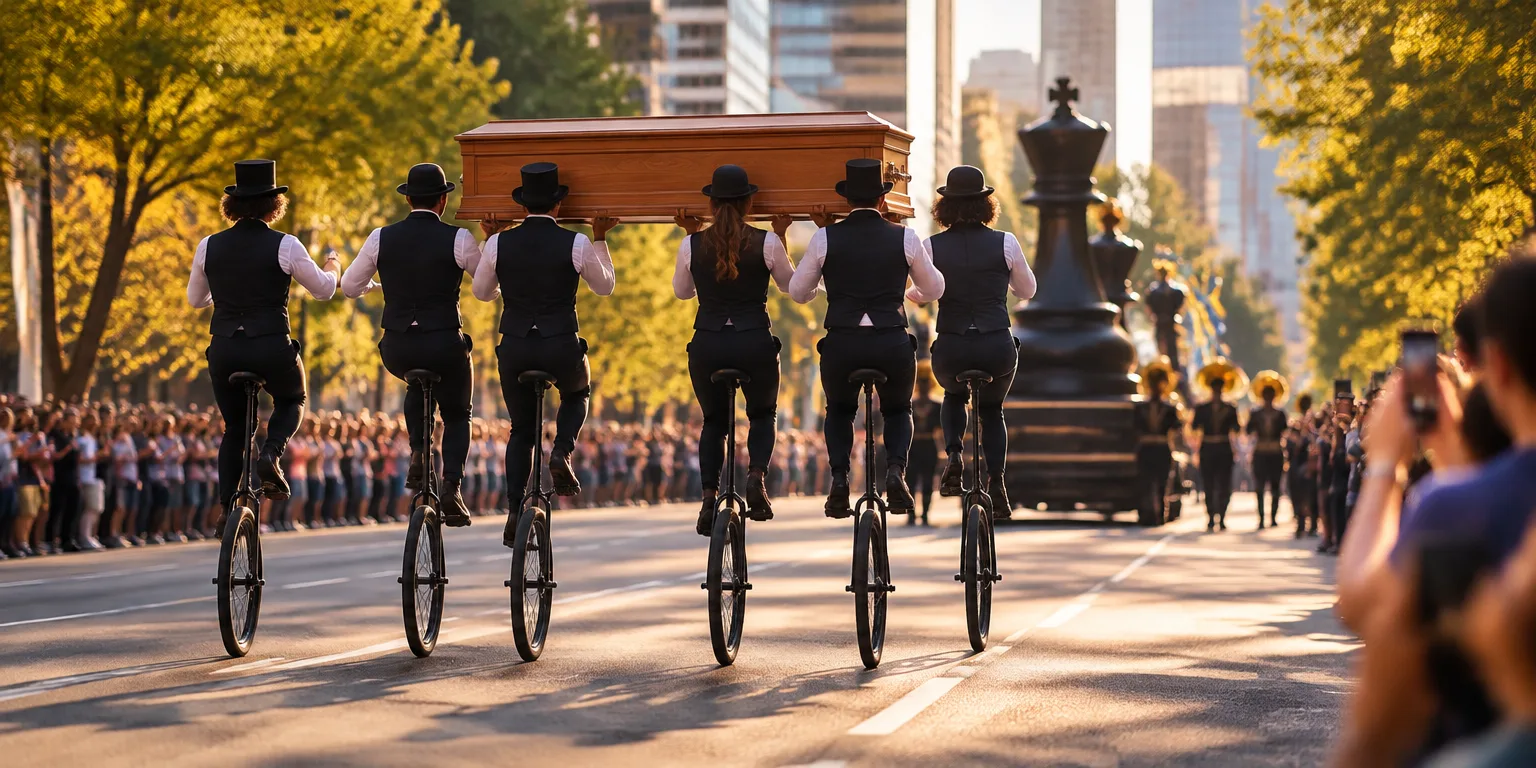
For him, the occasion called for laughter over mourning. He pictured a Macy's-style parade with floats and bands, meant to entertain onlookers and sum up a life spent on curious, serious play, in which building a mechanical juggler and a fire-shooting trumpet counted alongside pioneering digital circuits.
At the very front would walk a lone clarinet player. Directly behind would come a jazz combo, keeping time for what followed.
Then six riders on unicycles would carry his coffin, keeping it balanced as they rode. After them would walk his widow in mourning. Then would come eight jugglers in formation, followed by a mechanical juggler.
Then would come three dark chess pieces carrying $100 bills. Behind the money would walk three wealthy men from the West, backers from California's tech industry, trailing the cash. They would walk ahead of the chess float.
Atop that float would be David Levy, the British chess master, playing a live game against a computer while the parade moved. Behind the float would come scientists and mathematicians, runners, and a band of 417 players closing the march.
Questions people ask
Did Shannon actually get this parade?
In the transcript, only the plan is described, not a parade that took place. The same account notes his last decade in decline from Alzheimer's and full-time care. The plan survives as the remembrance he outlined before he died.
Why unicycles, juggling, and chess?
Those were Shannon's lifelong materials. He built customized unicycles, built a juggling robot and studied juggling scientifically, and built maze-solving and chess-playing machines. The lineup reads like an inventory of his workshop.
What do the $100 bills and California investors mean?
In the plan, three dark chess pieces carrying $100 bills come next, followed by three wealthy men from the West, described as California tech investors following the money. Shannon also treated the market as a puzzle, compounded wealth at about 28 percent a year for decades, and once beat all but three of 77 tracked money managers.
Who was David Levy?
David Levy is a British chess master known for a 1968 bet that no computer would beat him at chess within 10 years, a bet he won. A live human-versus-computer game on the float fit Shannon's long interest in thinking machines, which he had called his fondest dream.