Complex cells began when one cell trapped bacteria inside it and kept them alive
The trapped bacteria became mitochondria, and the partnership unlocked the energy that plants, fungi, and animals run on.
 On Humans · How Do Humans Fit into the Story of Life? ~ Jonathan Loh
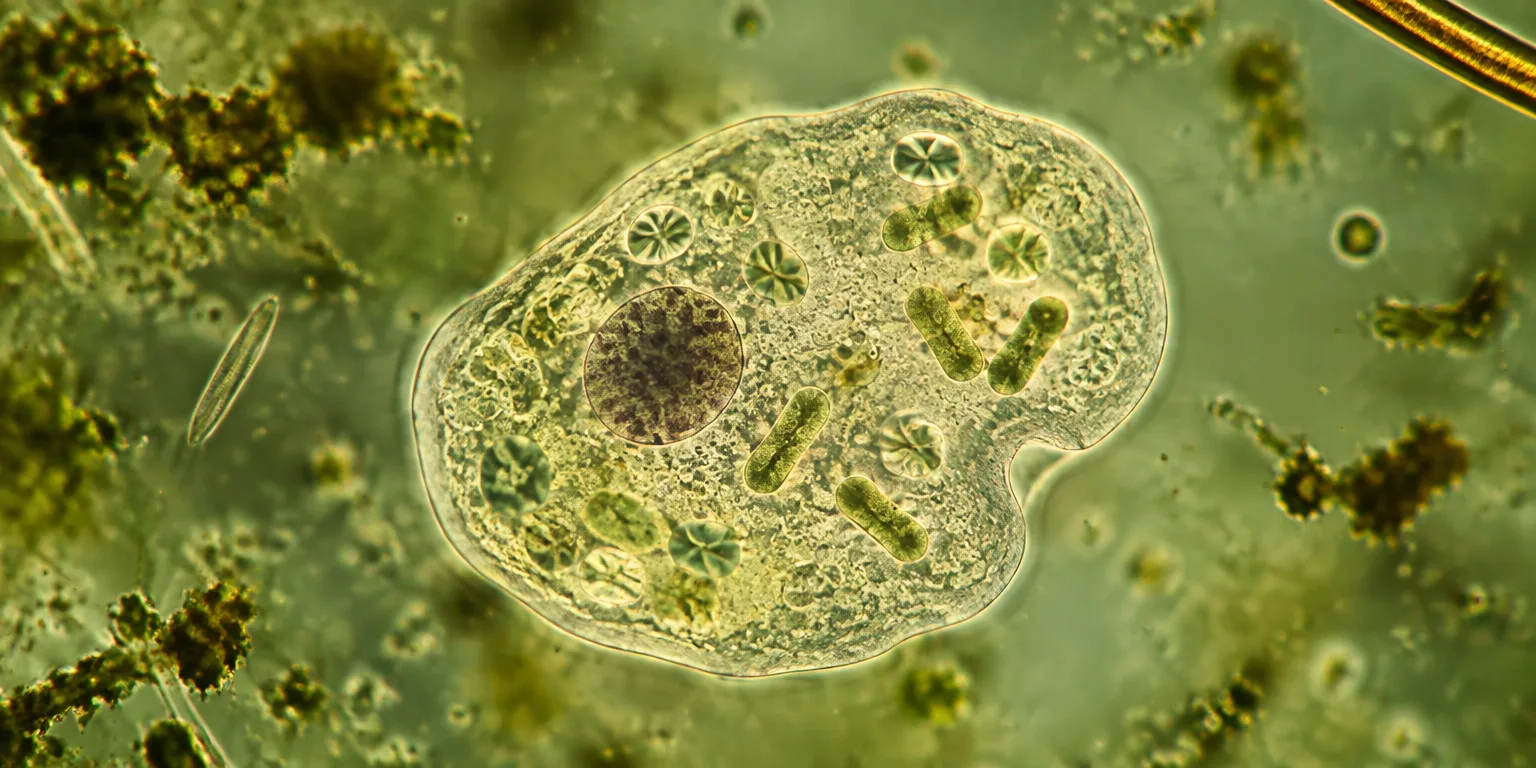
In the 1960s, American microbiologist Lynn Margulis was studying the inside of a complex cell under the microscope. It was crowded with structures, including a nucleus, the compartment that holds DNA, and many smaller bodies with different jobs, and one kind of structure caught her eye. The mitochondria, the parts that supply power, looked very much like bacteria.
The resemblance mattered because complex cells were a puzzle. All plants, fungi, and animals are built from them, and a complex cell is elaborate, with a nucleus and many inner bodies, while a bacterial cell is simple. Yet there is nothing in between, no half complex cell, and complex cells seem to appear out of nowhere.
The idea had been built up through the 1900s by different researchers, but Margulis was the one who proved it. She argued that a complex cell began when bacteria became stuck inside a bigger cell and carried on living. That idea, called endosymbiosis, meaning living together inside another cell, is now the accepted theory of how the first complex cells formed.
The trapped bacteria kept living and dividing inside the host. They specialized in making ATP, the chemical that serves as the cell's energy currency. Food enters in one form, and the cell must convert its energy into ATP before it can spend it, much as a traveler must change foreign money into local cash.
Over time the bacteria lost their independence. Mitochondria still carry their own tiny genome, a small set of genes, with only the instructions needed to make ATP. Many of their old bacterial genes moved into the host's nucleus, so the host now carries its own genes plus former mitochondrial genes.
What remained was a strict division of labor. The mitochondria handle energy capture, while the host cell handles upkeep and information processing, and neither can survive without the other. Because the mitochondria focus only on producing energy, the whole cell can capture far more energy than a simple cell could alone. The mitochondria in animals, fungi, and plants still descend from those bacteria.
Questions people ask
What exactly is ATP?
ATP stands for adenosine triphosphate. Cells break it apart to release usable energy, then rebuild it when new food energy comes in, so it works like a rechargeable battery pack.
When did this trapping happen?
It happened roughly two billion years ago, long after oxygen-producing bacteria changed the atmosphere. Scientists date it from genetic comparisons and fossils, though the exact timing is still debated.
Did this kind of capture happen more than once?
Yes. Plants and algae contain a second set of former captives called chloroplasts, descended from sun-using bacteria. They still do photosynthesis inside the plant cell, while mitochondria release that stored energy.