Dallas Could Not Make Its River Reach the Sea, So It Built a Boomtown Anyway
After Army engineers failed to connect the Trinity to the Gulf, willpower, rails, cheap homes, and a big airport brought more than 20 Fortune 500 companies.
 Wendover Productions · Why Texas Wins
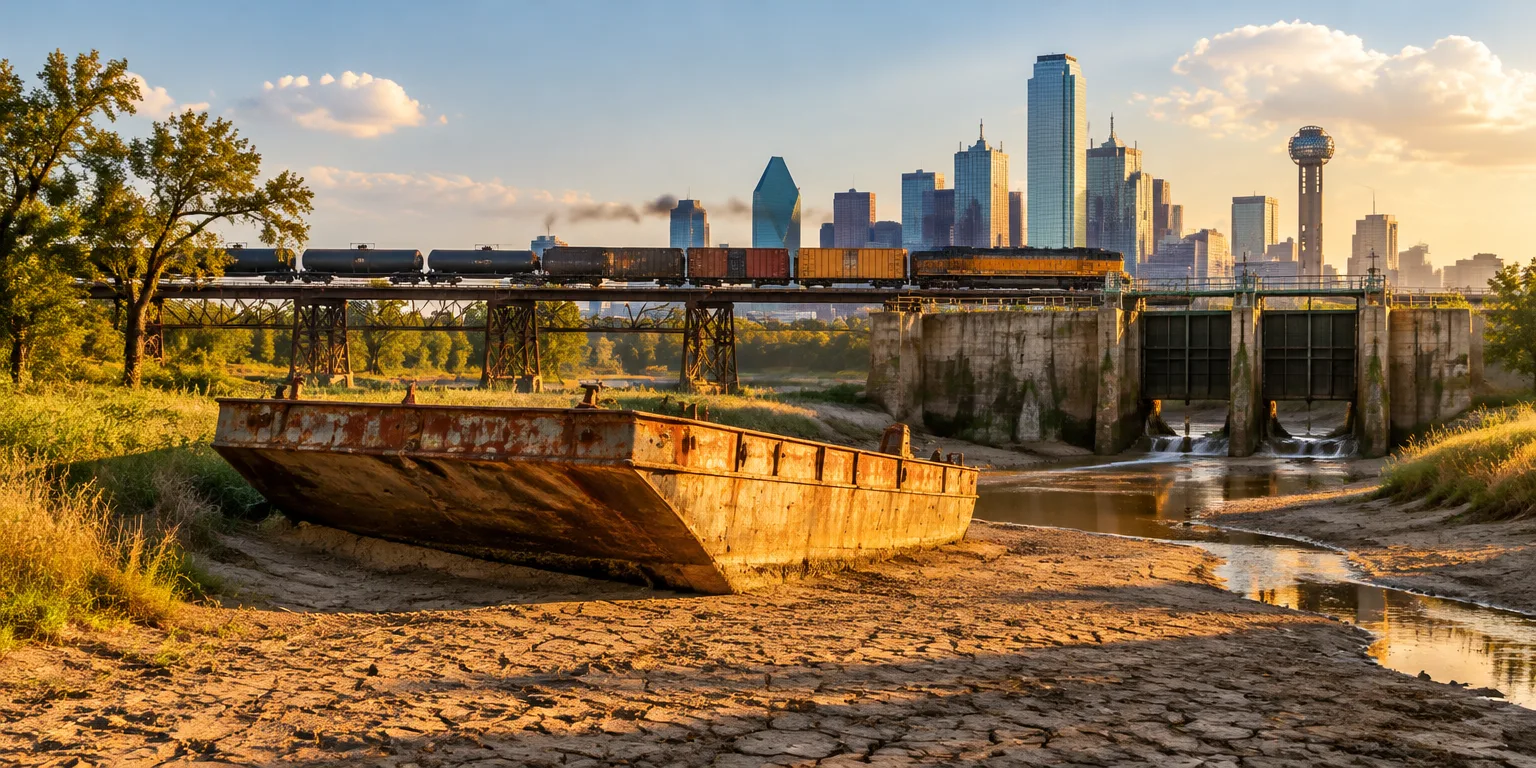
The plan in Dallas was to make a river do something it did not want to do.
The city had the Trinity River, and early promoters thought modest work could turn it into a water route from inland Dallas to the coast. The Army Corps of Engineers worked for years to make the Trinity navigable. It never worked.
That failure says a lot about Dallas, because almost everything about the place argued against building a great city there. Dallas-Fort Worth sits on a southern plain with harsh weather in every direction. Winters can bring ice storms and snow, summers stack weeks of 100 degree days with heat and humidity, and the clash of hot and cold brings tornadoes. One struck downtown Fort Worth in 2000. Unlike Houston, with its navigable Buffalo Bayou and port, the Dallas area has practically no navigable waterways, long considered almost a necessity for a major American city.
Yet Dallas-Fort Worth has passed Houston to become the fourth most populous metro area in the United States. It got there by will.
Thwarted on water, Dallas became a rail hub, then a cattle hub, and later a natural gas hub. City founders and later business leaders promoted the city relentlessly, and they gave companies other reasons to come. They built a big airport, kept operating costs low, and supplied a large, skilled, and comparatively cheap workforce by building homes at breakneck speed.
The result is a corporate capital with few natural gifts. The area now has more than 20 Fortune 500 companies, the largest American corporations by revenue, trailing only New York and Chicago. The list includes Texas Instruments, Toyota North America, Charles Schwab, Comerica, AT&T, and Caterpillar, spanning tech, finance, and heavy machinery.
More companies are still coming, and more people are coming with them, all to a city that could never make its river run to the sea.
Questions people ask
Why was lacking a navigable river such a big disadvantage?
Historically, moving heavy goods by water was far cheaper than moving them by land, so ports and navigable rivers let cities trade more cheaply and grow faster. Railroads, highways, and air freight have reduced that advantage, which helped inland places like Dallas compete. Water still matters, but it is no longer destiny.
What is wrong with the Trinity River for navigation?
The Trinity runs about 700 miles from North Texas to Galveston Bay, but it is generally shallow and its flow rises and falls sharply with rain. That made reliable barge traffic difficult without massive and costly engineering. The Corps studied and worked on navigation projects at various times, but they were never completed or sustained.
How big is Dallas-Fort Worth today?
The Dallas-Fort Worth metroplex has more than 8 million residents and includes Dallas, Fort Worth, Arlington, and suburbs such as Plano, Frisco, and Irving. It recently passed the Houston area to rank fourth among U.S. metro areas, behind New York, Los Angeles, and Chicago. Growth has been driven by jobs, relatively cheap housing, and domestic migration.