Deep-Sea Creatures Survive Crushing Pressure Because They Are Mostly Water
Without air pockets to collapse, their watery bodies barely change, with small chemical tweaks to handle the cold.
 Ologies with Alie Ward · Deep Sea Microbiology (UNSEEN OCEAN CRITTERS) with Peter Girguis
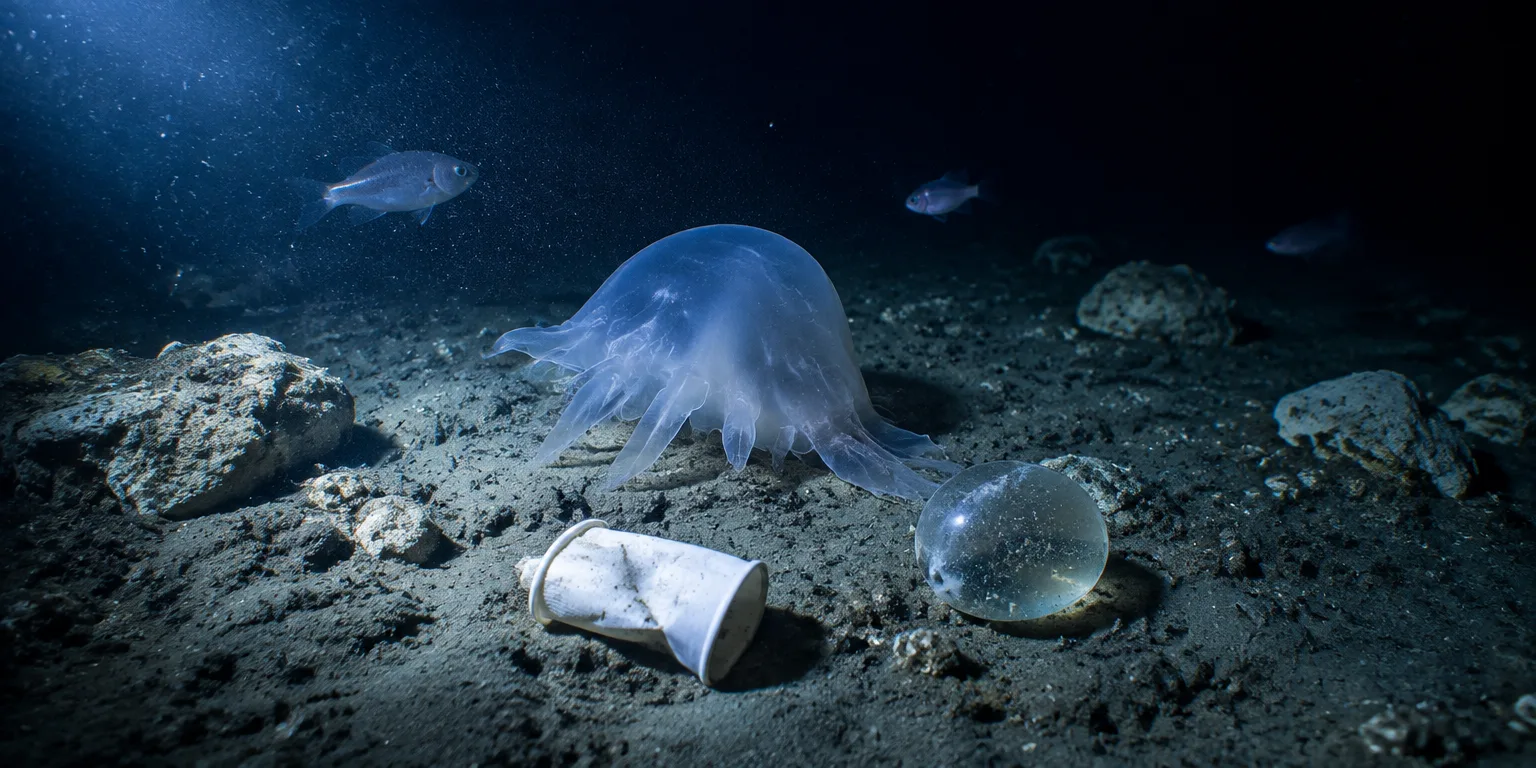
The pressure on the deep seafloor should be a death sentence. Instead, fish, worms, and microbes go about their business down there, and the reason is surprisingly simple: there is almost nothing in them to squeeze.
People are vulnerable because people are full of air. As Peter Girguis, a deep-sea microbiologist, explains it, humans are made mostly of water, plus proteins, fats, and other tissues, but they also carry air spaces in lungs, sinuses, and ears. On a scuba dive, a person can go only so far before, as Girguis says, those air spaces "cannot stand up to the pressure."
Deep-sea animals skip that problem by skipping the air. They have no internal air spaces, and the rest of them is primarily water. Water barely compresses. Girguis says it changes by "like, a percent in volume."
Girguis demonstrates the difference on dives in the Alvin submersible, the small research sub used to visit the deep seafloor. Take a foam cup, 8 or 12 ounces, outside the sub and the ride down squeezes all the air from the foam until it ends up the size of a shot glass, and stays that way. Tie a water balloon to the same sub and nothing happens, because it is already full of water.
Being water is not quite enough. Deep-sea creatures also make small chemical adjustments to their proteins, enzymes, and fats so those molecules still work under high pressure and in near freezing cold. The typical deep seafloor feels like a restaurant walk-in cold room or the inside of a refrigerator, just above freezing.
There is no frozen ice down there, even so. Because ice floats, it stays toward the top. As Girguis explains, the water found at the greatest depths "is the coldest water can get before it freezes and becomes buoyant." With bodies made mostly of water and no air to crush, deep-sea animals barely notice the squeeze.
Questions people ask
Would a person really be crushed going that deep without protection?
Yes, eventually. A scuba diver breathes compressed air, and the deeper the dive, the greater the pressure squeezing the chest, lungs, and other air spaces. Recreational divers usually stay above about 130 feet, and even technical divers with special gas mixes go only a few hundred feet, far above the thousand-foot depths where deep-sea life begins.
If animals do not need armor, why do submarines need such thick hulls?
The air inside people and crewed subs is the problem. A crewed sub carries an air-filled cabin so humans can breathe, and that air pocket would collapse under pressure. Engineers solve it with a very strong, usually titanium, personnel sphere, while the rest of the vehicle can be filled with incompressible fluids, foam, and batteries.
Do deep-sea fish have swim bladders?
Many do not, at least not in the familiar gas-filled form. Shallow-water fish often use a swim bladder, a gas sac, to control buoyancy, but that would be a liability in the deep. Many deep-living fishes have reduced the bladder, filled it with fat, or rely on watery tissues and oily livers for lift.