Deep-Sea Microbes Stay Alive by Breathing Rust
The trick is old and common, and it likely predates animals.
 Ologies with Alie Ward · Deep Sea Microbiology (UNSEEN OCEAN CRITTERS) with Peter Girguis
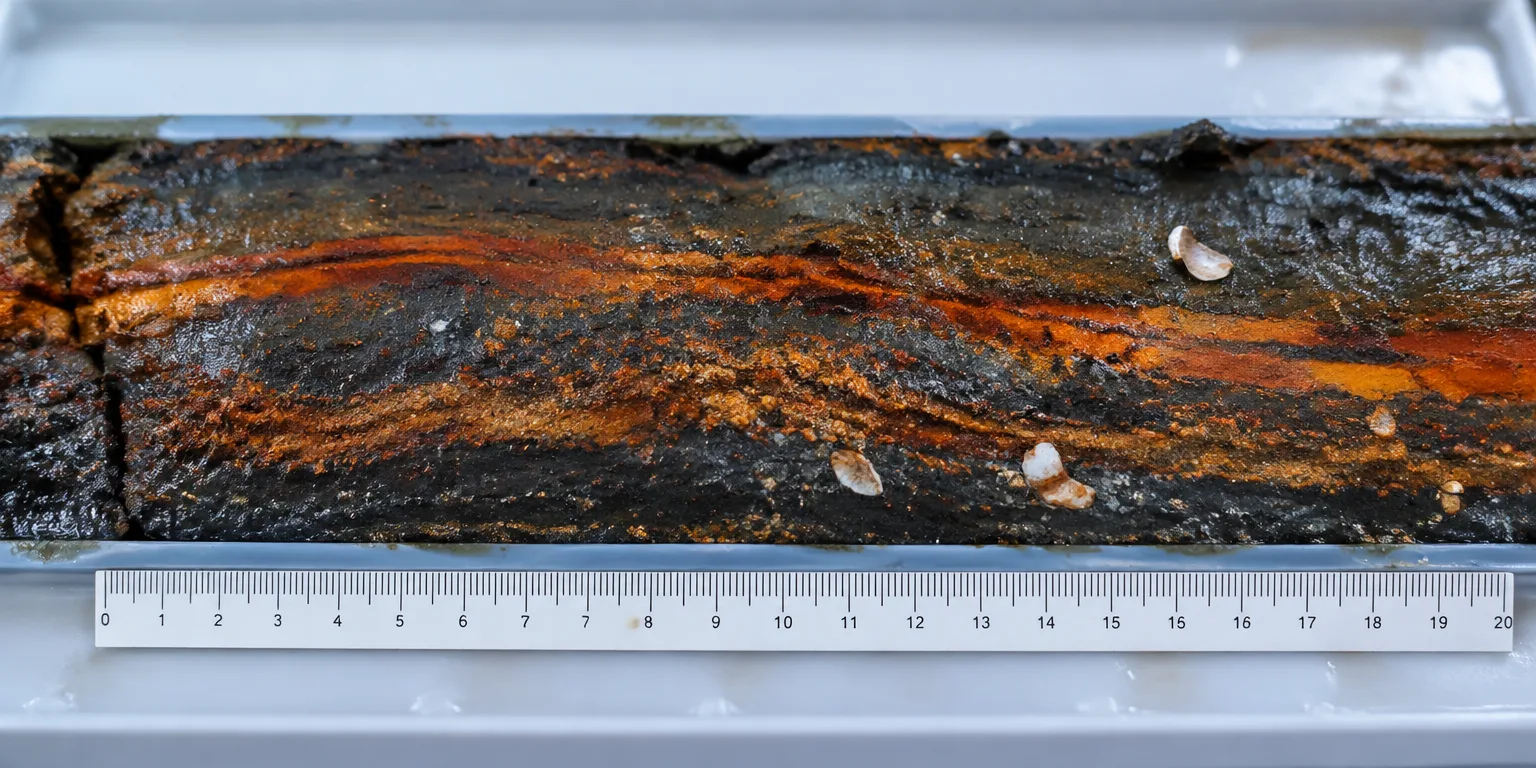
Deep under the seafloor mud, oxygen runs out completely, and life keeps eating anyway. The microbes buried there survive by breathing rust, dumping electrons from their food onto iron minerals instead of onto oxygen.
To see why that works, it helps to know what eating and breathing actually are. You take food, strip tiny charged particles called electrons from it, run those electrons through a chain of chemical reactions to power the cell, with oxygen waiting at the finish to receive them. That is what people do, and as microbiologist Peter Girguis, who studies life in the deep sea, puts it, animals are metabolically boring in this way. A person, a goldfish, a squid, and a whale all do the same basic thing: eat stuff and breathe oxygen.
The problem under the seafloor is that there is no oxygen left to catch anything. Microbes living in the mud above have already eaten much of the falling dead matter and used up the oxygen doing it. So deeper microbes still eat the leftover organic matter, the remains of fish waste and other animals, but they need another catcher.
Their solution is rust, literally iron oxides. They press themselves against a particle of rust and dump the electrons onto it. Scientists call this extracellular electron transfer, meaning transfer of electrons outside the cell.
Work by Girguis with former student Izzy Baker, now a professor at the University of North Carolina, and colleague Jeff Gralnick at the University of Minnesota, found that, in Girguis's words, "a surprisingly large number of different kinds of microbes" can do it. That makes sense, Girguis says, because there is still a lot of room on Earth with no oxygen but plenty of metal minerals, and there was a time in Earth's past with microbes and no oxygen at all. The rust breathers were probably at it long before anything that looked like humans existed.
The microbes' range of ways to make energy is easier to see once you know the three big groups of life. Life falls into three broad groups: archaea (microscopic cells, possibly our ancestors), bacteria, and eukarya (cells with a nucleus, which include us and many other microscopic single cells). We animals build complicated bodies with feet, tusks, hair, and fingers, but bacteria and archaea, usually only one to 10 microns across, have a far wider menu for making energy, including what Girguis called "microbes that can make a living off of eating radioactive materials."
Questions people ask
Do rust-breathing microbes damage ships or pipes?
Yes. The same ability to dump electrons onto iron and other metals lets some microbes corrode steel pipes, ship hulls, and oil infrastructure, which costs industries billions of dollars a year. Researchers study them both to prevent damage and to understand how metal cycles through the environment.
Can we use them to make batteries?
Researchers are trying. Because these microbes naturally move electrons onto and off of solid minerals, they can generate weak electric currents in devices called microbial fuel cells. The power is still tiny compared with a conventional battery, so the main interest is in low-power sensors in remote places like the seafloor.
Where does rust come from at the bottom of the ocean?
As general background, not something Girguis said in the episode, iron reaches the seafloor from land, from dust, and from underwater vents, and it gets buried in the mud. In deeper layers where oxygen is gone, Girguis says that iron is present as rust, or iron oxides. Those mineral surfaces are what the buried microbes can use to breathe.