Digging Up Barcelona's Olympic Stadium Saved Its Great Church
After quarrying pressed close to homes and the hill became a park, the unfinished basilica found 1,000 cubic meters of matching stone under a sports field.
 Real Engineering · Why Sagrada Familia Took 144 Years to Complete
Crews remodeling the old Olympic stadium for the 1992 Summer Olympics needed more seats. To get them, they dug down and lowered the stadium's field to expand spectator capacity.
Out of that hole came rock needed by another Barcelona landmark. The stadium sits in the middle of the protected city park on Montjuïc, which means Jewish mountain in Catalan, and the 1,000 cubic meters pulled from the excavation were Montjuïc sandstone, the same tan stone that gives the Sagrada Família its color.
Since Roman times, the mountain beside the harbor had been Barcelona's main quarry. Its stone was exported across the Roman Empire. Its sandstone, rich in quartz and holds up better than most sedimentary rocks, went into churches including Santa Maria del Mar and the Barcelona Cathedral, the hilltop fort, and the everyday houses that make the stone a familiar sight across the city.
The shortage was visible up close. From a distance, the tan basilica seems to rise straight from the earth beneath it. Up close, the towers on the eastern front show dusty browns, charcoal grays, tanned oranges, and hints of purple, and they are built from smaller bricks, a sign that big blocks were running out.
As good stone grew harder to find, quarrying pressed uncomfortably close to the neighborhoods below. In 1957 the city turned the hill into a protected park for residents. With no suitable replacement, builders were left with leftover piles or stone salvaged from other Catalan buildings, and carvers soon ran out of work.
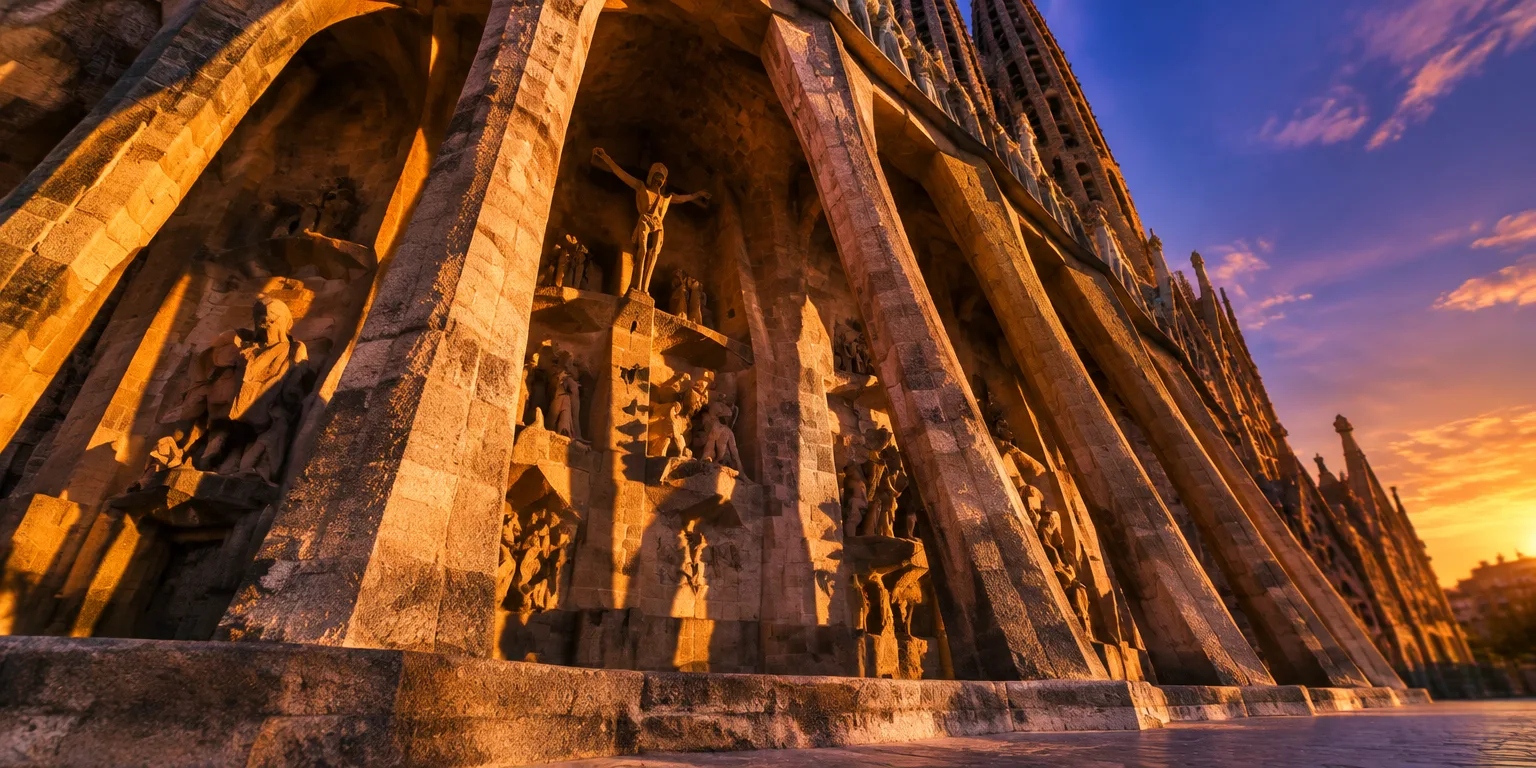
The stadium stone was a lifeline that let the Passion facade be built, the church's west-facing front depicting the torment of the crucifixion. The facade is held up by six skeletal, angled columns that needed the highest quality stone. They face west toward sunset, throwing long evening shadows over the front's sheltered wall, where light and shadow bring the carvings to life.
Questions people ask
What makes Montjuïc sandstone special as a building stone?
Montjuïc is a broad hill overlooking Barcelona's harbor and old city. Its sandstone formed from ancient sediments cemented together, with a high quartz content that made it harder and more weather resistant than many similar stones, which is why Romans and later builders prized it.
What is the Passion facade?
The Sagrada Família has three grand fronts, each telling part of the story of Jesus. The Nativity facade on the east faces the sunrise and celebrates birth, while the Passion facade on the west faces the sunset and portrays suffering and death with stark, bony forms.