Don't Ask an AI to Grade Your AI
An Inngest co-founder says watch what users do next instead, because it is cheaper and can cover every run.
 The Peel with Turner Novak · The Hidden Layer Every AI Agent Runs On
Tony, a co-founder of the software company Inngest, thinks asking an artificial intelligence model to grade an AI agent is crazy. "You're asking the criminal, did they commit the crime?" he said.
What he means starts with how testing works now. Teams run checks on about 100 examples on their own computers, push a new prompt into production, and hope.
Most people do not test their agents in production at all, he said. If they do, they grade only a sample of runs, either with an AI judge or with people reading transcripts.
Having a judge read every run is slow and costly. The judge must be fed the entire history, which can stretch to 10 helper agents and 100 steps and uses a huge number of tokens, the units of text that models charge for. He said he has never met anyone who checks 100% of runs that way.
His alternative is to watch cheap product signals instead. Those are simple events that companies have logged for decades, like what a customer did after talking to the agent.
His example was a medical chat service. The AI answers a patient, and the patient either books an appointment or does not. A booking is a cheap signal that the answer may have helped, and it costs almost nothing to record.
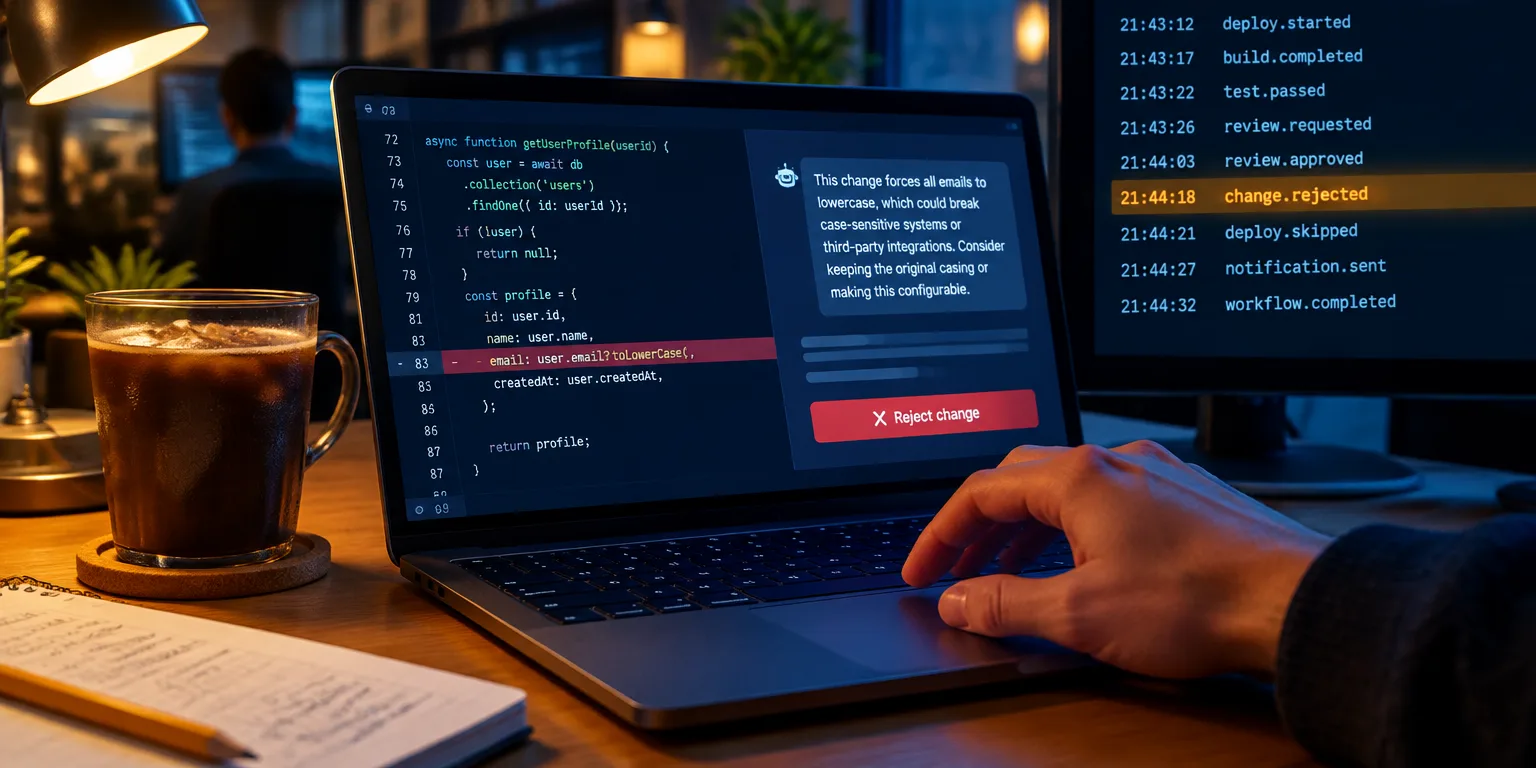
He does not say to abandon AI judges entirely. In his system, the product signal decides when to call one in. If a code review agent writes comments and the proposed change is later rejected, that rejection can trigger a detailed AI review of just that case. That way, he argues, you can score every run without paying to judge every run.
Questions people ask
What exactly is LLM-as-a-judge?
It is when one AI model reads the chat history and work of another agent and scores whether it did well. Tony describes those checks as unit tests over input, asking whether it gave the right output. The problem he points to is cost, because grading requires feeding the whole history into another model, which uses many tokens and is slow.
What counts as a product signal?
Any action a user or system takes after the AI acts, such as booking, buying, copying an answer, merging code, or rejecting it. Companies already log these events to run their products and measure sales or engagement. Tony's point is that they are nearly free to reuse as grades for the AI.
If product signals are so good, why keep the AI judge at all?
A signal tells you something went wrong, but not why. A rejected change, for example, does not say whether the AI comment was wrong or simply ignored. In that setup, the cheap signal picks the interesting cases, and the expensive judge is used sparingly to explain them.