Egypt Beat the Sea Peoples, and Still Fell Apart
Pharaoh Ramses III, with a poor reputation as a sailor, hid archers and spearmen in the delta reeds and won a battle that still could not save the economy.
 Fall of Civilizations · 2. The Bronze Age Collapse - Mediterranean Apocalypse
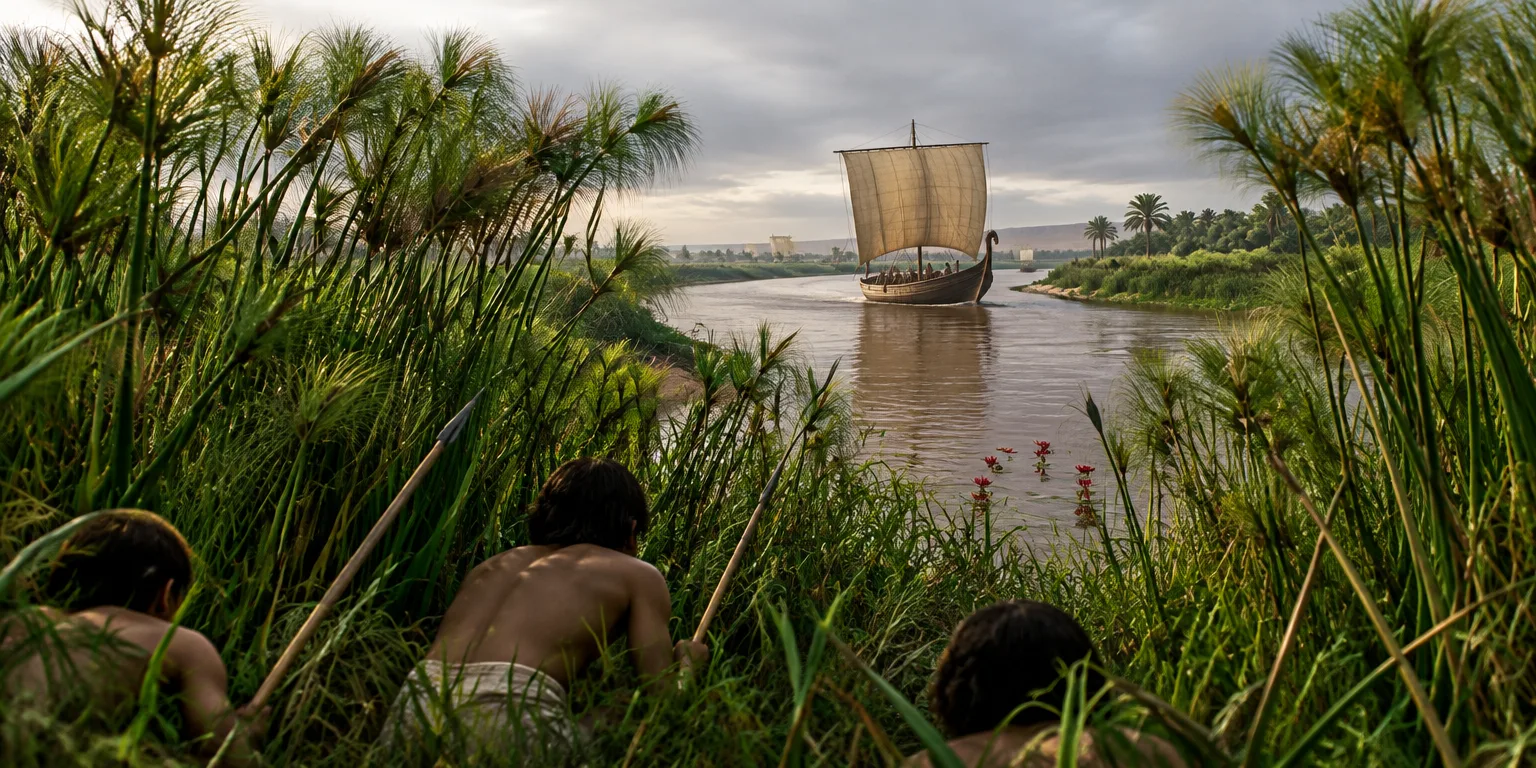
Thousands of Egyptian spearmen crouched in the papyrus reeds, holding their breath. On the banks above them, archers waited with arrows ready. Around a bend in the green, silt banked Nile Delta, the first enemy sail appeared, then another, and another, until the river filled with the invaders known as the Sea Peoples.
Pharaoh Ramses III of Egypt had been on the throne for eight years when word reached him that great powers around him were being destroyed entirely. He resolved that Egypt would not share their fate. That decision led to the ambush in the delta, the battle that stopped the invaders, and the reason Egypt survived when its neighbors did not.
Ramses had a problem. Egypt was a land power that dominated open battlefields with massed archers and swift, horse drawn chariots, but Egypt was regarded as weak at sea and left fighting on water to smaller nations. Members of the Sea Peoples tribes had even served in Egyptian armies, and they may have known this weakness. They seem to have planned to neutralize Egypt by sailing straight at its lifeblood, the Nile River, where all of Egypt's major cities stood. If resistance broke on the river, the cities would be taken in succession.
He chose ground that favored his men. The Nile Delta, where the river splits into branches before reaching the Mediterranean Sea, was a green land in rolling desert where red lotuses bloomed in autumn, and where crocodiles and hippopotamuses still ranged wild. As the enemy ships massed outside the delta, Ramses placed bowmen along the banks, backed by thousands of spearmen concealed in the reeds.
When the ships came within range, he unleashed a steady rain of arrows toward the fleet. When the panicked crews tried to land, Egyptian lancers surged from the reeds to meet them on the shore. Held at bay on the water, trapped and frantic, the Sea Peoples were then hit again as Egypt's small navy sailed in, using grappling hooks to haul in enemy ships. Men were impaled on spears, boats overturned, and bodies drifted face down in the churning river. A carving at Medinet Habu, the pharaoh's temple, describes the result: "They were dragged in, enclosed and frustrated on the beach, killed and made into heaps from head to tail." Egypt became the first people known to have turned back the seagoing invaders.
Victory did not save the empire. With vast and ancient societies around it collapsed utterly, the trade routes that sustained the region were broken. Egypt stood alone, able to fight off attackers at its borders, but its treasury emptied so far that it never fully recovered its imperial power, and the triumph in the delta gave way to a steep and lasting economic decline.
Questions people ask
Who were the Sea Peoples?
The Sea Peoples were a group of seaborne raiders who attacked cities around the eastern Mediterranean around 1200 B.C. Egyptian records list groups with names like the Peleset, Sherden, and Shekelesh, but scholars still debate where they came from, with theories pointing to Sicily, Sardinia, the Aegean, and Anatolia.
What is Medinet Habu?
Medinet Habu is Ramses III's large temple complex on the west bank of the Nile near modern Luxor. Its walls carry long inscriptions and large carved scenes that are our main Egyptian source for the land and sea battles against the Sea Peoples.
If Egypt won, why did it still decline?
Egypt kept its cities and its independence, unlike many neighbors that were destroyed and abandoned. But cut off from trade, its treasury emptied, food supplies faltered, and royal tomb builders staged the first recorded workers strike when rations failed. Within decades Egypt lost its empire and entered a long decline.