Egypt's Best-Preserved City Survived Because Everyone Abandoned It
A pharaoh moved 30,000 to 50,000 people to a remote site short of water to break with the past, and early records never mentioned him.
 The Ancients · Egypt's Lost Cities
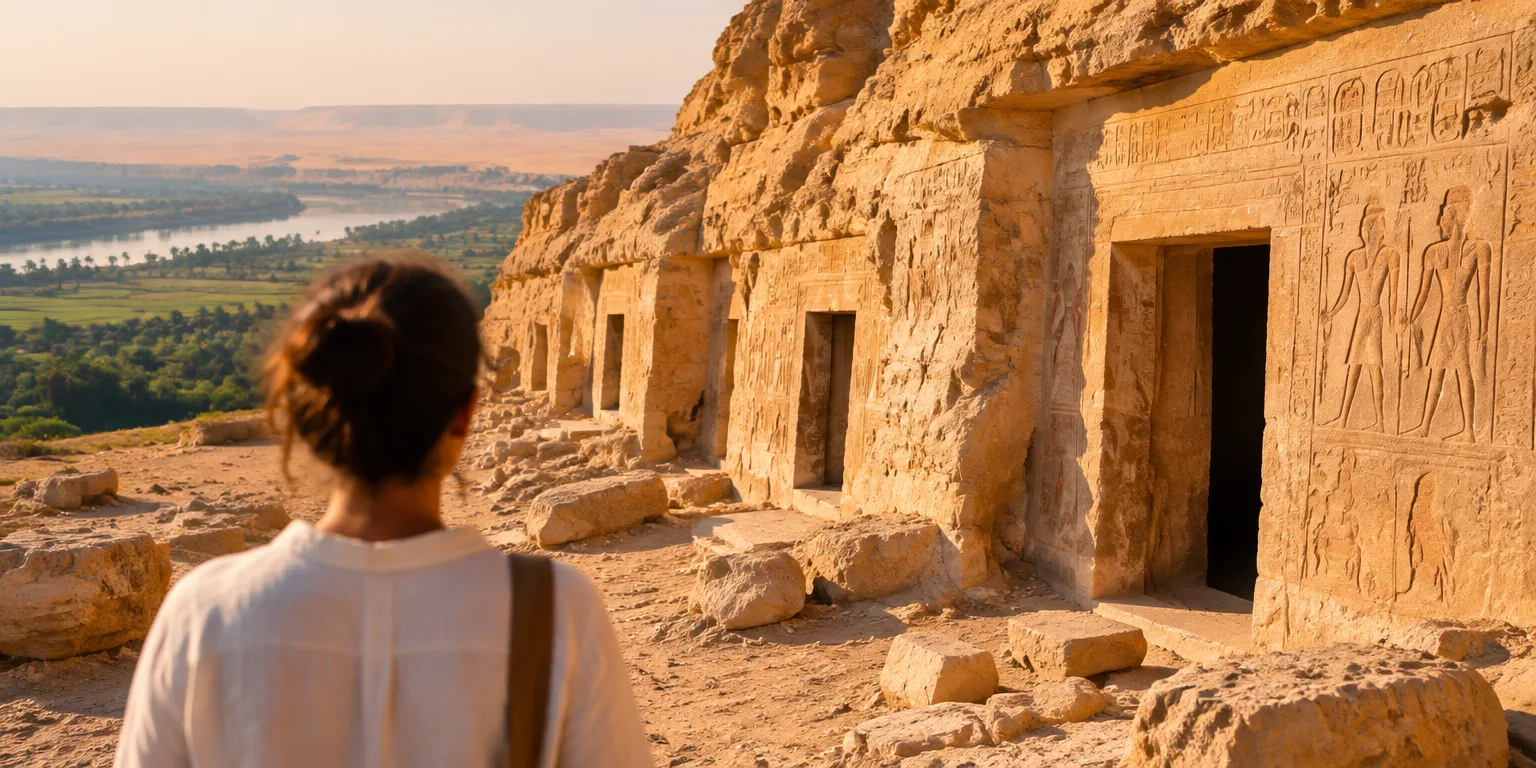
In the 1820s, John Gardner Wilkinson, an early English scholar of ancient Egypt, was guided to a line of rock-cut tombs on the eastern edge of some ruins in Middle Egypt. The walls were covered in hieroglyphs, the picture writing of ancient Egypt, so the tombs were clearly ancient. But the artwork looked strikingly unfamiliar, and the scenes inside were very unusual.
The central figure looked like a pharaoh, a king of ancient Egypt, yet no royal name appeared with him. Egyptologist Chris Naunton says Wilkinson could see the scenes centered on a kingly figure with no name attached, and only in a few spots where the carving happened to survive could the name be made out. It was Akhenaten.
That name unlocked the story behind Amarna, the short-lived capital that is now the best place to study an ancient Egyptian city. Akhenaten, who ruled there with his wife Nefertiti for roughly a decade, moved 30,000 to 50,000 people to the new city. Every history available to early scholars was silent about him, his city, and that mass move.
He deliberately sought a remote, untouched site for a clean break with the past. It sat on the Nile in Middle Egypt but far from the main religious centers, far from the roads north toward the delta and distant lands, and poorly supplied with resources and even water. The location was a poor choice for a capital, isolated and short of supplies.
Early travelers had walked through without understanding it. One of its monuments appeared in the drawings of an early French visitor named Sicard. A Napoleonic expedition around 1800 noted some archaeology there and roughly sketched where the ruins lay and a road through the center, now known as the Royal Road.
What archaeologists later found was a capital built in one go. Inscriptions say Akhenaten planned to build a complete city at once, and digging shows he did. There were houses for every social class from the smallest to royal palaces, plus temples, offices, craftsmen's workshops, roads laid out over the desert, and cemeteries including a royal one.
Then, soon after Akhenaten died, the city was abandoned. He came to be seen as a heretic and his project as forbidden, so the place was left empty and people stayed away for good.
Most ancient sites have many layers from different eras that must be untangled. Amarna was lived in during just one brief span, and because it was left alone, it survived incredibly well as the best-preserved single-phase site for studying an ancient Egyptian city.
Questions people ask
What did Akhenaten believe that made him a heretic?
Akhenaten elevated the sun disk, the Aten, above Egypt's traditional gods and especially challenged Amun, whose priests were powerful at Thebes. He closed many temples, moved religious life to his new city, and had older gods chiseled off monuments. After his death, his successor Tutankhamun restored the old gods, and Akhenaten was denounced as a heretic.
Why does a city occupied only once help archaeologists so much?
Most ancient towns were lived in for centuries, with houses knocked down, rebuilt, and built over, mixing walls, trash, and floors from different times. At Amarna, almost everything dates to about a decade, so archaeologists can map who lived where, worked where, and worshiped where at the same moment. That makes it unusually easy to reconstruct daily life.
Can you visit Amarna today?
Yes. Amarna is an open archaeological site on the east and west banks of the Nile in Middle Egypt, south of Cairo. Visitors can see house foundations, palace floors, temple outlines, the Royal Road, boundary stones, and the tombs in the eastern cliffs where Wilkinson first spotted the mystery.