Egypt Washed Through Israel's Sand Wall Instead of Blowing It Up
After a huge artillery barrage and an infantry crossing in small boats, engineers built pontoon bridges for tanks and more than 200,000 troops and washed gaps through sand embankments.
 nationalinterest.org · Israel Nearly Went Nuclear to Win the 1973 Yom Kippur War
Israel's defense along the Suez Canal, called the Bar Lev Line, did not rely only on concrete outposts. Israeli engineers had also piled up huge sand embankments along the water to block tanks and troops trying to come across.
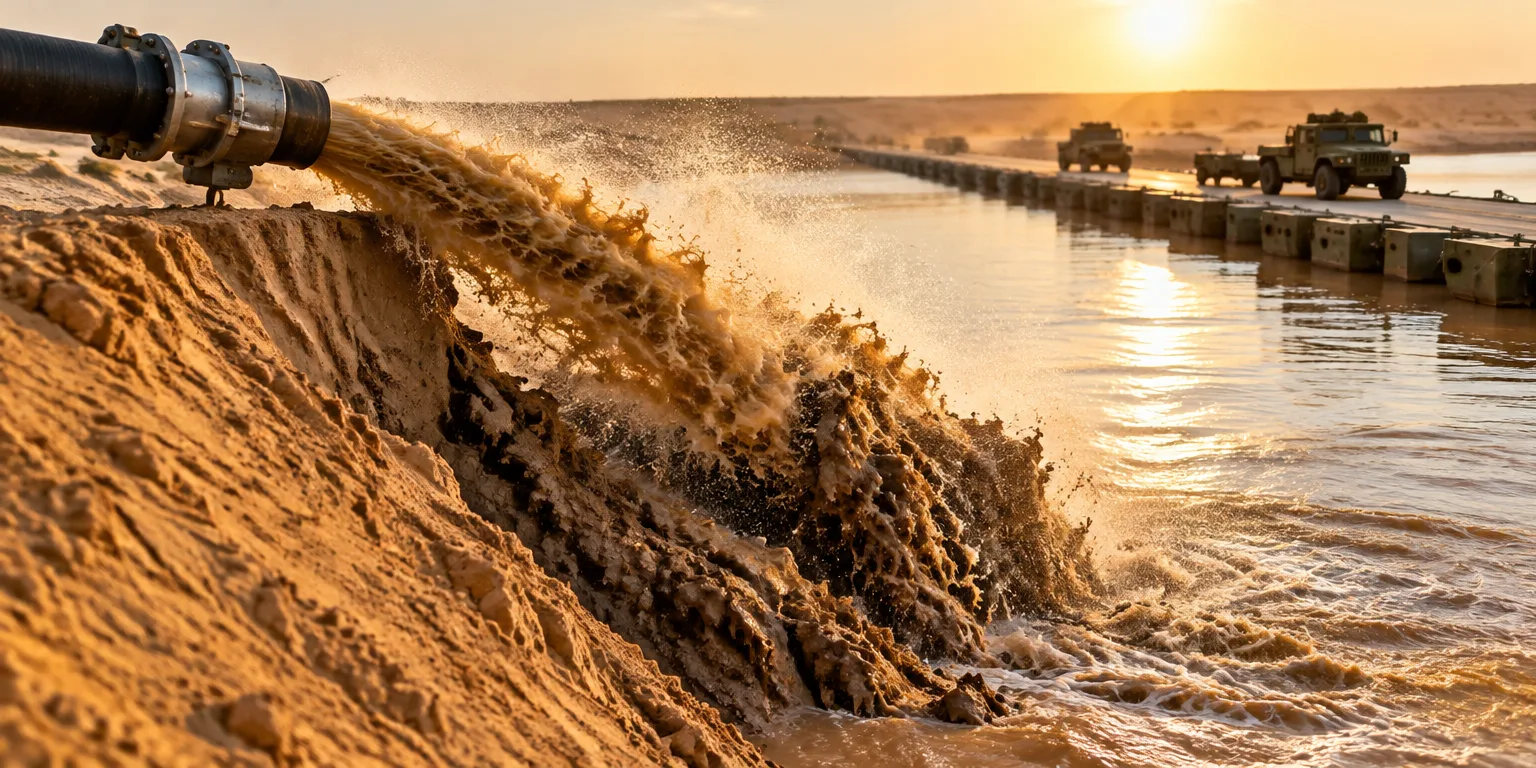
Egypt treated that wall as what it was: loose sand. Moving water carries sand grains away, and a soaked pile of sand falls apart.
At 8 in the morning on Oct. 6, Prime Minister Golda Meir weighed striking first and held back. About six hours later, more than 2,000 Egyptian howitzers, mortars, and rocket launchers opened a barrage on the Bar Lev Line, while 200 MiG and Sukhoi jets flew over to hit airbases, artillery, and command posts.
Under that cover, about four thousand Egyptian foot soldiers made the initial crossing in inflatable boats in an operation called Badr. Other forces widened the opening. Tanks and carriers built to float crossed the Greater Bitter Lake, helicopters carried Sa'iqa commandos, an Egyptian commando unit, past the front to delay counterattacks, and foot soldiers cleared concrete posts with flamethrowers and shoulder-fired rockets.
Once infantry held the far bank, engineers started building floating pontoon bridges for tanks and the first of more than 200,000 troops. Engineers also rafted special pumps across the canal and blasted paths through the embankments with water.
By 6 p.m., Egypt had secured a bridgehead two miles deep. After the crossing, the washed paths through the sand gave the army behind it a way forward.
Questions people ask
What is a pontoon bridge?
A pontoon bridge is a floating roadway held up by boats or hollow metal sections linked together. Armies use them when there is no permanent bridge, or when the permanent bridge has been destroyed, because they can be assembled quickly and then taken apart.
Why does blasting sand with water work so well?
Water erosion works because a strong jet loosens sand grains and carries them away, and a steep pile of loose sand cannot hold together once it is soaked and cut. That makes it much faster than digging or bulldozing, especially under fire, and it avoids the need to haul heavy earth-moving machines across the water first.
Why did Israel not strike first if it knew an attack was coming?
Israel knew an attack was being prepared, including through a secret in-person warning from King Hussein of Jordan. Henry Kissinger, the U.S. Secretary of State, warned Israel not to start hostilities or risk losing American support, and Prime Minister Golda Meir decided against a preemptive strike.