Epic's First Geothermal Field Overheated Until It Drilled Thousands More Holes
To fix it, engineers added thousands of boreholes, pond and quarry loops, and a water-only design that must be managed five years ahead.
 Inside Climate News · One of the World’s Largest Geothermal Networks Is Buried Beneath a Corporate Campus in Rural Wisconsin
Scott Brabender was driving across the headquarters of Epic Systems, an electronic health records company, when he rolled past an oversize toy soldier posed as if guiding haul trucks through an intersection. Brabender, an engineer with the firm Salas O'Brien, is quiet and soft spoken, wearing dark framed spectacles and light stubble, and he has become a fixture here.
He first helped sketch out Epic's underground heating and cooling network for about two years beginning in 2012. After taking on different assignments for a few years, he came back to the campus in about 2017. Epic told him he would be posted there "indefinitely" to keep expanding the system. Eight years later, he is still there. "We had a lot of work and it just never stopped," he said.
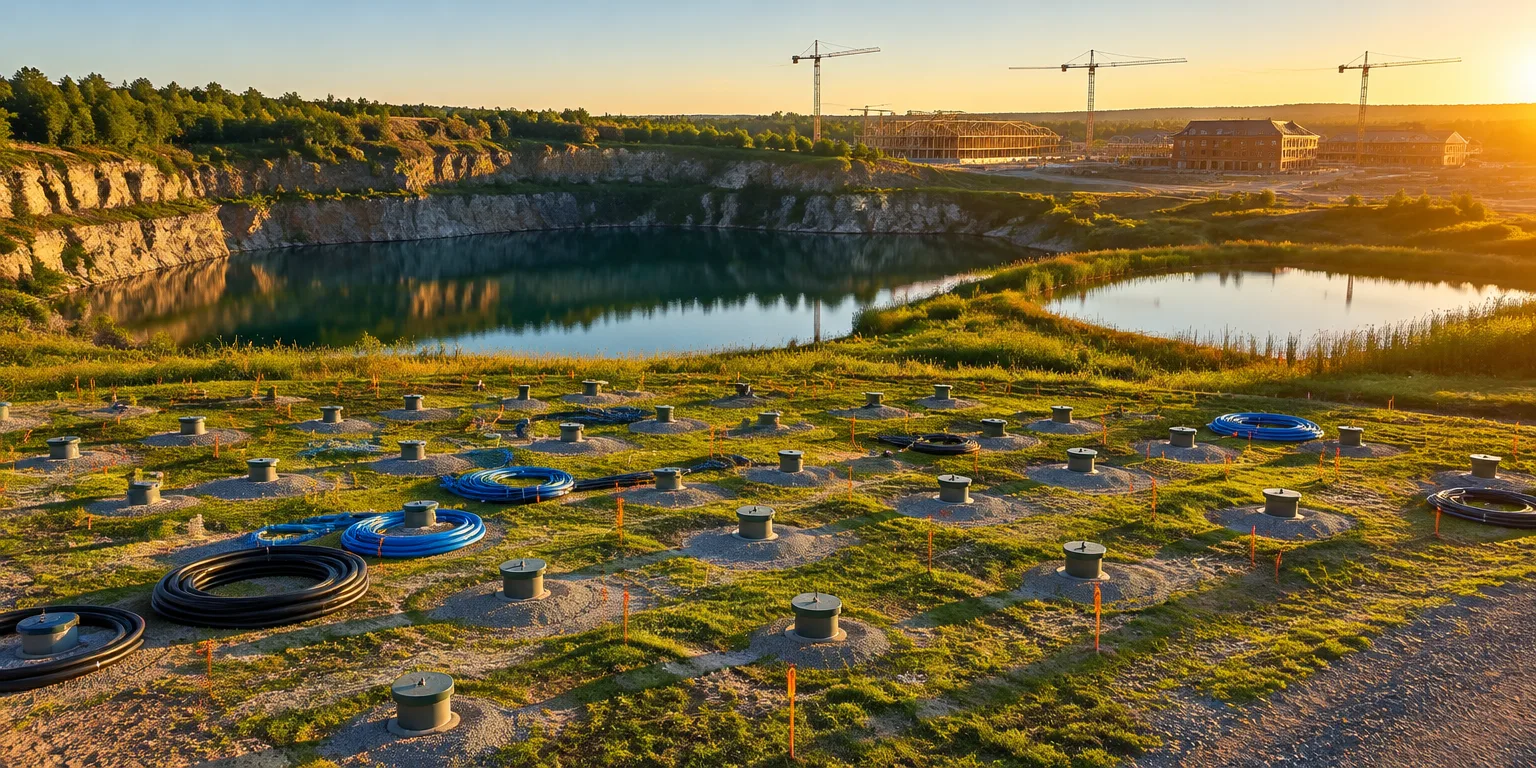
The work that kept him there is the company's underground heating and cooling system. Epic pumps water through deep holes to trade heat with the surrounding rock, but its first set of holes was too small for a fast growing campus. The undersized field overheated, and efficiency fell until Epic drilled thousands more holes.
That first network was too small to absorb all the heat added in summer, so the nearby rock and sediment overheated and the system worked less well. Some of that heat came from a data center at the headquarters, which the field must cool. The network pulls warmth from the data center, then reuses much of it to heat offices, supply hot water for dining areas, and melt snow from sidewalks.
"It was just growing pains," said James Tinjum of the University of Wisconsin. "That campus was quickly growing, and the first field just couldn't keep up with that capacity."
The fix was to add capacity. In later years, the company drilled thousands of extra holes to soak up more heat. It laid pipes beneath a stormwater pond and added extra pipe loops beneath a water-filled quarry to release surplus warmth when needed.
Derek Schnabel of Epic cautioned that such a system may not be for everyone. "In the absence of having advanced engineering staff, I've seen them gone awry," he said. "It's a newer technology that takes a little bit more investment in time and understanding to get it right."
Epic uses only water in its pipes, rather than the water and antifreeze mix most systems use. Water carries heat more efficiently, but it can freeze, so conditions have to be watched closely.
To keep the field from getting too hot or too cold, Brabender projects heating and cooling demand up to five years out. As he drove, several cranes rose over a former farm field where workers were building "Other Worlds," the latest storybook themed campus. There is more building to heat and cool, and more drilling to do. "For right now," Brabender said, "I think [my assignment] is still indefinite."
Questions people ask
Why would warming the rock make the system less efficient?
A geothermal field works because the ground stays near a steady temperature. In summer, warm water from buildings needs cooler rock to dump heat into. If the rock itself gets warm after taking too much heat, the temperature difference shrinks and heat moves less easily, so equipment works harder.
Why use only water instead of adding antifreeze like glycol?
Plain water carries heat better than a glycol mix and takes less pumping energy, which raises efficiency. The tradeoff is that it can freeze in cold weather and burst pipes or block flow. Epic manages that risk by carefully modeling heating and cooling demand years in advance.
What are the pond and quarry loops for?
They are extra places to release surplus heat that buildings do not need. Pipes at the bottom of a stormwater pond and a flooded quarry let warm water cool against a large body of water and rock. It wastes some heat, but uses little energy and no extra water compared with conventional cooling.