Even Thick Liquids Can Crack When Bubbles Make Breaking Cheaper
A Drexel lab found a thick oil snapped like glass, and researchers propose bubbles may explain why opening a void can cost less than holding together.
 Quanta Magazine · We Know Simple Fluids Can Flow. Turns Out, Some Can Fracture.
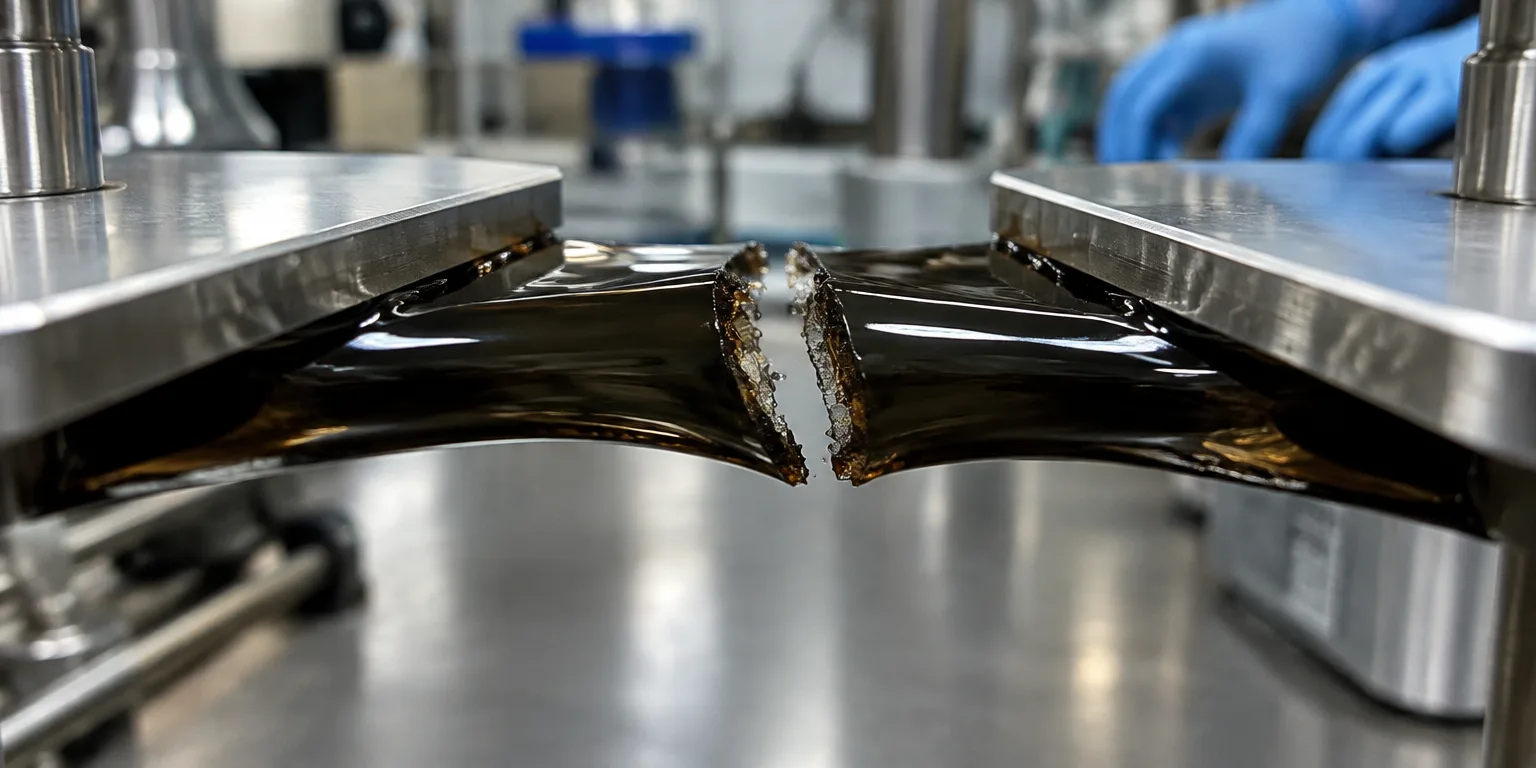
In a lab at Drexel University, Thamires Lima, a Drexel research professor in chemical engineering, was stretching a thick, dark blend of hydrogen and carbon between metal plates when a brief snapping sound startled her. She first thought the machine had broken. The fluid itself had snapped apart instead of flowing.
Nicolas J. Alvarez, a Drexel professor of chemical engineering whose lab led the research, said Lima measured the material again and again and it broke on each test with a sharp popping sound. High speed cameras showed the break resembled a brittle fracture, the kind seen when a glass dish shatters on the floor.
Brittle solids deform a very tiny amount under stress and spring back if not pushed past the breaking point. In most cases, such a solid holds a teeny defect, a crack tens of nanometers wide. Once stressed past a critical point, growing that crack becomes energetically cheaper than storing more stress, so the crack grows catastrophically and the solid breaks apart.
That is what made the Drexel result so puzzling. The hydrocarbon blend was a simple, nonelastic fluid with almost no ability to store elastic energy. Pulled or pushed, its molecules should simply rearrange and flow. “If there is no elasticity in a problem, then how can you think about initiation or growth of a crack?” said Brato Chakrabarti, a physicist in Bengaluru, India, who studies fluid motion.
A simple liquid has another way to relieve stress, called cavitation, the formation of tiny voids or bubbles between molecules. When propeller blades spin rapidly in a liquid, fluid moves much faster on one side of a blade than on the other, so pressure drops on the fast side and bubbles open there, and when those voids snap shut they unleash powerful pulses that can scar blades and pumping equipment.
Daniel D. Joseph, an engineering researcher at Minnesota, predicted in papers in 1995 and 1998 that such cavitation would allow even simple fluids to fracture under enough tearing stress. Alvarez and colleagues are testing the hypothesis that pulling molecules far enough apart opens a bubble that acts like the flaw in glass, so cracking becomes cheaper than holding the stress. On that account, Alvarez suggests, the breaking point may be set not by elasticity but by cohesive energy, the stickiness that holds molecules together.
Once that break starts, it runs fast precisely because there is nothing elastic to absorb energy and slow it. In melted polystyrene, cracks spread at about 0.07 meters per second with a shape the researchers describe as the “horn of a trumpet.” In the simple liquids, the researchers measured 500 to 1,500 meters per second, with breaks that looked like cracks moving through glass.
Questions people ask
What exactly is cavitation, and where else does it show up?
Cavitation is the opening of vapor or near empty bubbles when pressure in a liquid falls very low. Boat propellers, pumps, and snapping shrimp claws can trigger it, and the harm comes later when surrounding liquid slams the bubbles shut. That collapse focuses energy into tiny jets and shock waves.
What does elasticity mean in a liquid?
In a liquid, elasticity means deformed structure briefly pulls back before it relaxes and flows. Melted plastics and dough have a lot of it because their long molecules tangle. Simple oils and water have very little, because their small molecules slide and rearrange almost immediately.
Why don't we see water crack in everyday life?
Pouring, stirring, and sipping let molecules rearrange and flow, which is far cheaper than opening a void. To snap water you would need an extremely fast, strong stretch that builds tearing stress faster than the liquid can relax.