Fruit and Soda Share the Same Sugar, but Fruit Comes With Fiber
Fiber keeps much of fruit's fructose from reaching your bloodstream and feeds your gut bacteria instead.
 Andrew Huberman · How Sugar & Processed Foods Impact Your Health | Dr. Robert Lustig
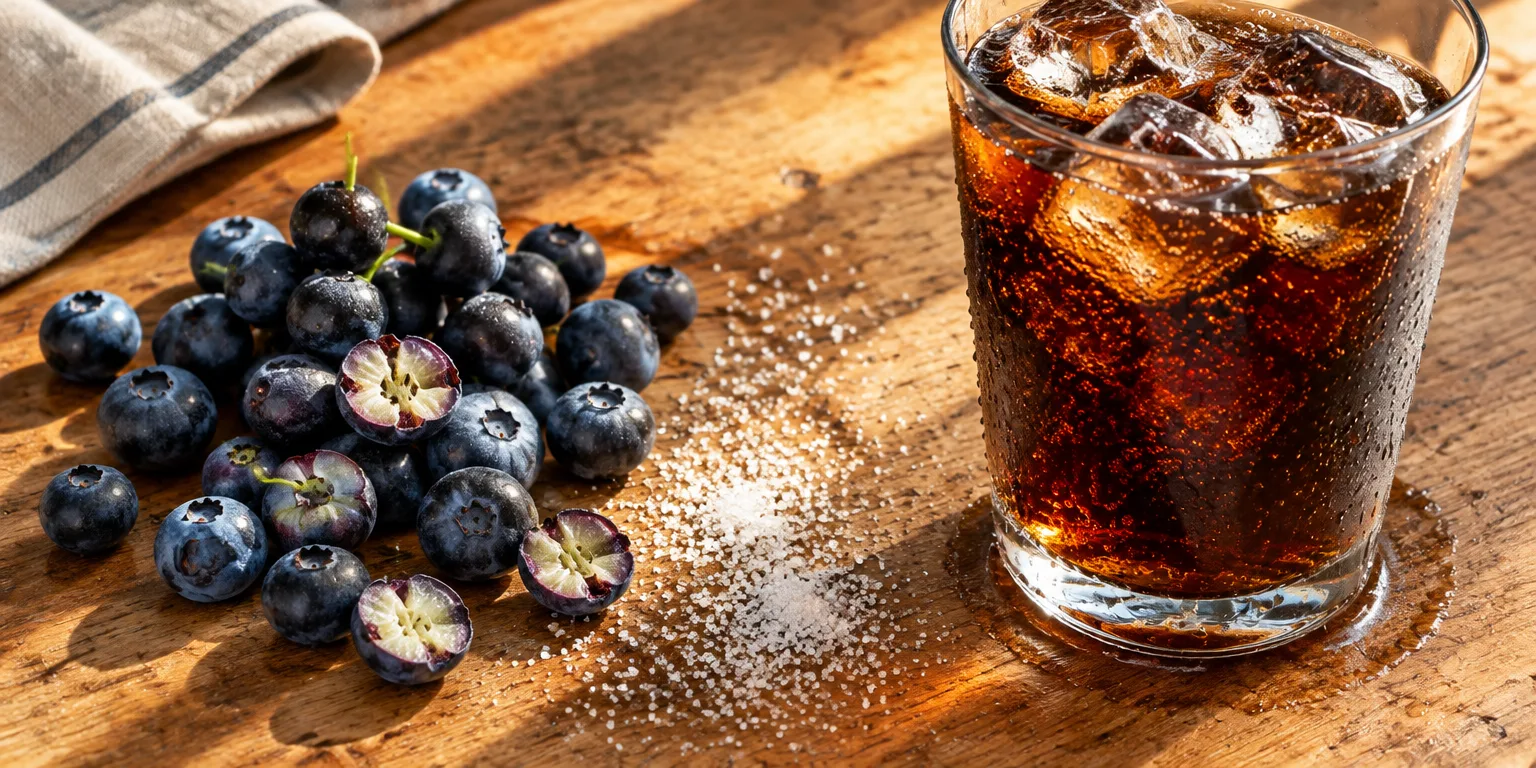
The sweet molecule in a blueberry is identical to the sweet molecule in a Coca-Cola.
That molecule is fructose, and according to Robert Lustig, a pediatric endocrinologist who studies metabolic disease, no vertebrate has a single biochemical reaction that requires it from food. Asked if fructose is vestigial, like the appendix, Lustig agreed, saying fructose "has no function in the human body." Yet American fructose consumption has risen 25-fold since the early 1900s.
The difference is the packaging.
In whole fruit, fructose arrives wrapped in fiber. In soda, it arrives alone. In a banana, it arrives with much less fiber than in a berry. Fiber slows absorption in the small intestine, so some of that fructose never reaches your bloodstream and instead feeds the microbiome, the 100 trillion bacteria that live in your gut.
That handoff matters because what you do not absorb, your bacteria do. They ferment the leftover calories into compounds called short-chain fatty acids, including acetate, propionate, butyrate, and valerate.
Those compounds are anti-inflammatory and protective against chronic metabolic disease, and Lustig describes them as anti-Alzheimer's as well. Fruit and soda look the same when you count what you eat. Measured by what your gut absorbs, they differ.
The practical consequence is simple. Berries, which are relatively low in fructose and high in fiber, send some of the fructose to gut bacteria instead of to you. Soda sends its fructose straight to you, with nothing to blunt the load.
Questions people ask
Does that mean fruit juice is like soda?
Nutritionally, it is close. Juicing removes most of the intact fiber while keeping the fructose, so the sugar is absorbed quickly without feeding the microbiome in the same way. Whole fruit preserves the fiber matrix that blunts absorption.
How much fiber should I aim for?
U.S. dietary guidelines suggest about 14 grams per 1,000 calories, or roughly 25 grams per day for women and 38 grams for men. Most Americans get only about half that. Whole fruit, vegetables, beans, and intact whole grains are the most reliable sources.
What do those short-chain fatty acids actually do?
Butyrate is the main fuel for cells lining the colon and helps keep the gut barrier sealed. Propionate and acetate travel in the blood and help regulate appetite, blood sugar, and inflammation. Low fiber intake is consistently linked with lower levels of these protective compounds.