Gaudi Designed Stone Arches Upside Down With String and Weights
A string hanging in tension traces the exact curve that, flipped over, keeps stone squeezed in compression.
 Real Engineering · Why Sagrada Familia Took 144 Years to Complete
The architect behind Barcelona's Sagrada Familia, Antoni Gaudi, figured out how to build impossible-looking stone curves by designing them upside down.
His problem was the stone itself. Gaudi built with Montjuic sandstone from a nearby quarry, and like all stone, it is enormously strong when squeezed in compression but fragile when pulled in tension. Tiny flaws let cracks spread under a pull, and the stone snaps. Keeping every block squeezed, all the time, is the whole craft of building in stone.
The Romans had the basic trick. Instead of flat beams laid across posts, the way the Greeks built, they built arches and domes. Those curves follow an invisible path of force, called the line of thrust, so each block pushes on the next and stays in compression. Their aqueducts and the dome of the Pantheon still stand as proof.
Gaudi's gift was finding that line in three dimensions for columns that split like trees and for arches, like those on the Passion facade, that sweep outward in ways that look like they should fall. His tool was string.
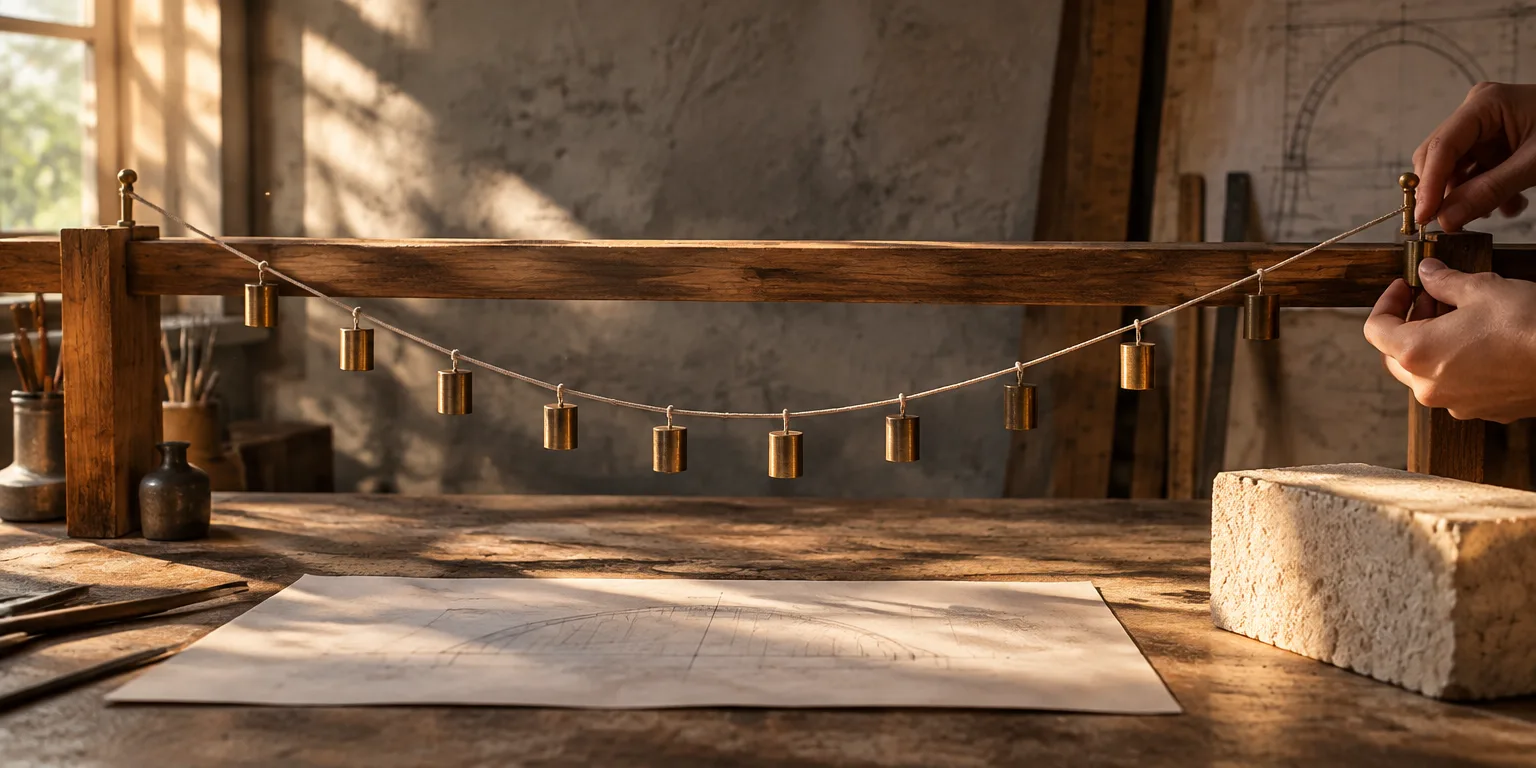
A hanging string can only be in tension. Hang it from one point and it drops straight down. Fasten it at both ends and it sags. Add weight and it sags deeper, always settling into a shape where every bit of it is being pulled.
Flip that sagging shape over, and pulling becomes pushing. The tension curve becomes a compression curve, exactly the shape a stone arch needs to stand.
Gaudi hung a floor plan at one-tenth scale, tied strings where columns would stand, and hung tiny weights where loads would meet and branch. Each weight represented roughly one ten-thousandth of the real load. Gravity did the math, drawing him the safe curve.
He got so fluent that, by the Sagrada Familia, he no longer needed the strings. He worked out how heavy each vault section would be, located where its combined force acted, and sketched the arch straight between the foot of the column and that spot. He treated the two approaches as the same method, one born out of the other.
Get that curve to match the loads, and every stone stays squeezed.
Questions people ask
Why does flipping a hanging string give you a strong arch?
Because the forces flip along with the curve. Every part of the string that was being pulled end to end becomes a part of the arch being pushed end to end, so the stone stays squeezed if the shape and the loads match.
Why is stone strong in compression but weak in tension?
Tension pulls it apart along tiny internal flaws, and those flaws grow into cracks. Compression pushes the material together, which closes flaws rather than opening them. That is why masonry, which is essentially stacked rock, must be kept squeezed.
Do architects still use hanging models today?
Yes, engineers still teach it, and designers sometimes use hanging fabric or chains to find efficient shell and vault shapes. Today the same physics is usually solved with computer models, which can test thousands of load cases in seconds.