Gaudi Twisted Stone Into Curves So Light Would Spread Without Hard Shadows
From one broken plaster fragment, architects decoded his geometry and used it to rebuild an entire facade from a single old photograph.
 Real Engineering · Why Sagrada Familia Took 144 Years to Complete
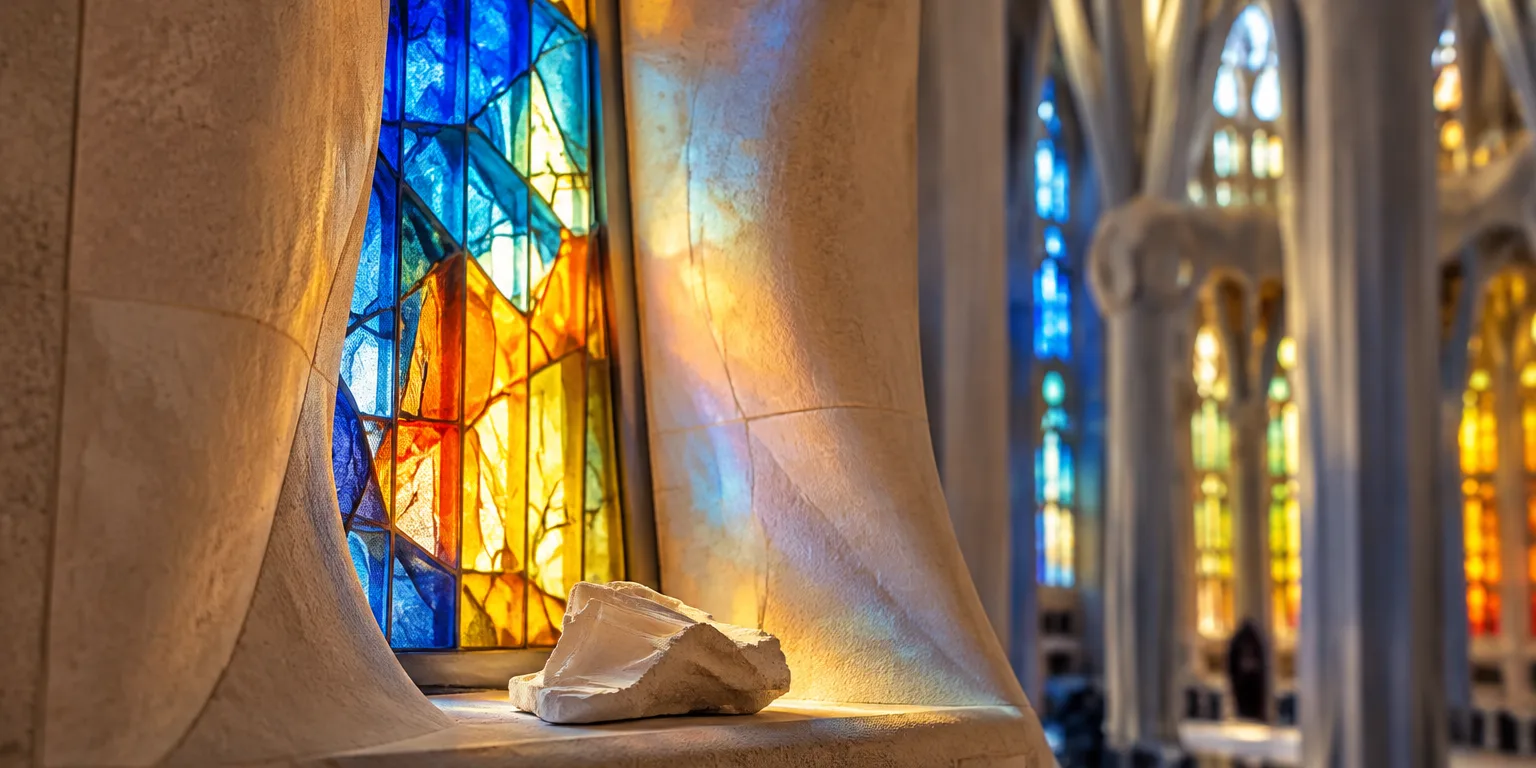
In Barcelona's Sagrada Familia basilica, the light does not fall in hard bars and blocks. It glides. The secret is in the stone around the glass.
Antoni Gaudi, the architect behind the basilica, did not set each window pane in a flat, square frame. He surrounded it with a smooth, flared surface made by twisting a cylinder. Picture a cardboard tube. Hold the bottom still and turn the top. The sides curve inward into an hourglass, yet every line running up the side stays straight.
That is what mathematicians call a ruled surface, a curved shape generated entirely from straight lines. So daylight spreads softly across the interior instead of casting sharp lines, leaving a wide field of glass where color can do the work.
What survived of that idea was one piece of a scale model. The team working to finish the church scanned the surviving plaster fragment and laid a computer version of the same hourglass shape over each window opening. That computer shape was parametric, meaning its twist and width were controlled by numbers that could be adjusted. They changed the numbers until the digital shape matched the plaster exactly. Once those numbers were locked in, the rest began to fall into place. The same twisted shapes, scaled up, turned out to shape the vaults overhead.
The same geometry later solved a bigger gap, the missing record of the Passion facade. Only one photo of a sketch remained. Workers had later made a plaster model from that photo in the early documentation years. Architects digitized that model and added it to the computer design, but lining up the digital copy against the sketch showed a mismatch in the rib-like columns.
The fix was the twisted cylinder again, combined with another curved shape made by twisting two lines. That second shape meets the cylinder at the foot of each column. The columns lean inward and grow taller toward the center, and each flares at the top and bottom. By tuning both shapes until they fit the old photograph, the team rebuilt the facade to match the photograph and the sketch.
Questions people ask
What exactly is a ruled surface?
It is a curved surface that can be drawn using only straight lines. A cone, a cylinder, and the cooling-tower shape of a power plant are simple examples. Builders like them because straight beams or straight cuts can form a curve.
What does parametric mean in architecture?
It means the shape is defined by adjustable numbers, or parameters, such as height, twist, or width. Change a number and the computer model updates automatically. For Sagrada Familia, that let architects test hundreds of twists until one matched Gaudi's plaster.
Why does soft light matter so much inside this church?
The windows are meant to work as one large painting in glass, with cool blues on the east and warm reds and ambers on the west. Hard shadows would chop that color into patches. Soft, spreading light lets the color wash across stone and visitors as the sun moves.