He Survived a Nazi Camp, Then Watched Soviet Tanks Crush His Student Revolt
Peter Lantos lost his father to Bergen-Belsen, lived through Soviet rule, and still remembers 12 days when Budapest believed it was free.
 Global News Podcast · Melania Trump brokers ceasefire for Ukrainian city
Peter Lantos was at home in Budapest when the shooting started. Police had fired on a peaceful student demonstration, and within hours the protest became a revolution. He went to his school to demonstrate.
Lantos, now 87, has lived through liberation collapsing into oppression twice. He survived the Bergen-Belsen concentration camp in Germany, only to return home to Hungary and watch a second dictatorship take hold, and then briefly rise up against it as a university student.
He had lost his father in Bergen-Belsen, and much of his family under Hungary's wartime government, which cooperated with Nazi Germany. When he returned home, he said, there was reason to hope. He recalled that between 1945 and 1948, Hungary, "believe it or not, was a free country, so to speak." Then rival parties disappeared, and the country became a one party dictatorship aligned with Moscow.
Soviet soldiers had arrived as liberators from the Nazis, he said, but stayed on as an oppressive force. Life narrowed. He described what he called the "lack of personal freedom and the way we couldn't say, do what we wanted to do."
As a student, he was beaten by police, not for anything he had done, but because his school uniform marked him as suspicious. His mother, who he called exceptional, went to the police station to protest. "I mean, nothing happened, but at least she made a stand," he said.
So when students marched in October 1956, the anger was already there. Lantos recalled, "There was no one practically not affected by it, and the surprise was extraordinary. It was a sort of explosion."
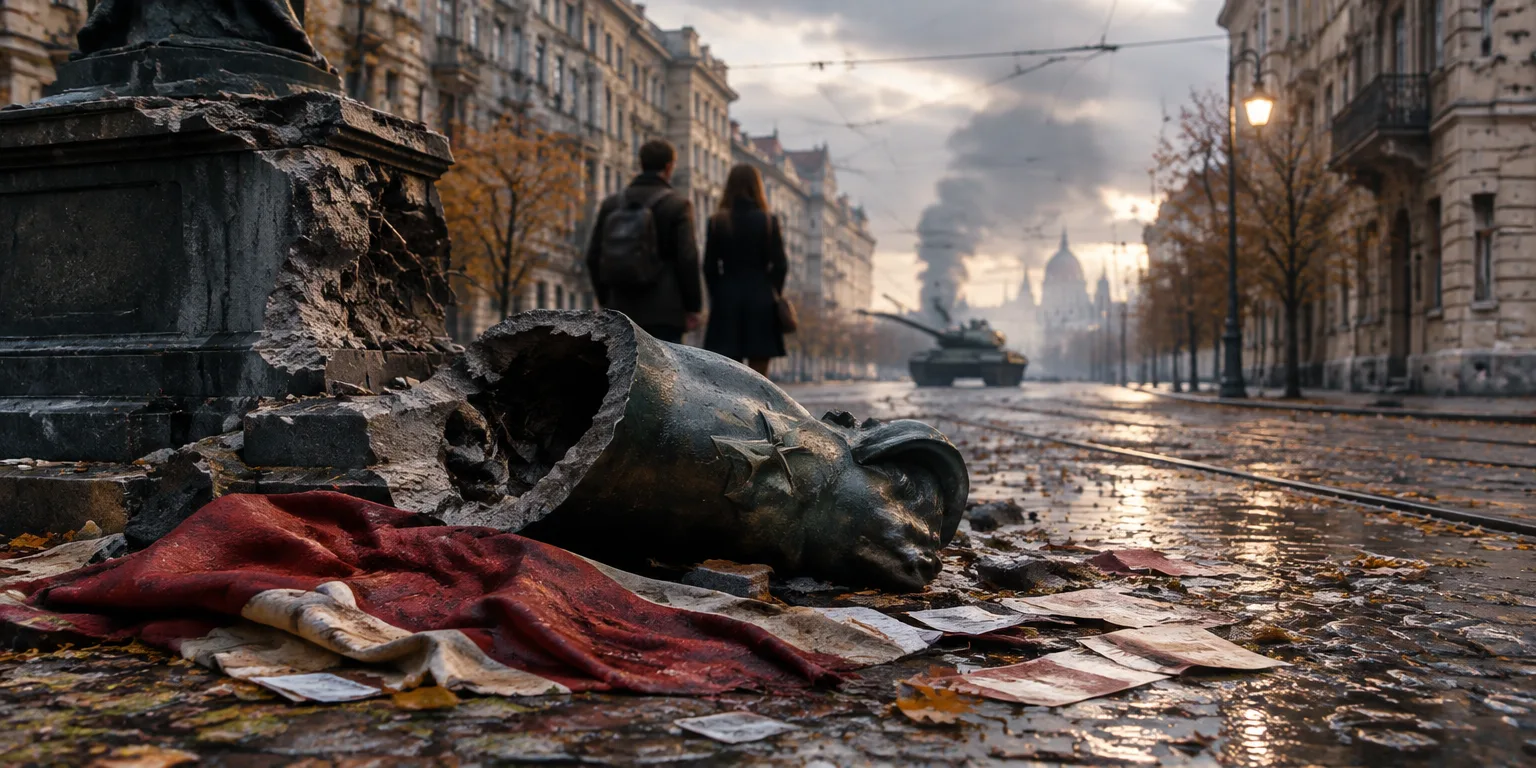
The Soviet military monument was destroyed. More demonstrations followed. University students drew up demands that he still described with wonder: Hungary should be neutral, leave the Warsaw Pact, a military alliance led by Moscow, hold free elections, and guarantee human rights. A system that had seemed unchangeable, he said, gradually changed.
What followed was the 12 day period of the uprising, between the October revolt and the return of Soviet tanks, when Budapest lived in euphoria edged with doubt. In his words, "We wanted to be excited, and we were. But at the back of our mind, could it be that it may not happen?"
The 12 days ended when Soviet tanks returned to Budapest amid severe fighting, and the hope was gone. Lantos said it was quite obvious that a very hard time would follow.
The crackdown reached his family, starting with his uncle's arrest. His uncle was accused of distributing weapons, though Lantos said, "My uncle couldn't distinguish one end of a gun from another, let alone to distribute it." The uncle was taken to a police station, beaten, and soon died. Lantos said many people disappeared, including Prime Minister Imre Nagy, who was taken away.
Lantos later built a career studying diseases like Alzheimer's and Parkinson's, and wrote books about his deportation to Bergen-Belsen. Looking back on 1956, he spoke of great disappointment, and of a cautious hope that Hungary would finally manage politically successfully.
Questions people ask
What was Bergen-Belsen?
Bergen-Belsen was a German concentration camp in northern Germany where tens of thousands of Jews, Soviet prisoners, and others died of starvation, disease, and murder during World War II. British forces liberated it in April 1945 and found about 60,000 severely ill prisoners and thousands of unburied bodies. Anne Frank was among those who died there.
What happened in the 1956 Hungarian uprising?
Hungarians rose against Soviet-backed rule in October 1956, briefly forcing Soviet troops to withdraw and forming a reform government under Imre Nagy. After about 12 days, Soviet tanks returned in force in early November and crushed the revolt, killing thousands. Tens of thousands of Hungarians fled, and Soviet-aligned control lasted until 1989.
What did Peter Lantos do after leaving Hungary?
Lantos became a physician and researcher in Britain, where his work on brain tissue helped advance understanding of neurodegenerative diseases including Alzheimer’s and Parkinson’s. He has also written memoirs about the Holocaust and his family’s experience. He was awarded honors in Britain for his medical research.