Healthy soil is often noisy soil
Activity peaks after midnight when earthworms are most active, and rewilded fields sound richer than cattle pasture.
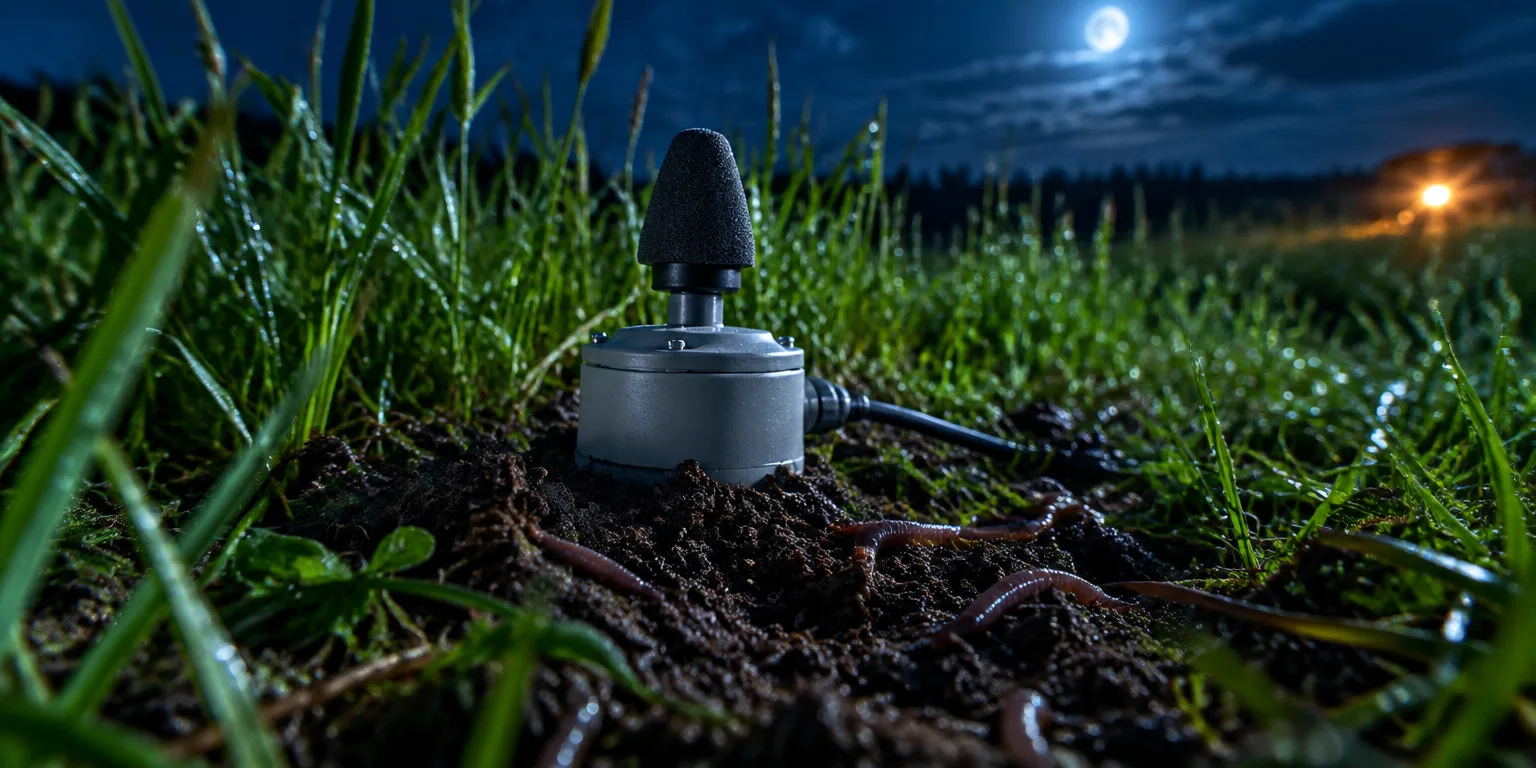
 Aeon · Worm munch matters
If you want to know whether soil is healthy, bury a microphone and listen. As Ella Browning, an ecologist at the University of Oxford, puts it, "a healthy soil is often a noisier one."
That is the premise of soil ecoacoustics. Researchers bury passive acoustic sensors, essentially small microphones built to work underground, and leave them to record for days at a time. The crackles and shuffles they pick up come mostly from animals moving, burrowing, and feeding. Early work in gardens, forests, and farmland suggests that thriving soils sound measurably different from depleted ones.
In Britain, Browning and her team made continuous 24-hour recordings across grasslands to test the idea. The soundscapes rose and fell over the day, with a distinct peak after midnight. The team links that late-night rush to earthworms, which are most active at that time.
It also mattered what grew overhead. Recordings from rewilded grassland, land left to recover with little grazing or chemical input, showed higher acoustic diversity than recordings from intensively grazed cattle pasture.
Earthworms may explain much of the sound. When the team scooped up soil animals, including ants, woodlice, beetles, and various grubs, earthworms were the commonest invertebrates in their samples, and the researchers believe their movements contribute significantly to the soundscape. The idea is still being tested.
They are what ecologists call ecosystem engineers. Different earthworms burrow vertically or horizontally, deep or shallow, and those tunnels change soil structure so air and water can flow. They also shred lifeless leaves, roots and animal remains into fragments, which bacteria and fungi then break down further, releasing nutrients that would otherwise stay locked up. That is why tallying worms is a widely used gauge of farmland condition.
Listening could make that job far easier. Traditional tests require digging samples by hand and sending them to a lab to measure acidity, nutrients, texture, compaction, water-holding capacity, enzymes, microbes, and carbon. The cost means only small patches can be tested, and each sample is just a snapshot in time. Buried sensors, by contrast, can stay underground gathering sound for days at a time, with several units recording in separate spots simultaneously.
The theory, still being tested, is straightforward. A soil where natural processes are intact holds more, and more kinds of, animals, and has a looser, better structured physical makeup than a worn-out or chemically damaged one. So it should sound different, and busiest just after midnight when the worms get to work.
Questions people ask
Can a farmer buy a soil microphone today instead of doing lab tests?
No, not yet as a replacement. Researchers still need to prove which sounds come from which animals, and how soil type and moisture change what a buried microphone hears. For now it is a promising complement to digging, counting worms, and lab tests.
Why would soil be loudest after midnight?
Earthworms do much of their feeding and burrowing at night, when the surface is cooler and damper. That reduces the risk of drying out, which is dangerous for an animal that breathes through damp skin. The post-midnight peak likely reflects that nighttime activity.
What is the difference between rewilded grassland and cattle pasture?
Rewilded grassland is former farmland or pasture left to recover naturally, with little or no plowing, fertilizer, or intensive grazing. Cattle pasture is grazed hard and often compacted by hooves, which can reduce plant diversity and squeeze the pores that soil animals need.