Heavy Things Sink When Soil Slides Sideways Underneath Them
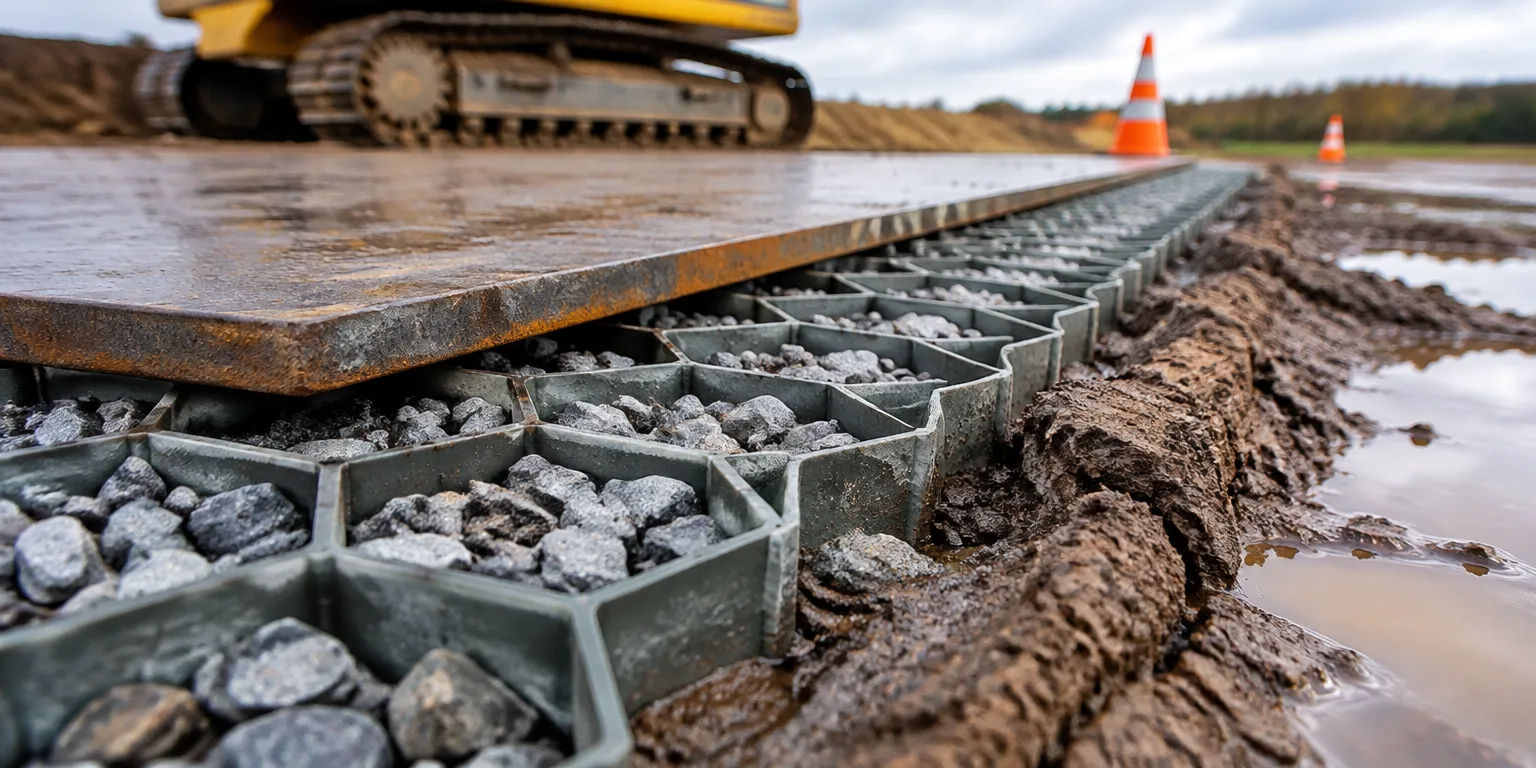
A honeycomb of plastic traps dirt in place, turning weak ground into something that can carry heavy loads.
 Practical Engineering · The Grid That Doubles the Strength of the Ground
Step onto a muddy lawn in high heels and you sink. Lay down a broad board and stand on it, and you stay on the surface. The difference is how the soil fails, not only how soft it is.
Soil cannot simply disappear under a vertical load. When the pressure gets too high, the friction between particles is no longer enough to hold them in place, and they slide past one another along a plane.
Engineers call this a bearing capacity failure. The soil is pushed down, then outward, then upward, and that sliding is what lets whatever sits on top sink or tip over.
The simplest defense is to spread the load over a wider area. Buildings do it with wide concrete footings. Roads do it with road base, usually broken stone with sharp edges that bite into each other, plus finer particles that fill the gaps and wedge the larger pieces tight.
Pressure from a tire or a footing widens into a cone shape as it moves downward. The base layer has to be thick enough that by the time that spreading pressure reaches the weak native soil underneath, it is low enough for that soil to support. Weaker soil means thicker base, sometimes many feet of material that must be excavated, trucked in, and packed down.
A plastic honeycomb helps because it blocks the sideways part of that failure. A geocell is a three-dimensional honeycomb made from plastic strips welded together. Filled with soil or gravel, each cell walls in its patch of ground rather than merely sitting under it.
Drop a weight on loose sand and it sinks deep. Confine that same sand in a small container and it sinks far less, because to fail it must shear and shift, and now there is nowhere for it to go. Placed side by side, those full cells start acting like a footing themselves, spreading heavy vertical forces so the weak soil below feels much less stress.
Questions people ask
What is the difference between normal settling and shear failure?
Settlement is slow, mostly uniform squishing as air and water are pressed out of the soil. Shear failure is sudden and directional, with ground bulging up beside the load as the structure drops or tilts. Engineers design to limit the first and prevent the second.
Why is crushed, angular stone better for road base than sand or round gravel?
Angular stones bite into each other and lock together under pressure, which increases friction between particles. Rounded sand or smooth river gravel slides more easily. The finer particles in road base fill the gaps and help wedge the larger pieces tight.
Does trapping the soil work in mud as well as in sand?
Confinement helps most in granular soils like sand and gravel, where strength comes almost entirely from friction between particles. In very soft clays and silts, water trapped between microscopic plates controls behavior, so drainage and other treatments matter too, though confinement can still spread the load.