Houston kept houses cheap by letting builders split one lot into four
After voters rejected zoning in 1948 and again in the 1960s, the city shrank minimum lot sizes and setbacks, turning sprawl into infill.
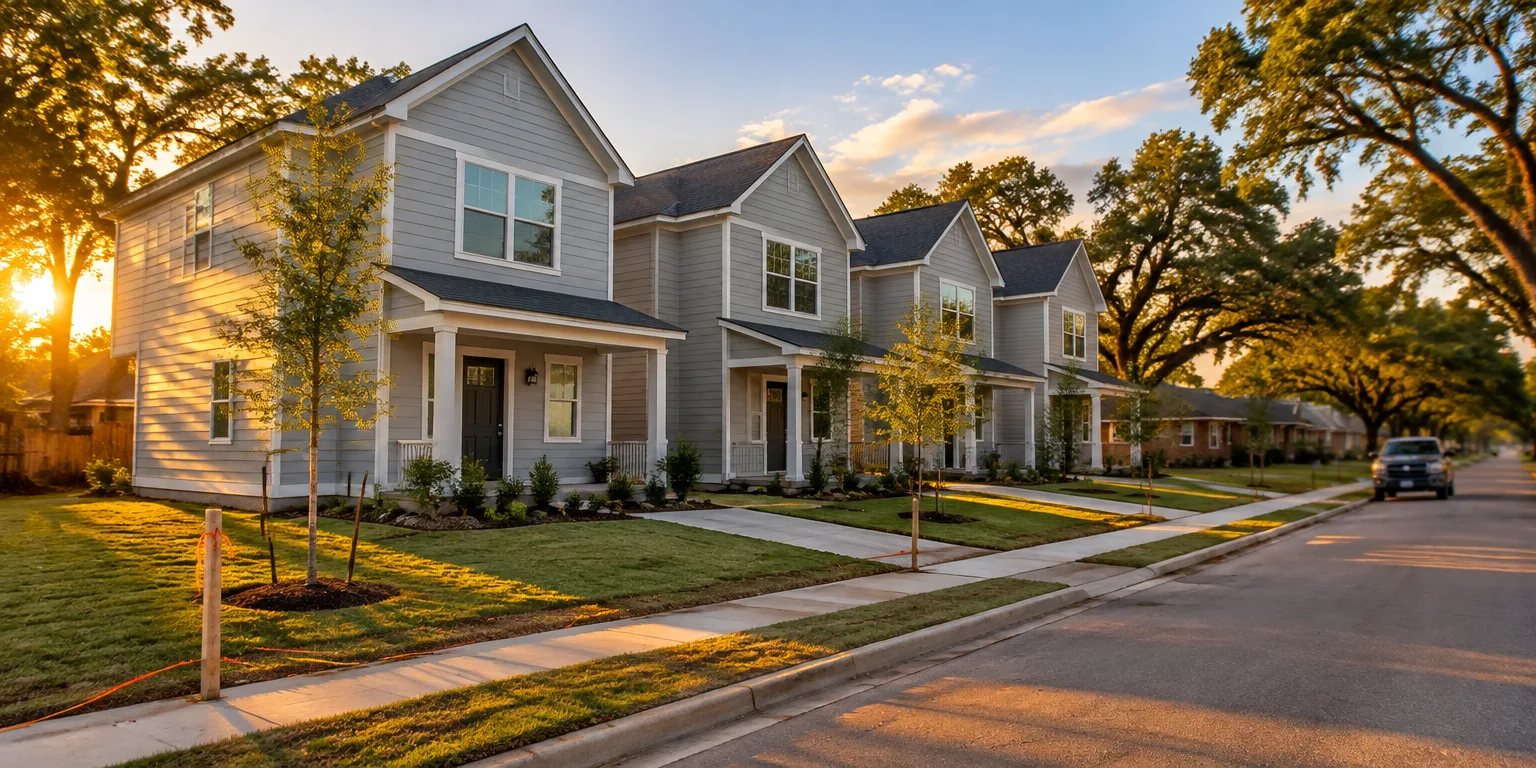
 Wendover Productions · Why Texas Wins
In Houston, the reason a newcomer can still buy a cheap house close to the city is simple. A builder is allowed to take a lot meant for one expensive house and split it into four small lots for four cheaper ones.
That permission traces back to two votes. In 1948, when most big American cities were adopting zoning, which is a city law that dictates what kind of building can go where, Houston voters said no. In the early 1960s, after the city had doubled in size and was approaching one million residents, they voted no again.
Without those rules, Houston grew in ways that looked strange. On streets like Huckleberry Circle, expensive single-family houses sit next to massive apartment towers. Downtown filled with never-ending parking lots, including a 1970s photo that became a symbol of a car-obsessed city with no plan. With few limits beyond minimum lot sizes, the city spread outward until its developed footprint covered more ground than greater London.
That sprawl then created an opening. Starting in the 1990s, Houston began filling in rather than just spreading out. In the Acre Homes neighborhood in Northwest Houston, a Houston-based design outfit, CGEA Planning, took a lot that would normally hold one house set well back from the street and divided it into four.
The math works for both sides. Instead of putting up a single bigger house for about $400,000, the firm can put up four houses priced at about $150,000 apiece. That lifts total sales by half. The neighborhood gets four affordable homes instead of one, and the extra families support local shops, attract more businesses, and make the street livelier and more walkable.
The city eventually made that kind of split the default inside the I-610 highway loop that rings the urban core. In the 1990s, petitions to carve large parcels into smaller ones piled up so often that officials shrank the smallest allowed parcel from five thousand square feet to fourteen hundred, and trimmed the required front distance from the street from twenty-five feet to only five.
The result is not Manhattan. Density inside the loop is about 4,500 people per square mile, similar to Sacramento, Long Beach, and Atlanta, but walkability is fairly high and bikeability is improving. More important for growth, the houses are cheap. Among America's twenty biggest metropolitan regions, Houston offers the second most affordable homes, which turns its reputation for openness into a real economic offer.
Questions people ask
Does no zoning mean anyone can build anything in Houston?
Zoning is a city law that decides what can be built where, such as keeping apartments out of single-family neighborhoods. Houston has no such citywide map, but it still enforces building codes, safety rules, and private deed restrictions that homeowners in many subdivisions use to limit what neighbors can build.
What is a setback, and why does it matter?
A setback is how far a house must sit back from the street or property line. Cutting Houston's required front setback from 25 feet to 5 feet lets houses occupy more of a small lot and creates a continuous street wall, which feels more urban and walkable.
How can four cheaper houses make more money than one expensive one?
Four $150,000 houses total $600,000 in sales, or 50 percent more than one $400,000 house on the same land. Because land is often the most expensive part of a home near a city center, spreading that land cost across four buyers lowers the price for each one.