How Scientists Measure What Something Feels Like
Born when psychology treated people as input-output machines, it kept inner life measurable.
 The Why Files: Operation Podcast · The Basement: Julia Mossbridge | Time Loops, Cosmic Consciousness, and Psychic Children
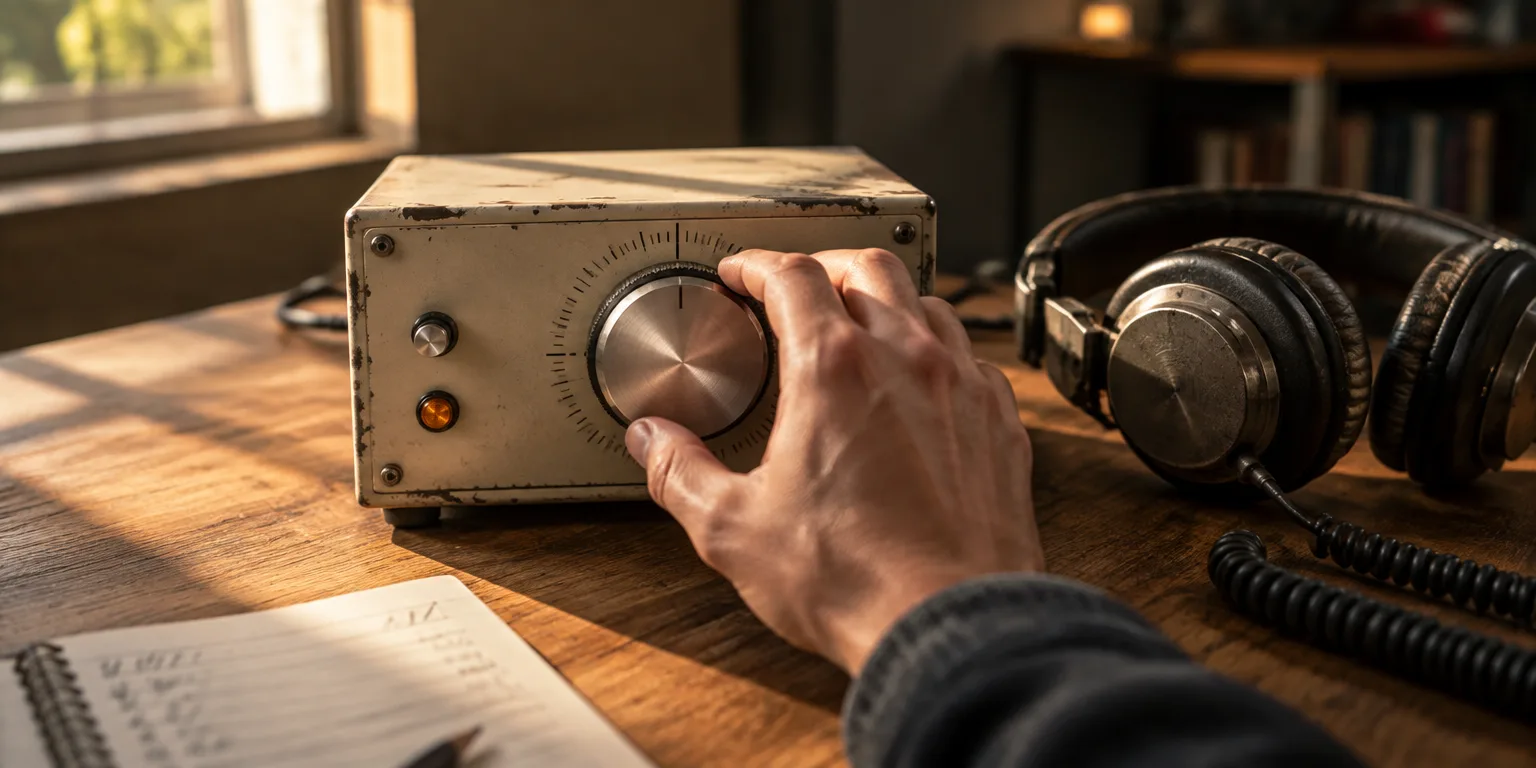
There is a way to measure what the world feels like from the inside, and it starts with a dial.
That is the trick behind psychophysics, a field that blossomed in the late 1800s and early 1900s. The name was meant to join psychology and physics, and the timing mattered.
Behaviorism was becoming popular then, says researcher Julia Mossbridge. The idea was that people were input-output machines, and what happened inside did not need to be studied because people could be trained, much as dogs can be trained.
Psychophysics kept inner life in the picture by asking people to report it. Play two tones, described as ding and then ding, and ask a listener to turn a dial to show how much lower the second one felt.
The units are arbitrary. But test many people, and the ratings line up: people give about the same range for one comparison and a wider range when the second tone is lower.
Researchers then work backward from those responses. The brain is treated as a black box, and the pattern of ratings is used to infer what is happening between sound in and judgment out.
The word physics helped it sound like hard science, Mossbridge says. In her telling, it was "a way of smuggling subjective experience into psychology for the entire last century."
Sound is only one use. Psychoacoustics is psychophysics applied to sound, while visual psychophysics might ask how different one color looks from another.
The larger point, she argues, is that subjective experience is not only beeps and flashes. It also includes feelings, ideas, dreams, and creativity, which is all anyone directly knows before inferring the world beyond.
Questions people ask
Who was Fechner?
He was Gustav Theodor Fechner, a German physicist and philosopher who lived from 1801 to 1887. His 1860 book, Elements of Psychophysics, proposed mathematical rules linking physical intensity and felt sensation.
Do scientists still use psychophysics today?
Yes, in updated forms. Hearing tests, vision exams, taste panels, and pain scales all ask people to judge private sensation against a controlled stimulus. Brain imaging and reaction-time measures are often added, but the rating remains central.
Why did behaviorism dismiss subjective experience?
Early behaviorists wanted psychology to study only observable behavior, partly to make it more rigorous. Leaders such as John Watson and later B.F. Skinner argued that thoughts and feelings were hard to measure and unnecessary to explain learning.