Hundreds of thousands of army ants besiege a leafcutter fortress
So far it is the only army ant known to overwhelm a mature leafcutter nest, and even a successful defense leaves thousands dead.
 Kurzgesagt – In a Nutshell · The World War of the Ants – The Army Ant
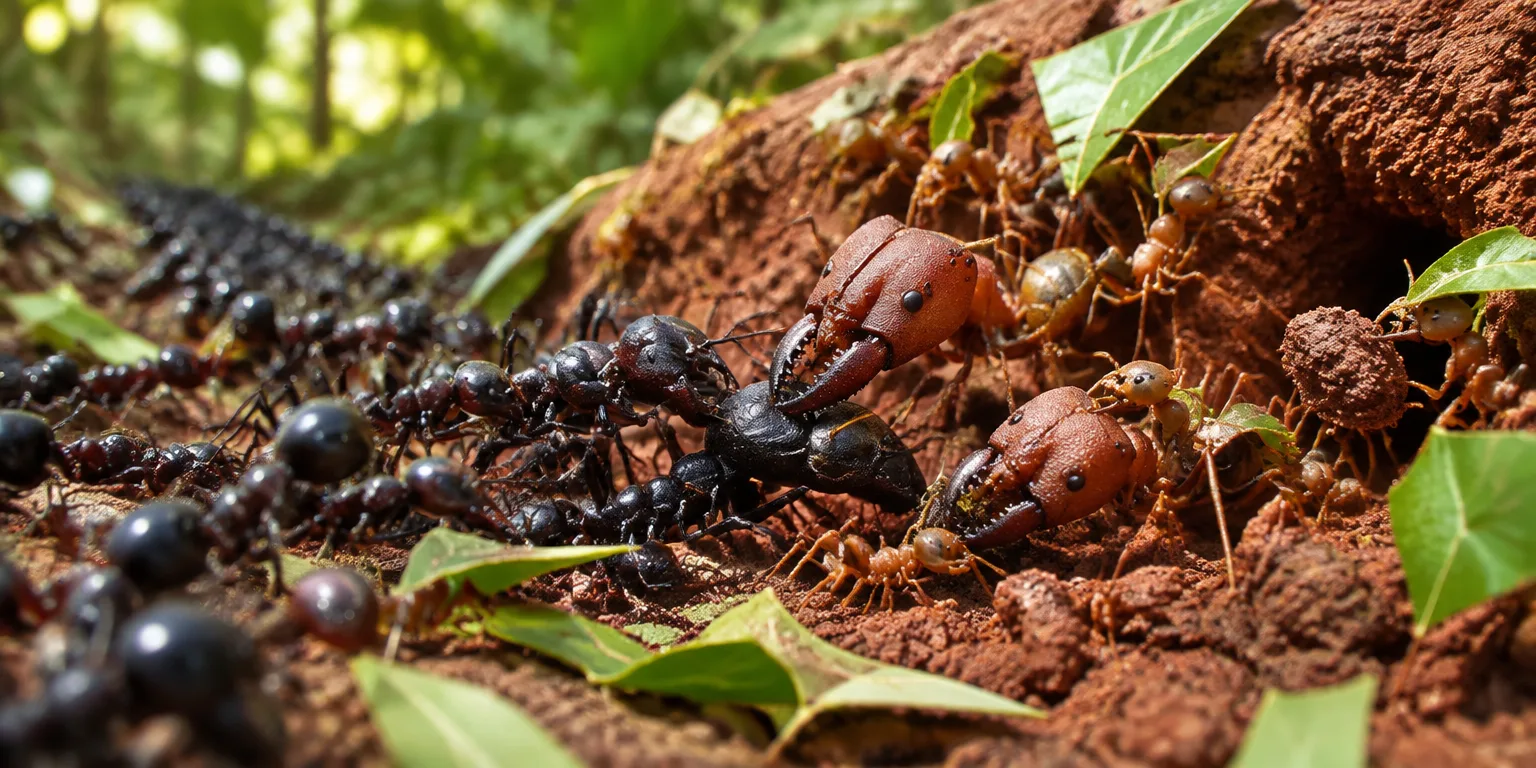
The raid begins when a long column of army ants finds a leafcutter nest and keeps pouring forward. The attackers, Nomamyrmex esenbeckii, are thick bodied even by army ant standards, and they feed mainly on the young raised inside other ants' nests. Hundreds of thousands can march together in a single assault.
The target is a fortress. Leafcutter ants, the fungus farmers that carry cut leaves underground, build cities that run meters deep and wide and house millions of residents with different jobs. Among them are enormous guards that weigh roughly a hundredfold what the smallest nestmates weigh, with huge heads and jaws. Researchers suspect that holding off army ants may be the reason those giants evolved.
No other raid at this scale is known to succeed. So far, this stocky army ant is the only one known to be able to overwhelm a full grown leafcutter colony.
When the leafcutters sense the intruders, they sound the alarm and rush their giants to the breach. A battle line takes shape a few meters wide and as much as a meter from front to back, soldiers in front and workers crowding behind.
There the giants meet the invaders face to face. The leafcutter guards clamp on and try to slice through the attackers' heads, while smaller workers seize the enemy to hold them still. Just behind the line, little crews tear at the captives, wrenching legs from bodies. The army ants fight back by piling onto the guards and trying to overwhelm them with stings.
Even while they fight, other leafcutters get ready in case the line breaks. Workers hurry to pile up soil and plug tunnels, trying to shut enough doors to keep the attackers out of the nurseries.
Numbers often decide it. Despite the defense, the army ants have more fighters to spend. If the defenders cannot drive them back or close enough tunnels in time, the column floods in, reaches the inner rooms, and hauls away tens of thousands of young to eat. A colony that manages to hold on can survive, but even then it pays a heavy price, with thousands of dead left on the field on both sides.
Questions people ask
How big are these ants in real life?
Both are small to the human eye. Workers are only a few millimeters long, while the largest leafcutter soldiers are much bulkier, with oversized heads and jaws built for cutting and holding. In weight, those giants can be roughly a hundred times heavier than their smallest nestmates.
Why do the army ants want baby ants instead of food from the forest?
Ant larvae are soft, defenseless packets of protein and fat, and a mature leafcutter nest holds tens of thousands of them in one place. For a marching colony of hundreds of thousands that must eat constantly, raiding one rich nest can feed far more mouths than hunting insects one by one.
Can a leafcutter colony recover after losing so much brood?
Often yes, if the queen and enough workers survive behind sealed chambers. Leafcutter queens can live for many years and lay millions of eggs, so a mature colony can replace lost workers and brood over months, though repeated raids can weaken or finish it.