In a Small Sand Test, Plastic Cells Stopped Washboard Bumps From Forming
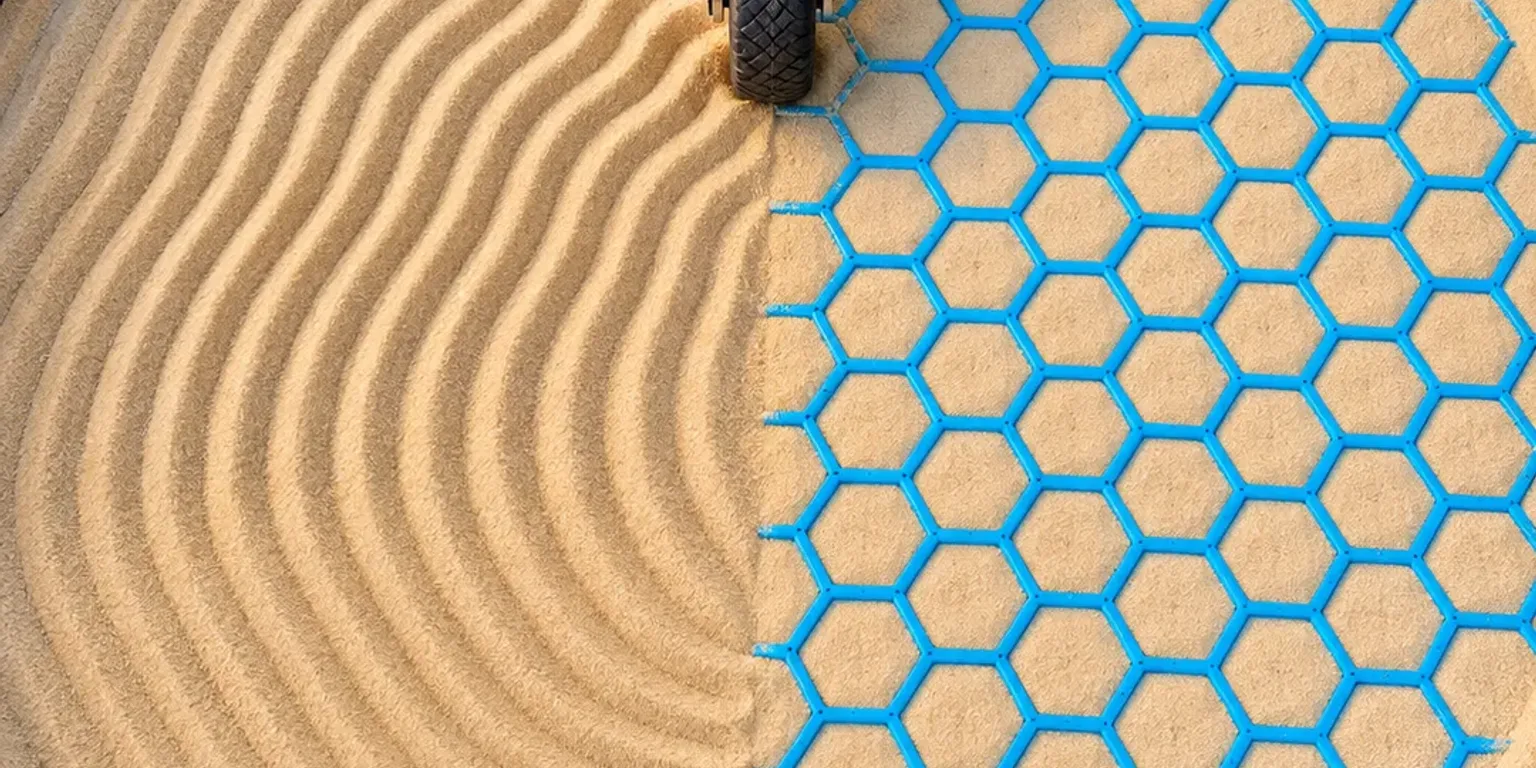
A small amount of plastic kept loose sand flat for about 100 laps, where bare sand starts to washboard at around 35 rpm.
 Practical Engineering · The Grid That Doubles the Strength of the Ground
In his garage, Grady, an engineer who tests ground behavior with small working models, set a little wheel spinning around a circular track filled with loose sand. The rig was simple, a motorized arm circling again and again, kicking the surface the way car tires hit a dirt road.
He already knew what loose grains do at speed. Go slowly, and a tire just leaves a rut. Go faster, and the surface breaks into rhythmic corrugations, the washboard bumps that rattle cars and can cost drivers traction. In his earlier test without reinforcement, that change started at about 35 revolutions per minute of the arm.
The question was whether a plastic honeycomb could stop it. The device is called a geocell, made from plastic strips welded into connected cells, a bit like honeycomb. Unlike a flat sheet or mesh laid under gravel, the cells wrap around the soil and hold it on all sides.
That matters because of how ground gives way. Soil does not vanish under weight. Its grains shear and shift. Drop a weight on unconfined sand and it sinks deep. Confine the same sand in a small pocket, and there is nowhere for the grains to go, so the sinking drops sharply. Set many pockets side by side, and they spread a heavy push over a wider area.
For the test, Grady printed miniature cells from TPU, a flexible plastic. The cells bulge under load and push against their neighbors, as full-size cells do. He laid them into the sand track and started the wheel at the 35 revolutions per minute speed where washboarding had started without the cells, with gearing that slowed the motor ten times before turning the arm.
After about 100 laps, the track looked almost untouched. There was not even a rut, though loose sand is about the worst surface one could choose for a road. So he ran the rig faster, at about the fastest speed he trusted the homemade machine to handle.
It still held. One section of cells began to ride up and float a little, but that was with the grid left exposed on top for viewing. In a real road it would sit buried under cover. Side-by-side high-speed video showed the difference: without the grid, grains skipped and piled forward, and with it, the sand stayed largely locked in place.
Questions people ask
Why does speed turn a rut into washboard bumps?
Washboarding starts when a wheel moving fast enough briefly bounces or unloads, then lands and shoves a little pile of loose material forward. The next wheel hits that pile, bounces again, and repeats the pattern, so evenly spaced bumps grow and reinforce themselves.
What are full-size geocells made of?
In real roads they are usually made from high density polyethylene, the tough, chemically inert plastic also used for underground pipe and bottles. The walls are perforated and slightly textured, and sections expand like an accordion for trucking, then get staked open and filled on site.
Can I use this idea for a driveway?
Yes, for driveways, sheds, trails, and parking pads on soft ground. Homeowners can buy smaller panels, unfold them over a level base, fill with gravel or soil, and top with cover. For heavy loads or poor soils, an engineer should still size the base.