In mice, the same memory returns whether brain cells fire in order, in reverse, or all at once
The result defies textbooks that say timing is everything, and it complicates efforts to read and control the brain.
 Invest Like the Best with Patrick O'Shaughnessy · Andrew Huberman - The Frontier of Neurotechnology - [Invest Like the Best, EP.494]
Fire the brain cells behind a learned behavior in reverse order, or all at once, and, as Stanford neuroscientist Andrew Huberman put it, "you get the exact same behavior" as firing them in order.
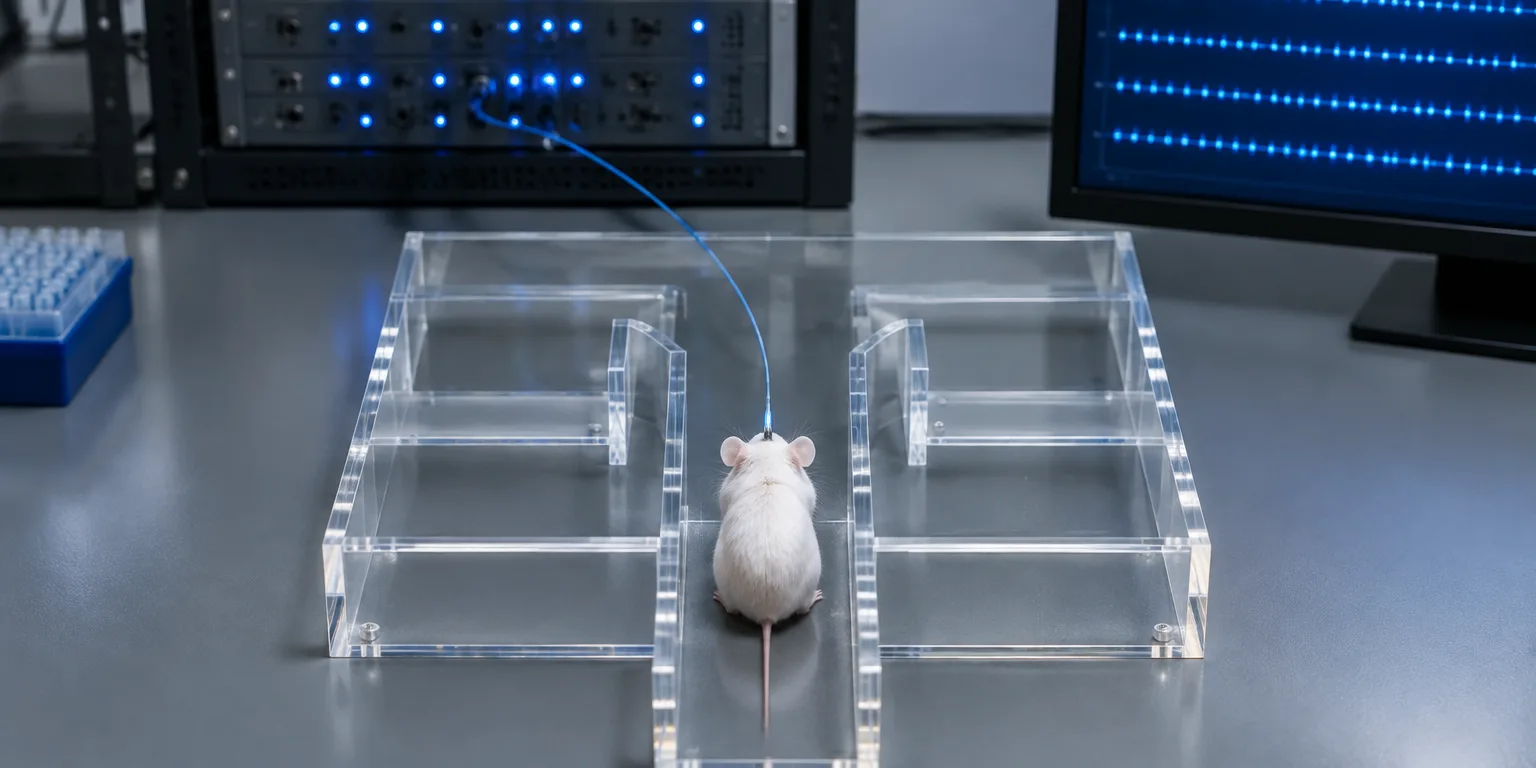
In experiments by Scripps neuroscientist Mark Mayford's lab and Nobel laureate Susumu Tonegawa, described by Huberman, mice learn a maze, a lever-press combination for a reward, or where a shock will come. Scientists tag the neurons in the hippocampus, a deep structure central to memory, that fire during learning. Switching those cells back on in the original sequence makes the animal repeat the behavior. Playing them backward, or switching them all on at once, produces the identical behavior.
That defies the textbook idea that firing order carries the memory. Huberman says it could simplify brain control, since activating the right group of cells might be enough, but also complicate it, because those same cells are reused in many other memories and thoughts.
Questions people ask
Does the firing order ever matter in the brain?
Yes. For basic senses, the direction of travel matters. Visual signals must go from the eyes to a relay station called the thalamus and then to the cortex, and cutting that chain stops perception. The surprise is that for recalled memories, the precise firing order may not matter.
What does the hippocampus do?
This is general knowledge beyond the interview: it is a small, curved structure deep in the brain that helps form and retrieve memories. Damage to it can prevent new memories from sticking, while older ones remain. In these mouse experiments, Huberman says ways to read from the hippocampus have gotten pretty good.
Could doctors use this to restore a lost memory?
The methods Huberman describes are animal-only, using chemical tags and reactivation that are not used in people. Restoring a memory would also require precisely targeting only the right cells, since the same cells are reused in other memories and thoughts. Huberman says activating select sets of neurons with high precision is already very hard.