In Northern Sweden, a Finished Housing Module Comes Off the Line Every 30 Minutes
The family-owned Lindbäcks studied Toyota and Volvo before opening its housing plant in 2017, and paints walls upright in the open air.
On a foggy day in June 2023, Stefan Lindbäck, who leads the family business as its fourth generation, handed out safety boots and led a group of visiting Americans onto a metal walkway. Below them spread a production hall covering roughly ten acres, as vast as an airplane shed but devoted to making homes. Workers wove between equipment in a steady, almost choreographed rhythm.
The visitors had traveled to far-northern Sweden to answer a simple question: what if houses were built the way carmakers build cars? Before opening its housing plant in 2017, Lindbäcks had taken that idea literally, sending managers to tour auto works operated by Toyota and Volvo and mills that make paper nearby, and borrowing their best ideas.
Everything in the building centered on a single central conveyor that crept forward while finished parts were joined into complete housing modules. That conveyor was the spine. Every half hour, one box-like unit rolled off it, ready to be joined with others to make flats in varying layouts and dimensions.
The surprise was in how the spine was fed. Shorter side lines handling slower jobs fed into it like ribs. There, equipment put together floors, walls and ceilings, plus fittings such as counters and cupboards. American factory housing, by contrast, usually moves down a single line.
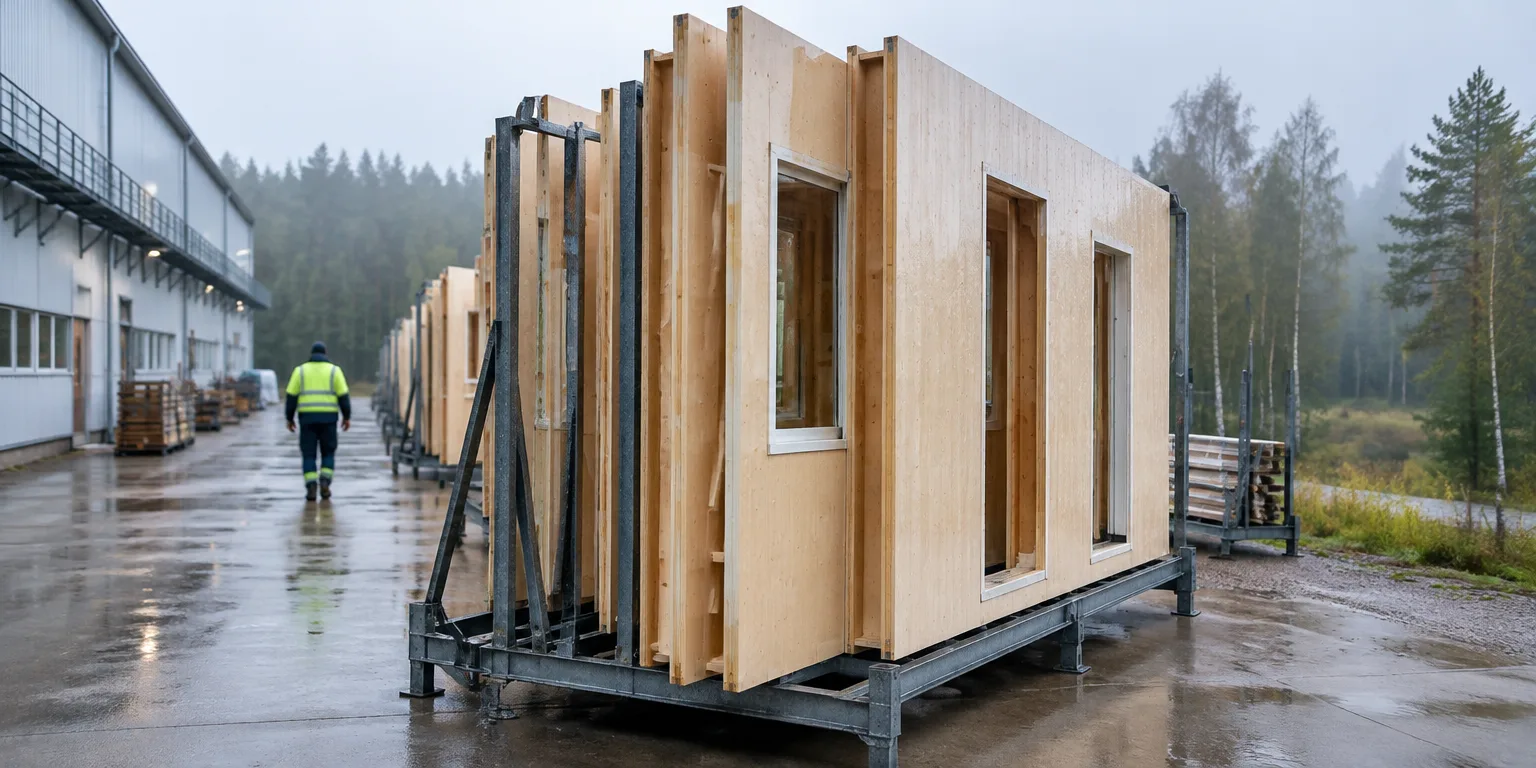
Along one of those side lines, a finished inside wall slid onto a rack and stood upright for painting, out in the open air. The trick struck Mary Tingerthal, who once ran Minnesota's housing agency and now advises a modular builder named RISE, as almost revolutionary. In American factories, damp finishes such as paint and stain are typically applied with the room already sealed shut, which slows everything down. Here, she marveled, "It's constantly out in the air!"
The biggest difference, though, is regulation. Sweden's performance rules let a certified factory try new methods, setting a goal and leaving the method to the builder, while American rules generally dictate precise materials and techniques.
Questions people ask
What exactly is a housing module?
In general, modular housing means building most of a home in a factory as box-shaped sections, called modules, then trucking them to a site and stacking or joining them.
How do Swedish building rules differ from American ones?
Sweden uses performance codes, which set a safety target and let engineers choose how to meet it. The U.S. mostly uses prescriptive codes, which spell out specific materials, thicknesses, and methods. Performance rules make it easier to get a whole factory certified and then try new layouts and materials.
Is this kind of factory building common in Sweden?
Yes. About 45 percent of construction in Sweden is industrialized, compared with about 3 percent in the United States. Sweden also has tall wooden structures.