Java's Biggest Buddhist Temple Has No Mortar, and That Is Why It Still Stands
Two million fitted stones, plus dragon mouth spouts for monsoon rain, let the temple ride out a thousand years of shaking ground.
 Fall of Civilizations · 21. Majapahit - Empire of the Islands
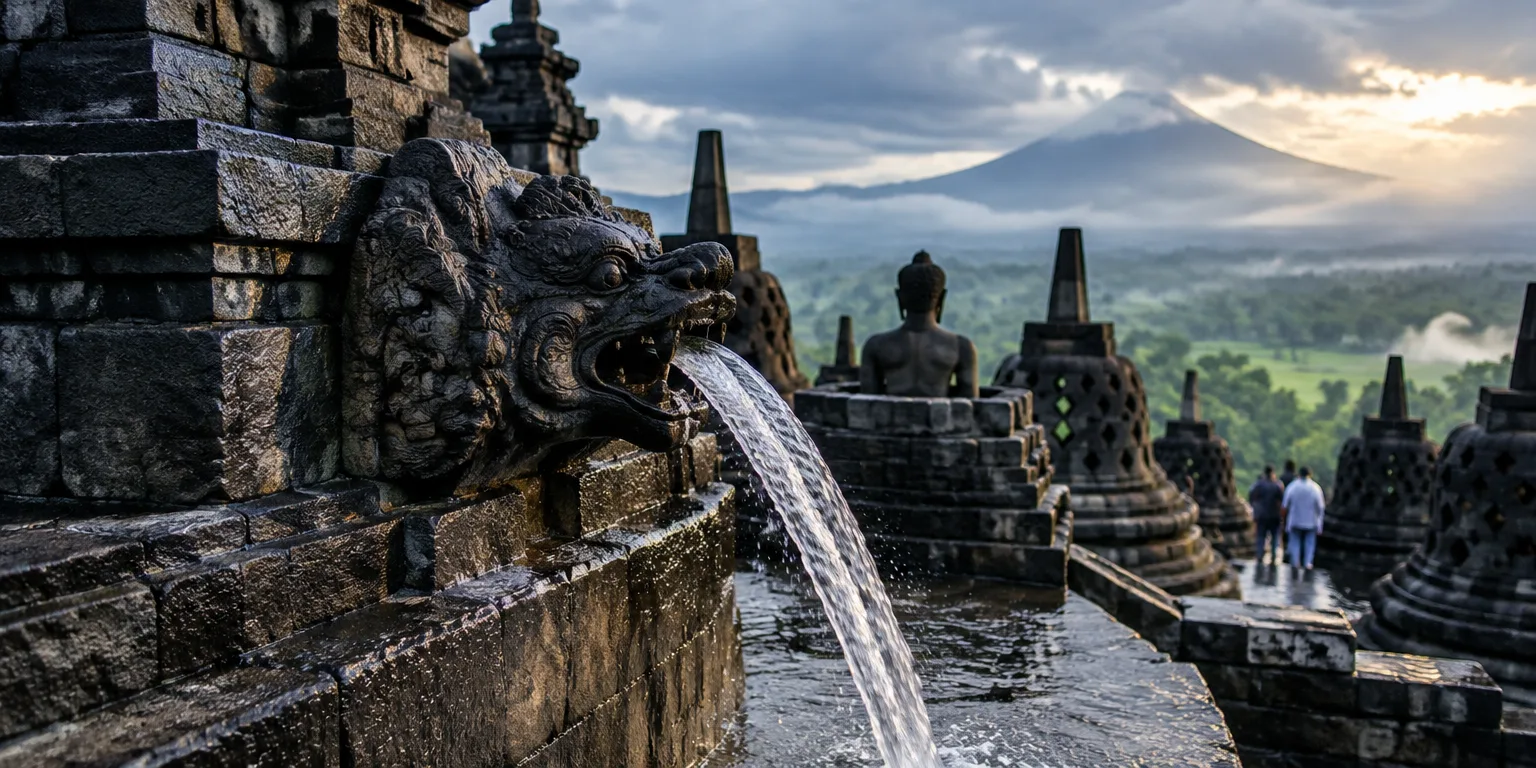
From a distance, Borobudur looks like a mountain rising from the river plains in the shadow of a great volcano. Up close, it is nine stacked platforms, 35 meters high with a rounded shrine at the peak, raised by the rulers of Mataram, the early kingdom that ruled central Java.
The design is an enormous mandala, an important geometric shape in Buddhism used to describe the form of the universe. From above, the mandala spans about as much ground as two soccer fields. On the ground, it guides pilgrims up through concentric walkways and stairways carved from black volcanic stone, bordered by almost 3,000 sculpted panels and 500 statues of the Buddha created by the kingdom's most skilled artisans.
What holds it all together is what is missing. The builders used no mortar or cement. They cut about 2 million pieces of volcanic rock so each piece grips its neighbors without glue. In one of the most earthquake prone places on Earth, that loose fit has been a strength, allowing the temple to ride out countless tremors and shifting ground over the past thousand years.
Rain was the other enemy. Java gets drenching seasonal monsoon rains, so the builders fitted Borobudur with more than 100 drainage spouts, each sculpted to look like a giant or sea dragon. When it rained, water poured from their mouths and away from the stone.
The symbolism would have been clear to medieval Javanese. Their stories said the gods had placed Java's mountains to hold the floating island steady. The king was placing his own mountain to show that his reign would last. As Raden Sokmono, the archaeologist who led the temple's modern restoration, put it, Borobudur is a prayer in stone. Heritage worker Gerard Bolla described it as a landscape for pilgrims seeking inner peace, with volcanoes glowing red at night beyond a ring of mountains made from the same volcanic stone.
It worked. Built as an artificial mountain, it survived like one.
Questions people ask
What does the name Borobudur mean?
Borobudur is thought to come from an old Javanese name, Bumi Shambara Budara, meaning the mountain of combined virtues of the 10 stages of Buddhahood. Today the name is understood to mean simply the great Buddha.
Why does Java have so many earthquakes?
Java sits where tectonic plates collide, so earthquakes and volcanic eruptions are frequent. That same volcanism produced the abundant dark stone the builders used, and the fertile soil that supported a dense farming population.
Can you still visit Borobudur today?
Yes. It remains the largest Buddhist temple in the world and a major pilgrimage site. The stone reliefs and statues were restored in modern times after centuries of burial, overgrowth, and volcanic ash.