Katrina Did Not Beat New Orleans Walls. Three of Them Broke Early.
Three breaks on the city's outfall canals, all below their design limits, let in most of the water that drowned central New Orleans.
 Practical Engineering · The Mind-Blowing Flaw That Flooded New Orleans
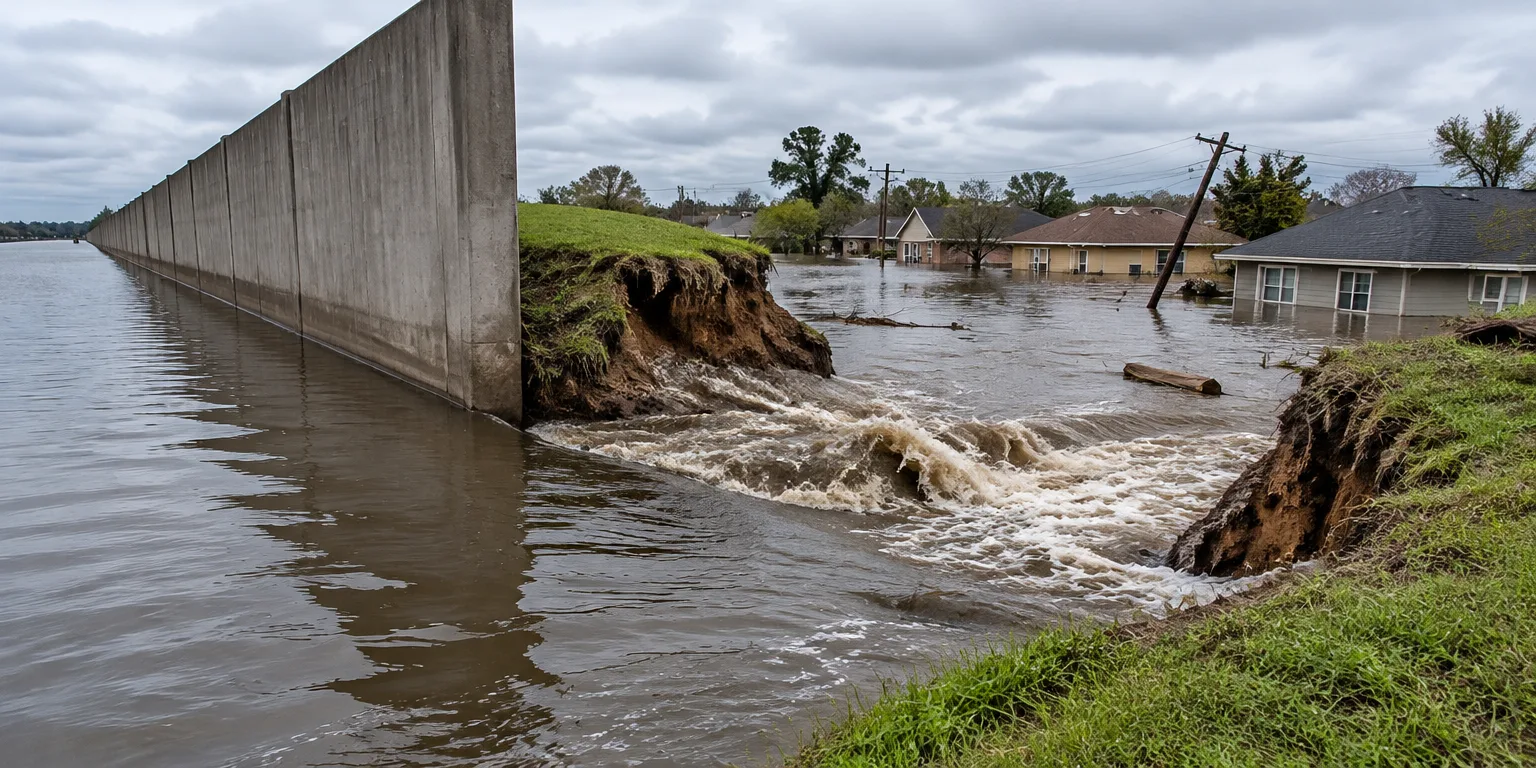
On the morning of August 29, 2005, just after Hurricane Katrina came ashore, the water in the 17th Street Canal stood well below the rim of the floodwall. It should have held.
Instead, a huge chunk of the earthen levee shifted. The movement tore open a gap 450 feet wide, and storm water poured through it into Lakeview and the surrounding neighborhoods. Two other walls on the city's outfall canals failed in quick succession as the surge peaked.
The scale of what followed is hard to picture. Katrina sent a surge of nearly 28 feet onto parts of the Gulf Coast, the highest ever recorded in the United States. Roughly four-fifths of New Orleans flooded, in places above the rooflines of houses. Two decades on, the city's population has still not returned to its pre-storm level.
That would be a familiar tragedy if the storm had simply been too big for the protections around the city. Those protections were a sprawling collection of levees and floodwalls built over many decades, and no such system offers absolute protection.
But that is not what happened in the heart of the city. During Katrina, levees or floodwalls broke in about 50 places. Many of those were cases where water poured over the top. Only three breaches, all on the outfall canals, accounted for most of the water that submerged central New Orleans, and for nearly half of the disaster's deaths and economic damage.
All three failed at water levels below what the walls were designed to manage. The disaster in those neighborhoods was not a storm beating the defenses. It was the defenses giving way early.
Questions people ask
What are the outfall canals?
They are three long, straight channels, the 17th Street, Orleans Avenue, and London Avenue canals, that drain rainwater from low-lying New Orleans north to Lake Pontchartrain. Because the lake connects to the Gulf of Mexico, a hurricane surge can push seawater south down the canals and into the middle of the city.
Did the whole city flood because of those three breaks?
No. About 50 levees or floodwalls broke during Katrina, and many failed after being overtopped by surge, especially east of the city. The three canal breaches matter because they supplied most of the water that filled the densely populated bowl around the center of New Orleans.
Were the floodwalls fixed after Katrina?
Yes. The federal government installed large gates at the mouths of the outfall canals to keep surge out of the city, and much of the levee system was raised, strengthened, and redesigned. A major new surge barrier was also built east of the city to reduce water entering from Lake Borgne.